Last one
Used
TL;DR: Minichamps' 1:43 Sauber C9 reproduces the Mercedes-powered Group C prototype in a matte black test livery, distinct from the silver scheme that won the 1989 24 Hours of Le Mans. The sealed-body diecast captures the C9's long tail and low nose for collectors chasing Group C variety beyond the Silver Arrow.
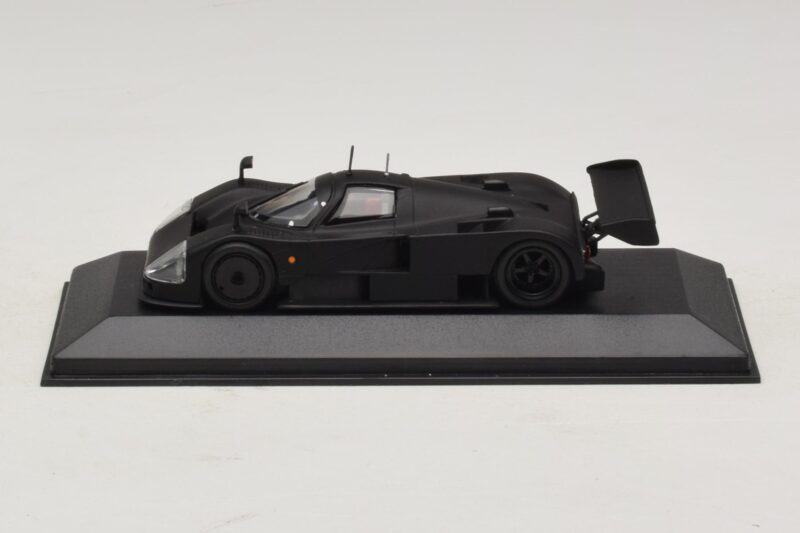
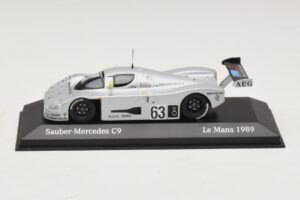
Group C's late-1980s golden era produced few cars as dominant as the Sauber-Mercedes C9, a twin-turbo V8 prototype that swept the 1989 World Sportscar Championship and won Le Mans outright. This 1:43 release wears matte black rather than the famous silver livery, a test-mule finish that gives the C9's shape center stage without the Silver Arrow branding.
Sauber built the C9 around a Mercedes-Benz partnership that turned a promising but underfunded prototype program into the dominant force of late-1980s endurance racing. Power came from a Mercedes M119 twin-turbo V8, mounted in a low, long-tailed carbon-composite body developed for top-speed efficiency on tracks like Le Mans's Mulsanne Straight. The 1989 season became the C9's defining year: Sauber-Mercedes swept the World Sportscar Championship and won the 24 Hours of Le Mans outright, with Jochen Mass, Manuel Reuter, and Stanley Dickens sharing the winning car. That result revived the Mercedes-Benz silver livery as a genuine symbol of speed for a new generation, decades after the pre-war Silver Arrows.
This particular release steps away from that famous silver scheme. Matte black liveries like this one were common on Group C test and development cars, used during aerodynamic evaluation before a team committed to its full race livery, and they rarely appear in period photography next to the polished race cars. Minichamps' choice to cast the C9 in this finish gives collectors a genuine alternative to the silver Le Mans winner already well represented across the hobby. It is worth being direct about what this piece is: a color-accurate reproduction of a test livery, not a specific race entry, and it should be valued on those terms rather than mistaken for a Le Mans-winning car finish.
Group C prototypes like the C9 were shaped entirely around airflow, and a sealed one-piece diecast body suits that kind of subject well. Minichamps casts the C9 with doors, engine cover, and nose section molded into a single zinc alloy shell, holding continuous, unbroken lines along the car's long tail and low nose where a hinged casting would need to interrupt the surface for practical opening mechanisms. That single-shell construction keeps the silhouette honest to the wind-tunnel-shaped original.
Matte finishes are harder to execute well than gloss, since they show every surface imperfection instead of hiding it under reflection, and a flat black paint job depends entirely on clean masking around the C9's driving lights, mirrors, and cockpit glazing to read correctly. The zinc alloy build gives the casting real weight in the hand, useful for a car this long, where a lighter material could feel hollow at the nose or tail overhangs. Wheels carry the period five-spoke magnesium look correct to Group C prototypes of the era, and the glazing wraps the low cockpit canopy without visible distortion, small details that matter more on a car defined by its surfacing than its badges. At 1:43, the C9's substantial real-world length translates into a model that still commands genuine shelf presence, roughly 11cm long, without the display footprint a 1:18 Group C car would demand. That scale efficiency is a large part of why 1:43 remains the standard format for collectors assembling full Group C grids rather than single hero cars.
A matte black C9 earns its place best alongside the silver-liveried Le Mans winner rather than instead of it, giving a Group C shelf the kind of visual range that a single livery cannot provide. Minichamps prices this release in the accessible mid-tier common to 1:43 diecast, a sensible entry point before chasing rarer resin variants of the same chassis. Displayed next to period Group C rivals like the Jaguar XJR-9 or Porsche 962C, the C9 fills out the closing chapter of the category's fastest era. The sealed body keeps the casting sturdy for handling as a display piece changes hands or shelves, a practical trade for a subject whose real interest sits entirely in its aerodynamic shape. For collectors specializing in Sauber's brief but decisive Group C era, this finish is the rarer find.



You save 16.00 €
Lowest price in the 30 days before the reduction: 123.00 €