Used
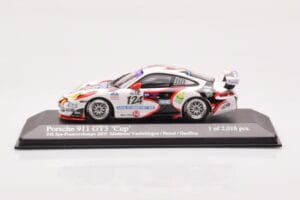
Porsche 911 997 GT3 Cup #124 Mattheus / Geoffroy / Vanbellingen / Fumal 24 Hours of Spa 2005 Minichamps 1:43
Only 3 left
Price:
33.00 €
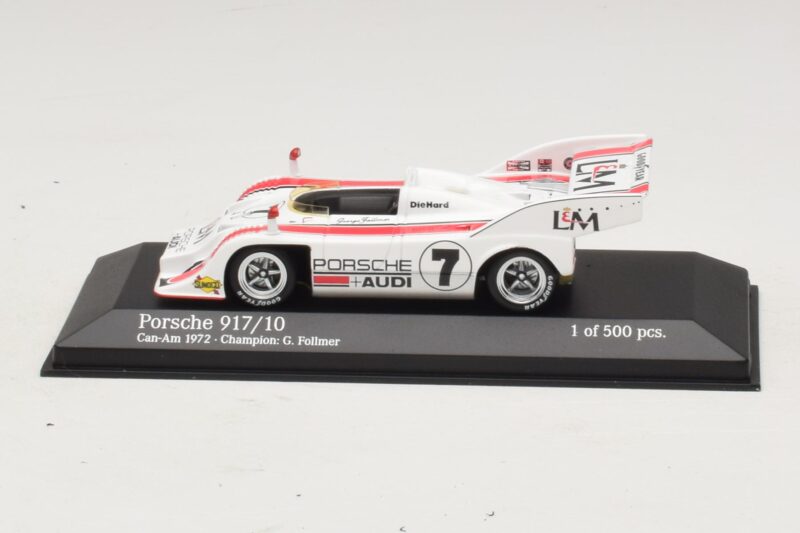
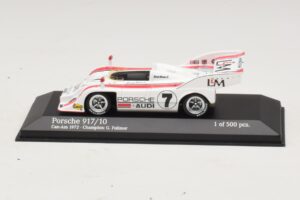
TL;DR: Minichamps' 1:43 diecast Porsche 917/10 reproduces the #7 Penske Racing car George Follmer drove to the 1972 Can-Am championship after Mark Donohue's testing injury. The sealed one-piece body carries the team's livery across the turbocharged spyder's open-cockpit shape, documenting Porsche's first serious assault on American road racing.
Can-Am ran with almost no rulebook, and Porsche answered that freedom with a turbocharged flat-twelve spyder powerful enough to embarrass the American V8 machinery that had dominated the series for years. Penske Racing's decision to run the 917/10 in 1972 turned into one of the great underdog-turned-champion stories in American motorsport, and Minichamps captures the title-winning #7 car at 1:43.
The 917/10's open-cockpit spyder shape has almost no straight lines, and Minichamps casts it as a single sealed body with no doors or engine cover that open, letting every curve read cleanly without a hinge line interrupting the surface. The nose taper, the wide rear haunches housing the turbocharged flat-twelve, and the low windscreen surround all hold their shape as one continuous casting. Panel lines that do exist, like the bodywork seams around the cockpit surround, stay tight and even rather than gapping the way a functional opening panel sometimes has to at this scale. It is a shape built almost entirely for aerodynamics, and the casting treats it that way.
Penske's livery for the 917/10 favored bold blue and yellow panels with clean sponsor lettering, and the decal registration on this casting holds those color transitions sharp across the body's compound curves. The rear wing sits mounted correctly high and wide for a car built to manage genuinely enormous horsepower without matching downforce technology, and the engine cover's cooling vents are picked out in the casting rather than smoothed over. Wheels carry the correct wide rear track proportion the 917/10 needed to put its power down, sitting noticeably wider than the front, a detail that separates a considered casting from a generic prototype shape wearing a Penske paint job.
Can-Am's regulations placed almost no restrictions on engine size, aerodynamics, or construction, which had let American teams running big-block V8 power dominate the series through the late 1960s. Porsche's answer was a turbocharged flat-twelve producing power figures that dwarfed anything the series had seen before, mounted in a chassis derived from the closed-cockpit 917 that had already proven itself at Le Mans. That combination of raw power and race-proven chassis engineering gave Porsche a genuine shot at a series American manufacturers had treated as their own territory, and it worked faster than almost anyone in the paddock expected.
Mark Donohue was set to lead Penske's 1972 Can-Am campaign before a testing crash sidelined him with serious injuries partway through the season, and George Follmer stepped into the #7 car with little preparation time. Follmer went on to win the championship anyway, a result that says as much about the 917/10's dominant power advantage as it does about his own ability to adapt under pressure. That title marked the practical end of Can-Am's open era, since the series' organizers moved to limit turbocharging and engine size soon after, unable to keep pace with what Porsche's engineering had made possible.
Can-Am occupies a specific place in American motorsport history: a genuinely unrestricted era before rulebooks caught up with what manufacturers could build, and Porsche's turbo spyders were the cars that forced that reckoning. This 917/10 works as a natural centerpiece for a shelf built around American road racing rather than European endurance events, standing apart from the Le Mans-focused prototypes that usually fill Porsche displays. At 1:43, it takes up modest space while still carrying the wide-track stance and turbo-era proportions that make the full-size car so distinctive in photographs. Pair it with the 917's other spyder variants for a focused turbocharged-prototype theme.


You save 16.00 €
Lowest price in the 30 days before the reduction: 123.00 €