Used
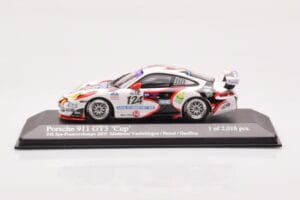
Porsche 911 997 GT3 Cup #124 Mattheus / Geoffroy / Vanbellingen / Fumal 24 Hours of Spa 2005 Minichamps 1:43
Only 3 left
Price:
33.00 €
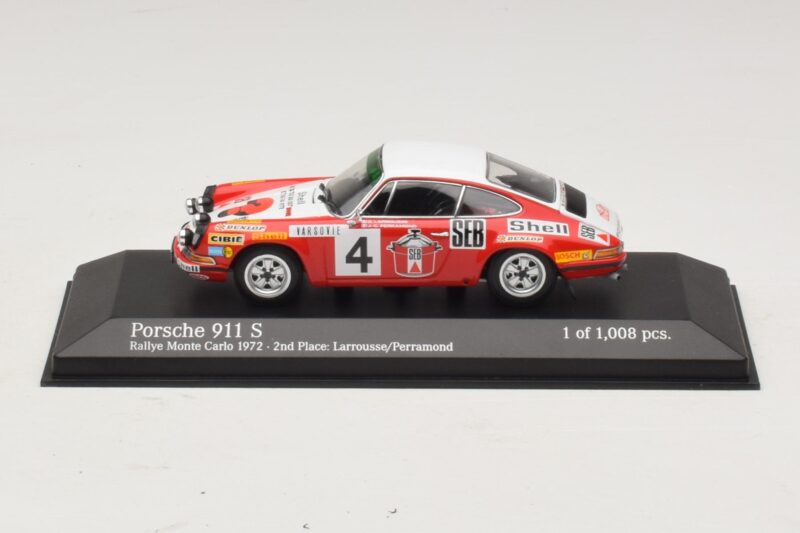
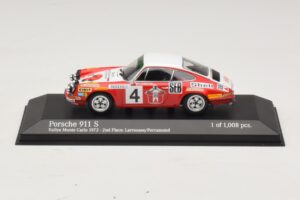
TL;DR: Minichamps' 1:43 diecast Porsche 911 S reproduces the #4 car that Gérard Larrousse and Jean-Claude Perramond drove to second place at the 1972 Monte Carlo Rally. The sealed-body casting carries rally-spec lamps and livery graphics on Porsche's rear-engine shape, a compact companion to the brand's endurance racing entries.
Endurance racing gets most of the attention in Porsche's competition history, but the 911 built an equally serious reputation on winter rally stages. The Monte Carlo Rally tested ice, snow, and mountain roads in equal measure, and a strong result there said as much about a car's engineering as any twenty-four hour race on tarmac.
The Monte Carlo Rally routed competitors through the French and Italian Alps in the depths of winter, with special stages that switched between dry tarmac, packed snow, and sheet ice sometimes within the same run. A car needed genuine all-weather grip and a chassis forgiving enough to handle sudden changes in traction without punishing the driver for a small mistake. The 911 S's rear-engine layout put weight over the driven wheels, an advantage on snow and ice that offset the car's reputation for tricky handling on dry, high-speed tarmac. Gérard Larrousse and Jean-Claude Perramond needed every bit of that grip advantage to bring the #4 car home in second place against a strong international field.
Porsche had already proven the 911's rally credentials by the early 1970s, following results that dated back to the car's first Monte Carlo entries in the late 1960s. That history gave the works and semi-works efforts real credibility on European rally stages, competing against Alpine-Renault, Lancia, and other manufacturers building dedicated rally programs of their own. A second-place finish in 1972 kept the 911 firmly in contention rather than merely present, reinforcing Porsche's reputation as a manufacturer whose road-going sports car could genuinely compete at the top level of European rallying. Larrousse's later career, including founding his own Formula One team, adds further context to this early result.
This 911 S carries the auxiliary lighting pods, roof-mounted spot lamps, and number panel graphics that defined a period rally car's appearance, all reproduced as separate applied details rather than molded flat into the body. The #4 door numbers are tampo printed for sharp, flat edges, while the spot lamps sit forward of the front bumper exactly as a rally-prepared 911 would have carried them for night stages. Getting these small details right matters more on a rally car than a pure circuit racer, since the auxiliary equipment is as much a part of the car's identity as its factory paint scheme.
Minichamps casts the body as a sealed one-piece shell, keeping the 911's already compact roofline and rear deck as one continuous surface without the added bulk a working door or hood would introduce at this scale. Zinc alloy diecast gives the model real weight for its size, a noticeable difference from a lighter resin casting when the piece is lifted from its display case. Paint sits on the hard metal shell with consistent gloss, so the rally livery's contrasting stripes and body color hold their finish evenly under a shelf light. At roughly ten centimeters long, the model fits naturally among other 1:43 rally entries from the same period.
Most Porsche display cases lean heavily toward Le Mans and Targa Florio liveries, which makes a Monte Carlo Rally entry like this one a useful counterweight. It shows the same rear-engine platform succeeding in an entirely different discipline, on ice and snow rather than closed circuits or open mountain roads. Collectors building a rally-specific shelf will find this 911 S pairs naturally with other European rally cars from the early 1970s, a period when manufacturer rivalries on snow were just as intense as anything happening at Le Mans. At 1:43, a small run of Monte Carlo entries across different years traces how the event, and the cars built for it, evolved decade by decade.


You save 16.00 €
Lowest price in the 30 days before the reduction: 123.00 €