Used
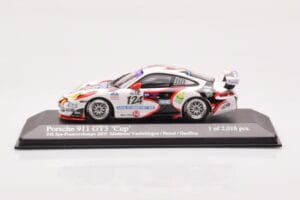
Porsche 911 997 GT3 Cup #124 Mattheus / Geoffroy / Vanbellingen / Fumal 24 Hours of Spa 2005 Minichamps 1:43
Only 3 left
Price:
33.00 €
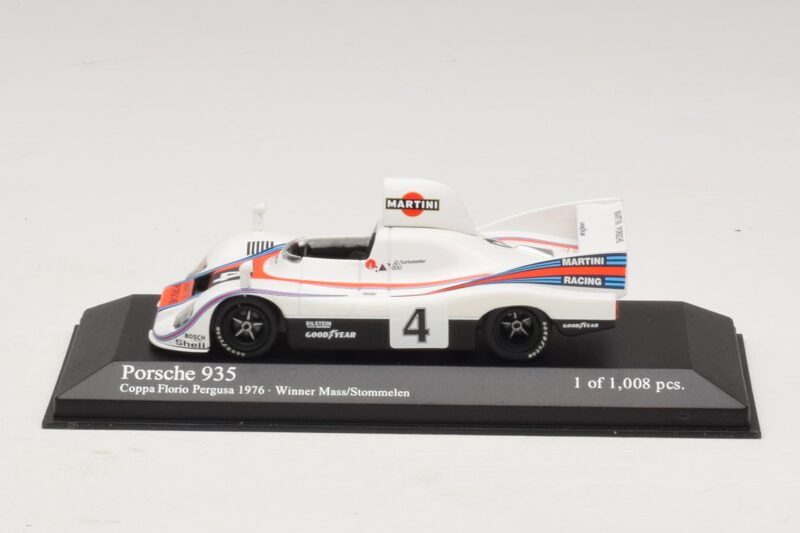
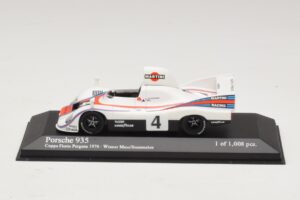
TL;DR: Minichamps' 1:43 diecast Porsche 936/76 reproduces Martini Racing's #4 car, driven to victory by Jochen Mass and Rolf Stommelen at the 1976 Coppa Florio in Pergusa. The sealed body carries the Martini stripe livery over the 936's long-tail prototype shape, a factory racer built for Porsche's Group 6 program.
After Sicily's classic open-road Targa Florio gave way to safety concerns, its companion event, the Coppa Florio, moved onto the purpose-built Pergusa autodrome. Porsche's factory 936, one of its most dominant Group 6 prototypes, made short work of the shorter, more conventional circuit, giving Martini Racing a decisive win in a car built primarily for Le Mans.
The 936 represented Porsche's serious return to top-level sports prototype racing after a gap following the 917's retirement, built specifically to contest the World Sportscar Championship and, above all, to win Le Mans outright. Its long-tail bodywork minimized drag for high-speed circuits, while a turbocharged flat-six borrowed development directly from the 911 Turbo and 935 programs running in parallel. The '/76' designation marks this as the season's evolved specification, reflecting continuous development across a single championship year rather than a fixed, unchanging design. As a factory-run car rather than a privateer entry, the 936 carried Porsche's full competition resources, and results like Pergusa reflected that advantage directly.
The original Targa Florio ran on Sicily's public mountain roads for over half a century before rising speeds and safety concerns finally ended the open-road format in the mid-1970s. The Coppa Florio, historically run alongside or in place of the Targa in various years, relocated to the Autodromo di Pergusa, a purpose-built circuit near Enna that offered none of the danger of unmarshaled mountain roads but retained the Sicilian event's name and championship status. That shift changed what kind of car suited the race entirely, rewarding sustained high-speed pace on a conventional track rather than the agility and reliability the old road course had demanded.
The 936's low, sweeping long-tail bodywork gives this model considerably more complex curvature to capture than a boxier GT car, and diecast tooling handles those compound shapes well at this scale despite slightly wider tolerances than a resin equivalent would allow. Minichamps keeps the panel lines around the removable engine cover and rear wing supports crisp and consistent, tracing the prototype's actual bodywork divisions rather than smoothing them away for manufacturing convenience. The nose air intakes and side radiator ducts are molded with real depth rather than flattened into the surface, giving the front of the model genuine dimensionality when viewed from a low angle on a display shelf.
Martini's red and blue stripes run the full length of the 936's long-tail body, from the nose across the roof and down the tail, and keeping that line straight and evenly spaced across so much continuous bodywork is a real test of print registration. Minichamps tampo prints the stripes directly onto the white base coat, avoiding any visible seam where the design crosses the model's sealed one-piece shell. Zinc alloy diecast construction gives the piece real weight and holds the paint's gloss evenly across the car's large flat surfaces. At roughly ten centimeters long, this 936 carries the long-tail's low, stretched proportions distinctly from the shorter GT and rally models sharing the same 1:43 scale.
This 936 pairs naturally with Martini's contemporaneous 935 program, showing how Porsche ran a Group 6 prototype and a Group 5 silhouette car under the same livery and the same sponsor at once during the mid-1970s. Displayed together, the two cars highlight just how differently Porsche's engineers approached outright prototype speed versus production-based silhouette racing within a single competition season. At 1:43, the 936's longer, lower proportions stand out clearly next to boxier GT models, giving a shelf visual variety beyond just different paint schemes. This is a strong choice for a collector assembling a factory-era Porsche endurance program display built around the Martini identity.


You save 16.00 €
Lowest price in the 30 days before the reduction: 123.00 €