Used
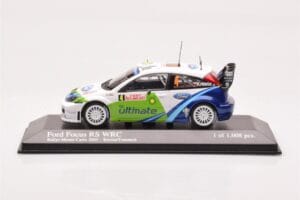
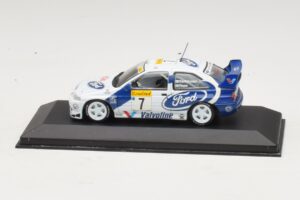
Ford Focus RS WRC #4 R. Kresta / J. Tomanek Rally Monte Carlo 2005 Minichamps 1:43
Only 2 left
Price:
103.00 €
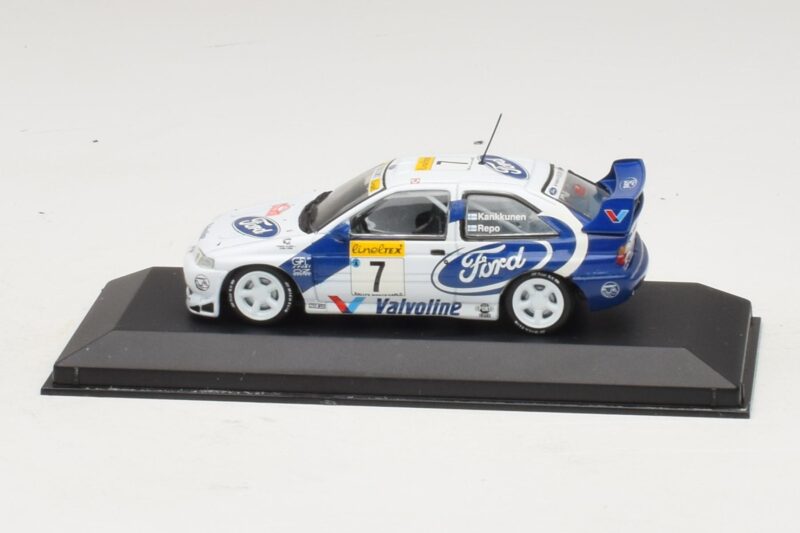
TL;DR: Minichamps' 1:43 diecast reproduces the #7 Ford Escort WRC that Juha Kankkunen and J. Repo drove at the 1998 Monte Carlo Rally, during the four-time World Champion's brief run with Ford's factory team. The sealed zinc alloy body carries the World Rally Car generation's wider aero and vented hood.
Juha Kankkunen had already won four World Rally Championships with other manufacturers by the time he joined Ford's factory squad for the Escort WRC's second generation. This #7 entry from the 1998 Monte Carlo Rally captures that later chapter, a proven champion adapting to a newly homologated World Rally Car alongside co-driver J. Repo.
This casting is a sealed zinc alloy shell at 1:43, the wider bodywork, vented hood, and rally-spec lighting molded into the shell rather than fitted separately. That construction suits the World Rally Car generation particularly well, since its aerodynamic addenda, extended arches and hood vents especially, are exactly the kind of fine, low-relief detail a one-piece casting reproduces cleanly without hinge lines interrupting the surface. The Ford factory livery's blue and white tones sit with a hard, even gloss typical of zinc alloy. That aero-heavy bodywork is also what visually separates this later Escort WRC from the boxier Group A cars Minichamps covers elsewhere in the same range.
The clearest test of accuracy here is the arch width and hood vent placement, since the World Rally Car regulations allowed far more aggressive bodywork than the Group A Escort this shell replaced. Kankkunen's #7 also carries specific co-driver and sponsor graphics worth checking against 1998 season photography, since Ford ran slightly different sponsor arrangements across its two-car factory line-up that season. Getting those small sponsor differences right is what separates a season-accurate casting from a generic factory livery. Kankkunen's teammate that season ran a differently marked car, so confirming this #7's specific graphics against Monte Carlo entry lists is worth the extra step for anyone chasing accuracy.
The World Rally Car regulations introduced in 1997 allowed manufacturers far more freedom to modify a road car's bodywork and drivetrain than the older Group A rules had, and Ford's Escort WRC was built specifically to exploit that freedom. Wider arches, more aggressive aerodynamics, and a more sophisticated four-wheel-drive system all followed, moving the Escort a significant step beyond its Group A predecessor even though the two shared a family resemblance. That extra design freedom is part of why World Rally Cars from this era look so different from the Group A Escorts that came before them on the same badge.
Kankkunen's four titles had all come in earlier eras of the sport, with different manufacturers and different regulations, which makes his Ford Escort WRC seasons an interesting late-career chapter rather than a repeat of past glory. He shared that Ford factory drive with Carlos Sainz during this period, giving the team a genuinely championship-caliber line-up even without a title to show for the effort at Monte Carlo specifically. A shelf that includes both a Group A Escort and this later World Rally Car version shows that regulatory shift directly, which is a more informative pairing than two liveries from the same era. Monte Carlo's mixed conditions that year tested the new car's four-wheel-drive system as much as its drivers, a genuine proving ground for a still-young set of regulations.
This #7 entry works best as a bridge piece between the Group A era and the more extreme World Rally Cars that followed later, and Kankkunen's name gives it added weight for anyone building a driver-focused or Ford-focused rally shelf. Check the arch width, vent placement, and sponsor graphics against 1998 Monte Carlo photography, the standard markers of accuracy for this generation of car. Displayed beside earlier Group A Escorts, it shows how quickly the sport's regulations reshaped a familiar badge's shape. That contrast, more than any single result, is what makes this piece worth including. A champion driver's name on a transitional car gives it a story beyond just the 1998 season it actually raced. It rewards a closer look.




You save 16.00 €
Lowest price in the 30 days before the reduction: 123.00 €