Used
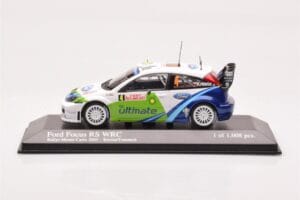
Ford Focus RS WRC #4 R. Kresta / J. Tomanek Rally Monte Carlo 2005 Minichamps 1:43
Only 2 left
Price:
103.00 €
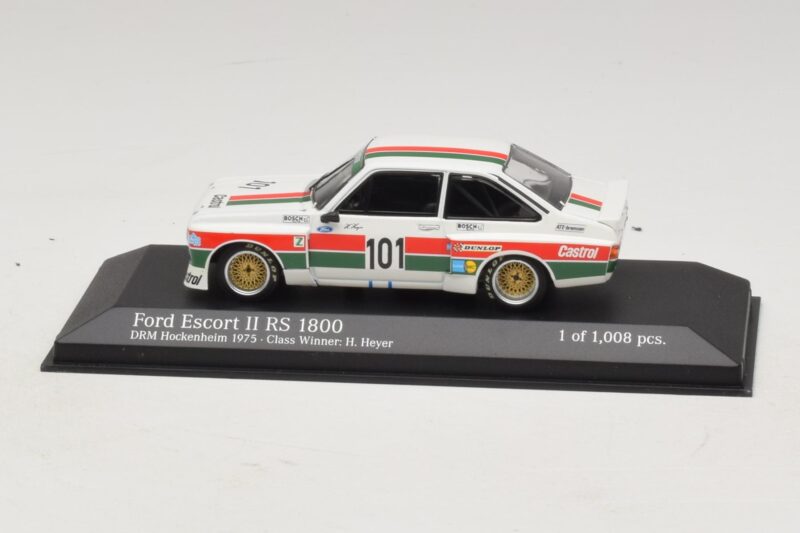
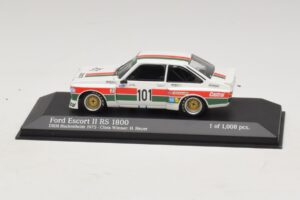
TL;DR: Minichamps' 1:43 diecast Ford Escort Mk2 RS1800 recreates Hans Heyer's #10 class-winning entry from the 1975 DRM season at Hockenheim, cast as a sealed zinc-alloy body with tampo-printed sponsor graphics and tight, consistent panel lines. A compact touring-car piece suited to a German racing display.
Germany's Deutsche Rennmeisterschaft built its identity on production-based touring cars fighting wheel to wheel, and few cars defined that era like the Ford Escort Mk2 RS1800. Hans Heyer, a driver better known for his brief, colorful Formula 1 cameo, campaigned this Escort to a class win at Hockenheim in 1975.
Minichamps reproduces the #10 Ford Escort Mk2 RS1800 exactly as it ran at Hockenheim in 1975, sponsor graphics and number boards placed to match period photography rather than a generic touring car scheme. Heyer built his early reputation in German saloon car racing before a Formula 1 cameo at the 1976 German Grand Prix, driving a Penske PC4 he had never tested and famously starting from the pit lane after a jump-start penalty. That background matters here: by 1975 he was already a seasoned front-runner in production-based racing, and the class win this livery commemorates reflects a driver who understood how to extract results from a car built for reliability as much as outright pace.
The Deutsche Rennmeisterschaft ran its production-touring classes on cars that started life as ordinary road models, and the Escort Mk2 RS1800 was Ford's answer to homologation-based competition. Under Group 1 rules the bodywork stayed close to showroom specification, so the racing came down to suspension tuning, brakes, and driver skill rather than aerodynamic bodywork. Ford's RS1800 shared the championship stage with BMW's 3.0 CSL and other manufacturer-backed saloons, a period when German touring car racing drew factory attention years before the DTM era formalized it. A class win in that field carried real weight.
Minichamps casts this Escort as a sealed one-piece body, a construction choice that keeps every graphic where it belongs. Sponsor lettering and the door number wrap across panel lines without a shut line to interrupt the artwork, and the tampo-printed decals sit flat against the paint rather than showing the raised edge older transfer methods left behind. At 1:43, that flatness matters more than it would on a bigger casting because there is less surface to hide inconsistency. The Ford factory-blue livery holds a consistent tone across the hood, roof, and rear deck, and the black lower-body treatment separates cleanly at the waistline.
Lifted from its display base, the model carries the reassuring heft of zinc alloy rather than the lighter feel of injection-molded plastic toys at the same scale. That density is a byproduct of pressure-cast metal construction, and it is one reason diecast at this scale holds its shape and finish over years of handling. The trade-off against resin is wider tolerances at the panel lines, but at 1:43 the difference is rarely visible to the naked eye, and the metal body brings a durability that suits a piece meant to sit on an open shelf.
This Escort works best alongside other mid-1970s Group 1 and Group 2 touring cars, where the contrast between homologation-based saloons and their more radical successors tells its own story about how quickly the category evolved. At 1:43, a dozen or more of these liveries fit on a single shelf, which makes the scale the practical choice for collectors chasing a full DRM season rather than a handful of hero cars. Buyers considering this piece are usually building out a German touring car theme, and the accessible size and price point make that kind of breadth realistic. Compared to a 1:18 alternative, the smaller scale trades outright presence for the ability to represent an entire grid.




You save 16.00 €
Lowest price in the 30 days before the reduction: 123.00 €