Used

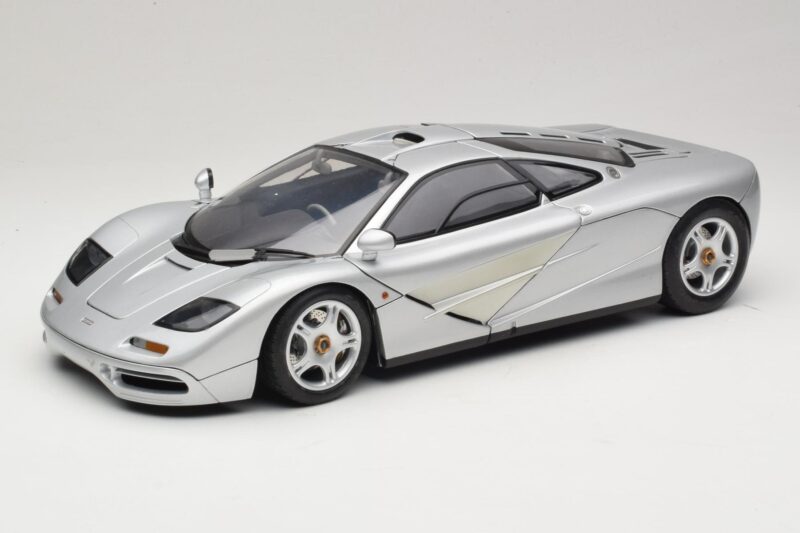
TL;DR: Minichamps' 1:12 diecast McLaren F1 recreates Gordon Murray's 1997 hypercar in silver, its dihedral doors opening to reveal the three-seat cabin and central driving position. Large-scale diecast weight and genuine panel articulation set this apart from smaller-scale McLaren F1 castings. A hero piece for anyone building a display around the fastest production car of its era.
The F1 remains one of the few production cars that genuinely earned the word hypercar before the term existed: a central driving position flanked by two passenger seats, a naturally aspirated V12, and a top speed that stood as the production-car record for years after its 1997 run ended. Minichamps' 1:12 scale gives that engineering room to breathe, large enough to show the doors actually opening.
Gordon Murray designed the F1 around a single, uncompromising idea: put the driver in the center, flanked slightly behind by two passengers, and build everything else around making that layout as fast and as light as possible. The result carried a naturally aspirated 6.1-liter V12 from BMW's motorsport division, a carbon-fiber monocoque years before the material became common even in racing, and a curb weight that undercut most of its rivals by a significant margin. In 1998, a modified F1 set a production-car top speed record that stood for years, a benchmark achieved without turbocharging or forced induction of any kind, purely through weight discipline and aerodynamic efficiency. That combination is why the F1 still gets discussed in the same breath as far newer hypercars.
Few road cars justify the jump to 1:12 scale the way the F1 does. Its three-seat cabin, central steering wheel, and gold-foil-lined engine bay are all genuinely worth seeing in detail, and a smaller scale simply can't deliver that. Minichamps' silver finish suits the F1's understated design philosophy, a car that never relied on aggressive styling to make its case. For a collector who already owns the F1 at 1:18 or 1:43, this 1:12 version isn't a duplicate; it's the scale at which the car's genuinely unusual layout finally becomes fully visible rather than merely implied.
The real F1 used dihedral doors, hinged at the front and swinging both up and outward, a solution Murray chose to keep the door swing tight in narrow parking spaces despite the car's wide sills. Minichamps replicates that motion on this 1:12 casting: the doors genuinely open, and lifting one reveals the cabin's central seat and the offset passenger positions behind it, a display angle no sealed-body casting could offer. At this scale, the mechanism has real presence, the door settling naturally once opened rather than needing to be propped, and the reveal of that unusual three-seat layout is arguably the single best reason to choose this scale over a smaller one.
At 1:12, diecast construction gives this F1 genuine heft, weight that registers immediately when lifting it from its display base and that a resin casting at the same size would not replicate as convincingly. Silver paint sits deep on the metal shell, catching light along the F1's smooth, understated bodywork in a way that flatters the design's lack of aggressive creases or vents. Panel gaps around the opening doors stay tight and consistent, a genuine test of build quality on any model with moving parts, and one this casting passes cleanly. Interior detail visible through the opened doors, seat stitching, dashboard layout, carries the same finish standard as the exterior.
This McLaren F1 works best as a centerpiece rather than one piece among many, the sort of model a display gets built around rather than added alongside. At 1:12, it commands real shelf space and real attention, appropriate for a car that held the production-car speed record and pioneered a driving layout nothing else on the road matched at the time. Minichamps prices this scale above its smaller F1 releases, reflecting both the larger casting and the added engineering of functional doors, and that premium is easy to justify given what the scale delivers. For a collector building a hypercar shelf around genuine engineering milestones rather than just recognizable badges, this F1 belongs at the front of that display, not the back.





You save 16.00 €
Lowest price in the 30 days before the reduction: 123.00 €