Last one
Used

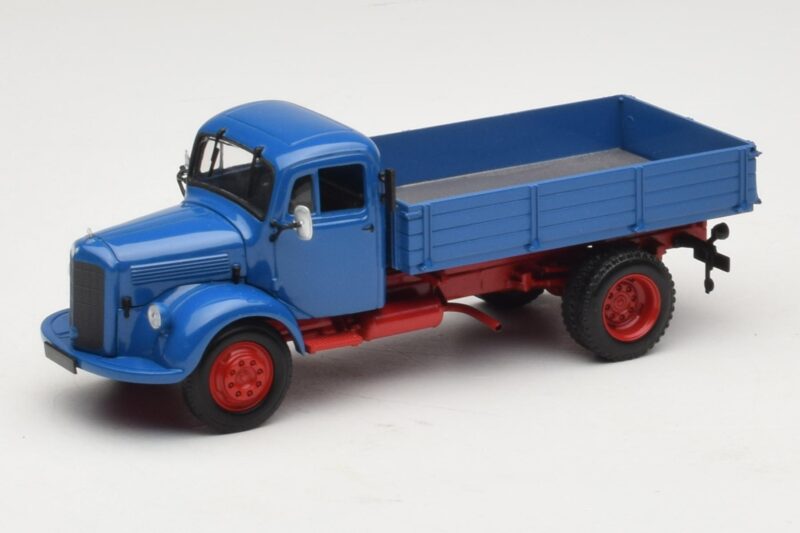
TL;DR: Minichamps' 1:43 Mercedes-Benz L 3500 tipper truck reproduces a 1950 construction-era hauler in blue and red, cast as a sealed zinc-alloy body with correct cab proportions and tipper-bed detail. A light-commercial pick for a postwar German road-transport display beyond passenger cars.
Mercedes built the L-series trucks as the backbone of West Germany's postwar reconstruction, and the L 3500 tipper this model reproduces did unglamorous work hauling rubble and building material through cities still rebuilding from the war. Minichamps casts it at 1:43 in a blue and red livery.
A tipper truck's defining feature is its rear bed, hinged in real life to dump loose material, but Minichamps casts this L 3500 as a single sealed zinc-alloy shell with the bed molded in position rather than built to articulate. That is the standard approach at 1:43 across nearly every commercial-vehicle casting in the segment, and it lets the model hold tight, consistent lines around the bed edges and cab corners that a working hinge mechanism would otherwise compromise. The cab carries correct proportions for the L-series, a narrow, upright greenhouse typical of early 1950s German trucks, and the blue cab paired with red chassis and bed detailing is applied with clean separation between the two colors rather than any bleed at the panel breaks. Paint depth reads utilitarian rather than showroom-glossy, appropriate for a truck built to work rather than to be admired, and the wheels carry the dual rear axle configuration the tipper's load capacity demanded. Underneath, the chassis rails and bed support structure show molded detail rather than a flat, unfinished surface, a detail that rewards a buyer who actually turns the model over rather than only viewing it from the side. Mirrors and cab steps are cast integrally rather than applied separately, keeping the build simple but consistent with the sealed-body approach used across the rest of the model.
Mercedes-Benz launched the L-series trucks in the years immediately following the war, and by 1950 the range covered everything from light delivery vans to heavier haulers like the L 3500, built to move the enormous quantities of rubble, timber, and construction material that West Germany's rebuilding effort required. These were fundamentally utilitarian vehicles, engineered for reliability and ease of repair over comfort or styling, and their liveries typically reflected the construction and haulage firms that operated them rather than any factory show finish. The L-series played a genuinely significant role in the country's economic recovery, hauling the physical materials that literally rebuilt bombed cities, which gives a truck like this L 3500 tipper a claim to historical relevance that has nothing to do with speed or glamour. Reconstruction-era demand for commercial vehicles outpaced Mercedes' prewar production capacity, pushing the company to expand truck manufacturing rapidly through the early 1950s, and the L-series became a common sight on West German roads well before the passenger-car range regained its prewar prestige.
At 1:43, this L 3500 sits well next to period Mercedes sedans without dominating the display, a useful contrast between the passenger cars collectors usually chase and the working vehicles that actually filled the streets alongside them. Commercial trucks from this era rarely receive diecast treatment at all, so a well-executed tipper in a specific livery is worth prioritizing over waiting for a more common subject to appear. Pairing this L 3500 with heavy trucks and light vans built in the same period rounds out a genuine postwar transport display. It also gives newer collectors an accessible entry point into commercial-vehicle diecast, a corner of the hobby with less competition than passenger-car subjects.











You save 16.00 €
Lowest price in the 30 days before the reduction: 123.00 €