Last one
Used
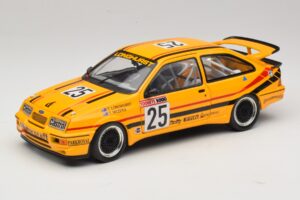
Ford Sierra RS500 #25 T. Longhurst / T. Mezera Bathurst 1000 Winner 1988 Replacement Box Biante 1:18
Only 1 left
Price:
237.00 €
Biante concentrates on Australian touring car racing, rendering Ford Falcons from the Group C era in detailed 1:18 diecast. Livery accuracy and race-correct stance define the brand, making it a focused destination for collectors building an endurance touring car display rather than a broad general collection.

TL;DR: Biante scale models specialize in Australian touring car replicas, led by Ford Falcon subjects from the 1970s and 1980s Group C era in 1:18 diecast. Livery accuracy and race-specific detail define the brand's appeal, making it a focused destination for endurance touring car collectors rather than a broad general-purpose diecast manufacturer.
Biante built its name on a narrow, deliberate focus: Australian touring car racing rendered in 1:18 diecast with the kind of livery precision broad-catalog manufacturers rarely attempt. Ford Falcon subjects from the Group C era anchor the range, pairing period-correct sponsor graphics with the boxy, flared-fender silhouette that defined 1970s and 1980s touring car racing. For collectors chasing a specific endurance-racing era rather than a scattershot model collection, that narrow focus is the entire appeal.
Evaluating a Biante release starts with the same checklist that applies to any diecast manufacturer working at the mid-to-upper tier: paint depth under direct light, the crispness of tampo-printed sponsor logos, panel gaps around the doors and hood, and how convincingly the wheel and tire combination matches the real car's stance. Because Biante's catalog concentrates so heavily on livery-driven touring car subjects, sponsor graphic accuracy carries more weight here than it would on a road-car manufacturer's lineup, where paint color and proportion do most of the work.
The brand's 1:18 diecast construction gives each piece real weight in the hand, a metal-bodied solidity that suits the flared-fender, aggressive stance of Group C touring cars better than a lighter material would. Pricing sits above true entry-level diecast, reflecting the livery complexity and narrower production runs that come with a motorsport-focused catalog rather than mass-market road cars. Collectors new to the brand should expect a tighter subject range than a general manufacturer offers, traded for depth within that specific racing niche.
Australian touring car racing in the 1970s and 1980s produced some of the most visually distinctive race cars in the sport's history: Ford Falcons widened and flared to fit oversized tires, running full-length sponsor liveries across endurance classics that rewarded reliability as much as outright speed. The Group C era, which ran through the mid-1980s before regulations shifted the category toward Group A machinery, gave these Falcons a boxy, muscular silhouette that still defines the look of Australian touring car heritage today.
Rendering that silhouette at 1:18 scale gives a collector enough surface to appreciate the flared arches, the full-width front spoiler, and the sponsor graphics that wrapped around the car's flanks. Smaller scales compress these details into something closer to a toy; 1:18 keeps the proportion between the car's aggressive stance and its livery legible from across a display shelf. For collectors who trace their interest back to Australian endurance racing specifically, the Ford side of that rivalry remains one of the most collected subjects in the hobby.
Because livery accuracy carries so much weight in touring car diecast, the first thing worth checking on any Biante piece is how the sponsor graphics align across panel lines, particularly where a decal or tampo print crosses a door seam or wheel arch. Misaligned graphics are the clearest sign of a rushed production run, while crisp, continuous artwork signals the kind of attention this niche demands. Beyond livery, check the usual diecast fundamentals: even shut lines, a paint finish free of orange-peel texture, and wheel and tire proportions that match the flared stance of a Group C Falcon.
Interior detail matters less here than it would on a road-car replica, since touring cars of this era were stripped for racing, but roll cage visibility through the glazing and correct gauge-cluster presence still separate a careful casting from a generic one. Collectors comparing multiple liveries of the same base casting should look for consistent build quality across variants rather than assuming every livery in a series meets the same standard, since production runs and finishing can vary release to release.
Biante rewards a focused collecting approach more than a scattershot one. Because the catalog concentrates on a specific era and rivalry, a shelf built around Group C Ford Falcons tells a coherent story: the same basic body shape wearing different sponsor liveries across different seasons, which makes side-by-side comparison genuinely informative rather than repetitive. Pairing Falcon subjects with their period rivals fills out the narrative of a specific racing era without requiring a collector to track down an entire manufacturer's unrelated road-car lineup.
Display-wise, these models benefit from being grouped by season or livery family rather than scattered among road cars, since the visual language of sponsor graphics reads best in context with similar subjects nearby. A single 1:18 Falcon holds its own as a centerpiece, but the appeal of this niche grows with a run of three or four liveries from the same era displayed together. For collectors already invested in Australian motorsport heritage, Biante offers one of the more concentrated, detail-focused paths into that specific chapter of touring car history.
Biante concentrates almost entirely on Australian touring car racing rather than road cars, which means livery accuracy and race-specific detail receive more attention than a broad-catalog manufacturer typically affords. That narrow focus produces deeper coverage of a single racing era rather than wide coverage across many subjects.
Group C regulations, which governed Australian touring car racing through the early 1980s, produced the widened, flared-fender Ford Falcons that remain some of the most recognizable shapes in the sport's history. Models from this era capture a distinct chapter before Group A regulations changed the category's look entirely.
1:18 scale gives sponsor graphics enough surface area to stay legible and crisp, where a smaller scale like 1:43 compresses the same artwork into less readable detail. For livery-focused subjects like Biante's Falcons, the larger scale genuinely changes how much of the design intent survives the translation to miniature.
Starting with one well-reviewed Group C Falcon livery gives a clear baseline for the brand's build quality before expanding into a themed run. From there, collectors often add liveries from the same season or rival manufacturers to build out a specific era rather than buying broadly across unrelated subjects.