Used
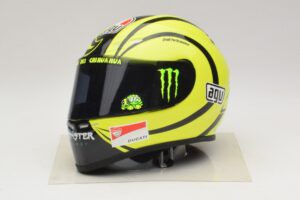
AGV Helmet V. Rossi MotoGP Valencia Test 2009 Minichamps 1:2
Price:
179.00 €
Helmets form their own collecting type, separate from cars and bikes. This collection holds 1:2 diecast helmet replicas from Minichamps, reproducing AGV designs from MotoGP and motorcycle racing in the 2000s. With no wheels or bodywork to share attention, shell shape, paint depth, and graphic detail carry everything on these compact racing display pieces.
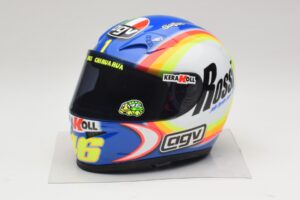
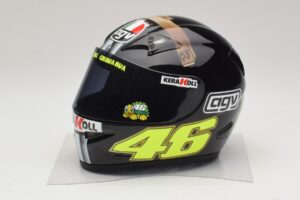
TL;DR: Helmet scale models in this collection are 1:2 diecast replicas by Minichamps, reproducing AGV racing helmets from MotoGP and motorcycle racing in the 2000s. A helmet replica has no wheels or body panels, so shell symmetry, paint depth, graphics sharpness, and finish consistency decide quality, and each piece works as a compact display object.
A helmet is one of the few collectible subjects where the whole object is one sculpted, painted surface. That makes helmet scale models a quiet test of finishing skill. This page explains how a helmet replica differs from a vehicle model, what the parts of one are, what this collection holds, and how to display and care for pieces at half size.
Collectors used to cars carry certain habits: check the wheel offset, look at the glazing, count the opening panels, read the badges. None of that applies. A helmet replica has a single dominant form, and every judgment falls on that form. If the curvature is slightly off, the whole piece looks wrong at once, and if the paint is clean and the lines are even, it looks right from across the room.
That concentration is why helmets reward a different kind of looking. Where a car model spreads detail across wheels, interior, grille, and lamps, a helmet puts everything into the surface. The graphics are the livery, the gloss is the paint depth, and the silhouette is the stance. Collectors who enjoy close inspection often find this format refreshing, because there is nowhere for a weak finish to hide. It also means a collector can compare pieces quickly, since the same few checkpoints apply to every one.
Knowing the parts helps you read a replica accurately. A racing helmet is built from a handful of visible elements, and a faithful model gets each one right in proportion:
Which of these are modeled as separate parts, and how finely, varies from piece to piece, so the product card is the authority on detail. What stays constant is that proportion matters most. A chin bar that is too long or a crown that is too flat reads as wrong long before a collector can say why.
The assortment is tightly defined. The pieces are 1:2 scale, built in diecast by Minichamps, reproducing AGV helmets from MotoGP and motorcycle racing, with designs belonging to the 2000s. That is a narrow slice, and it should be read as such: this is a themed collection of racing headgear, not a survey of every helmet type or every brand in the sport.
The narrowness helps. A collector can compare like with like, because scale, material, and manufacturer are shared, leaving design and finish as the variables. It also gives a clean starting point for a themed shelf, since the era and discipline are consistent. Neither Minichamps nor AGV is characterized here beyond what this assortment contains; their wider output is left open. If you are building around helmets as a type, this group is a focused first chapter rather than a final word.
Scale affects helmets more than most subjects. At very small ratios a helmet shrinks to a few centimeters, where graphics become tiny smudges and a rounded shell has no room to show its curvature. At 1:2 the replica is about six inches front to back, big enough for lettering to be legible and for edges between colors to be judged by eye.
Half scale also keeps the object proportionate to its role. A helmet is something a person holds in two hands, and a half-size version still feels like an object you could pick up and examine. Compared with a 1:18 car, it takes less shelf width but has more visual mass, because a rounded form fills its volume. For collectors with limited room, one or two helmets can deliver real impact without needing a dedicated cabinet. The trade-off is that very few pieces fit on a standard shelf before it feels crowded.
Curved surfaces are demanding. Paint pools in low spots, thins on edges, and shows any variation in gloss as a patch. A good finish on a diecast shell looks even in reflection: move the piece under a lamp and the highlight should slide smoothly across the crown without breaking or rippling. Color boundaries should be crisp lines, not soft gradients, unless the design calls for one.
Diecast helps here in a practical way. A hard metal shell gives paint a stable base, and the gloss it holds suits racing graphics. Very fine trim can read slightly softer than resin would allow, which is a normal trade for toughness. Check the lettering too: small text should show even letter spacing and clean edges, with no fuzzy halos. Dust specks trapped under the paint or uneven coverage near the chin bar are the usual weak points, so look there first before committing to a piece.
A round object needs a stable seat. A stand, or a shelf with a slight rim, keeps a 1:2 helmet from rolling, and a few inches of clearance on each side lets the silhouette read cleanly. Set it at eye level so the front faces the viewer. Soft, indirect light flatters glossy curves, while a bare spotlight creates a glare patch that hides graphics.
Keep helmets out of direct sunlight, which fades paint and yellows clear parts over the years. Dust gathers on the crown and in seams, and a soft brush removes it without scratching the gloss. A glass-fronted case cuts maintenance and protects the finish. When moving a piece, lift it with both hands from the base area rather than gripping the shell hard. Store original packaging if you have it, since it protects the finish during any future move.
A helmet is a single sculpted surface, so quality depends on shell symmetry, paint depth, and graphic sharpness rather than wheels, glazing, or interiors. A flaw has nowhere to hide, which makes helmets a clear test of finishing standards at any tier.
Check shell symmetry from the front, then color boundaries, lettering sharpness, and gloss consistency under a lamp. Look near the chin bar and crown, where paint tends to pool or thin. Visor and vent detail varies by model, so confirm it on the product card.
A stable stand at eye level, a few inches of clearance, and soft indirect light work best. Avoid direct sun and hard spotlights. A glass-fronted case keeps dust off the shell and reduces how often the gloss needs brushing.
Pick one thread, such as a racing discipline, a decade, or a single helmet brand, and add designs within it. The 2000s MotoGP group here gives a consistent era and format. Pair a few helmets with smaller-scale bikes to give the shelf context.