Last one
Used
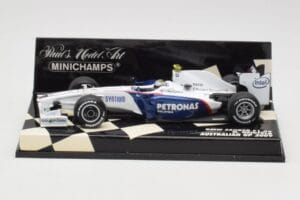
BMW Sauber’s brief factory era, 2006 through 2009, gets focused coverage here through Minichamps 1:43 diecast, tracing the works team’s short but competitive run in Formula 1. This collection suits collectors building a narrow, complete slice of 2000s grid history rather than a sprawling multi-team display.
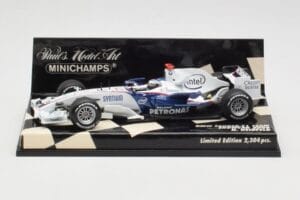
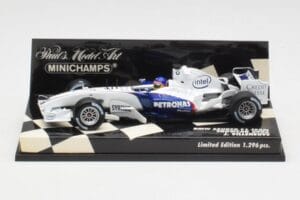
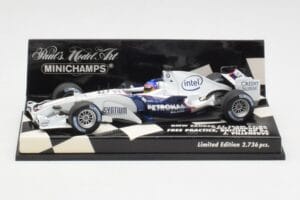
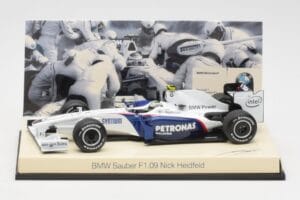
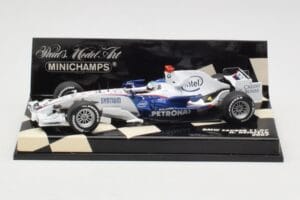
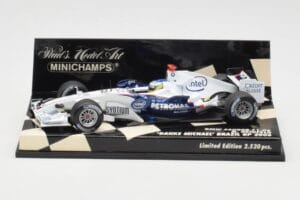
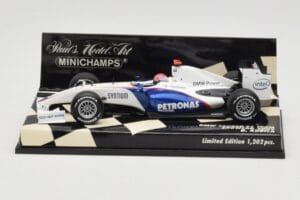
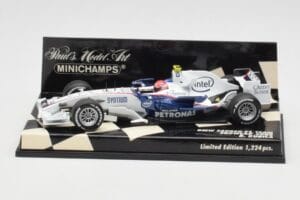
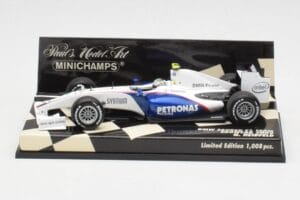
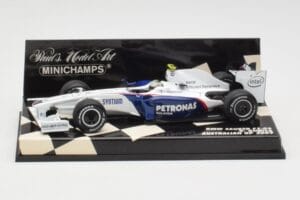
TL;DR: BMW Sauber F1 diecast models document the works team's 2006 to 2009 era, when BMW owned Sauber outright and fielded Robert Kubica and Nick Heidfeld. Minichamps covers the period in 1:43 diecast, a scale built for systematic season by season Formula 1 collecting rather than shelf dominating display pieces.
BMW Sauber's run as a Formula 1 works team lasted just four seasons, but that compact window gives this collection a rare quality: a genuinely completable scope. BMW Sauber F1 diecast models here come from Minichamps in 1:43 scale, tracking the team from its 2006 launch through BMW's 2009 withdrawal.
BMW had already spent years supplying engines to the Williams team before acquiring Sauber outright in 2006, turning a Swiss independent into a fully badged works effort. BMW Sauber F1 Team ran from 2006 through 2009, fielding Robert Kubica and Nick Heidfeld as its lead pairing through the team's most visible seasons. Kubica's win at the 2008 Canadian Grand Prix remains the team's signature result, backed by a string of podium finishes that made BMW Sauber a consistent front of the midfield rather than a backmarker. BMW withdrew at the close of 2009, and the operation reverted to independent Sauber ownership, closing a compact four season chapter that this collection exists to document. That short window explains why the range stays narrow: one marque, one factory backed era, and a manufacturer catalogue sized to match it rather than pad it out.
Minichamps built its reputation on systematic Formula 1 coverage, and 1:43 is the scale where that approach shows best. At roughly 10 centimeters long, a 1:43 grand prix car occupies a fraction of the shelf a 1:18 counterpart demands, so a full season's grid, or a single driver's full career, fits into one display case without the footprint problem larger scales create. Diecast construction gives these models the weight and durability to handle regular handling, with detail concentrated on livery accuracy rather than opening panels.
Judge any BMW Sauber piece against these same signals. The scale rewards precision over the opening doors and engine bay theatrics that larger scales use to draw attention.
This is a narrow category by design, and that narrowness is a genuine strength rather than a shortfall. Four seasons and one marque give a collector a realistically completable target, something broader constructor categories rarely offer. Two practical approaches work well here: collect by season, lining up each year's livery change side by side, or collect by driver, following Kubica or Heidfeld through their BMW Sauber years before comparing those cars to their time with other teams. Either approach sits naturally alongside other 2000s Formula 1 categories on the same shelf, since the era's grid included several manufacturer backed works teams whose cars display well together. Do not expect the sprawling manufacturer landscape that a decades spanning brand supports here. This is a focused, achievable slice of grid history, and the collection is sized to match it.