Last one

Dacia’s transformation from budget-focused runabouts into design-led compact SUVs has caught the attention of resin specialists, and OttOmobile answers with 1:18 replicas that treat the Romanian marque with the same care usually reserved for premium brands. This collection suits collectors who value underdog stories, Renault Group engineering, and a marque still building its scale model presence from the ground up.
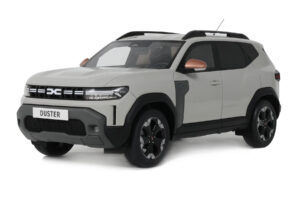
TL;DR: Dacia scale models arrive through OttOmobile's resin craftsmanship, capturing the marque's compact SUV line in 1:18. Renault Group's budget-focused Romanian brand gets a niche treatment mainstream diecast skips, appealing to collectors chasing underdog marques and design-led budget cars from the 2020s onward.
Dacia scale models occupy a curious niche: a marque built on affordability now reproduced in hand-finished resin, the material usually reserved for exotics and heritage racers. OttOmobile's 1:18 treatment of the compact SUV line gives collectors a way to document Renault Group's value engineering alongside their premium-marque shelves, and the appeal only grows as Dacia's own design language matures. This guide covers the construction tier, the heritage behind the badge, and how to build a focused Dacia display.
Most 1:18 resin subjects come from motorsport pedigree or six-figure exotics, the kind of car that already justifies hand-finished paint and a small production run. Dacia earns none of that through image alone; its whole identity rests on stripped-down pricing and honest engineering. That contrast is exactly what draws a specific kind of collector to the marque. A shelf built entirely from prestige badges tells one story. A shelf that makes room for Dacia tells a different, more complete one: the story of what Renault Group actually builds for the mass market, reproduced with the same resin care usually reserved for cars ten times the price. Completionists who track a marque, or an owner who actually drives a Duster and wants a shelf piece that matches, are the two collectors this category serves best. There is also a simple scarcity argument. Very few manufacturers bother with budget-focused marques, so a resin Dacia is genuinely hard to replace once a production run ends, which gives even an unglamorous subject some staying power on the secondary market.
Evaluating a resin model has little to do with the badge on the box and everything to do with what the surface tells you. Start with the shut lines around the doors, hood, and tailgate: on a well-cast resin body they stay narrow and consistent all the way round, without the slight waviness that signals a rushed mold. Check the paint next. Resin holds pigment differently than metal, so a quality finish shows even depth and gloss across every panel, with no thin patches at the edges where paint tends to pull. Wheel offset and ride height matter more than most buyers expect; a Dacia sits at a specific stance, and a model that looks slightly too tall or too narrow-tracked breaks the illusion immediately. Interior detail is the other tell. At this tier, expect a properly separated dashboard, defined seat stitching, and door cards that read as distinct pieces rather than a single molded shell. None of this depends on price alone. A modest resin release with tight tolerances and accurate proportions will outdisplay an expensive one that got the stance wrong, so judge the piece in hand rather than by reputation.
Dacia's story starts in Romania in the 1960s, built as a state-backed answer to a country that needed affordable transport more than it needed style. Renault took a controlling stake by the end of the 1990s, and that partnership is the real engine behind everything that followed: shared platforms, shared engineering, and a pricing philosophy that let Dacia undercut nearly every rival in Western Europe once it expanded there. For two decades the formula barely changed. Then the compact SUV boom arrived, and Dacia's response, sold under the Duster line, gave the brand its first genuinely modern design language: creased surfaces, a bolder grille, and proportions clearly aimed at buyers who wanted SUV presence without the SUV price tag. The 2020s redesign pushed that further, trading the last of the brand's utilitarian styling for something closer to a design statement. That shift is precisely why a resin manufacturer found the marque worth reproducing. A Dacia from this era photographs well from every angle, which matters just as much to a model as it does to the real car sitting in a driveway.
Resin behaves differently from the zinc-alloy diecast most collectors grew up with, and those differences suit a compact SUV subject well. A cast resin body holds tighter panel gaps and sharper creases than a die can typically produce, which matters on a vehicle whose entire design language leans on crisp surfacing rather than curved metal. The material is lighter in hand than diecast of the same size, and it is fully painted at the factory in the catalogue color rather than left for a hobbyist to finish. The trade-off is fragility: resin chips more readily than metal if dropped or knocked against a shelf edge, so handling by the base rather than the body matters more here than it would with a heavier diecast piece. At 1:18, a compact SUV like this runs a bit taller and boxier than a sports car of the same scale, which changes how it reads on a shelf: it commands slightly more visual weight per centimeter of shelf space than a low, wide coupe would. That proportion is worth factoring into any display plan built around this subject.
A single-marque Dacia collection works best with a clear angle, since the catalogue depth simply isn't there yet to collect by chronology the way a century-old marque allows. Treating the brand as a legitimate branch of a broader collection, rather than a novelty purchase, tends to produce a more satisfying shelf over time. A few approaches hold up in practice:
Whichever angle fits, treat the piece as a starting point rather than a one-off purchase. Resin runs from underrepresented marques tend to be limited and rarely get reissued the way a headline marque's back catalogue does, so a collector who wants to build the theme out should plan to move when new releases surface rather than assume the option will still be open a year later. Patience pays off here in a way it doesn't with more mainstream subjects.
A resin Dacia asks for the same baseline care any resin model needs, with a couple of extra considerations tied to its shape. Keep it out of direct sunlight; UV exposure fades paint and yellows clear plastic lenses faster than most collectors expect, and a boxy SUV shape has more flat panel area exposed to catch the light than a low sports car would. Dust settles into body creases and around the wheel arches, so a soft brush or a can of compressed air clears it without the risk a cloth carries of snagging a mirror or an aerial. Because resin chips more easily than diecast, lift the model by its base rather than gripping the roof or bumpers, and give it a stable, low-traffic shelf position where it won't get bumped during dusting or rearranging. Keep the original box and any foam insert; on a limited run from an underrepresented marque, complete packaging matters more to future value than it might on a mass-produced diecast, since there's less of a secondary market to fall back on if the piece needs replacing. A glass-fronted cabinet solves most of these problems at once, trading some shelf flexibility for real protection, and it's worth the trade for a piece that won't be easy to find again once the run sells through.
This collection is produced in resin rather than diecast, which suits the compact SUV's crisp surfacing better than cast metal typically allows. Resin holds tighter panel gaps and sharper creases, comes factory-painted in the catalogue color, and stays lighter in hand than a diecast piece of the same size, though it chips more easily if handled roughly.
Part of the appeal is scarcity: few manufacturers reproduce budget-focused marques, so a Dacia model is genuinely hard to replace once its run ends. The rest is story. Collecting the brand alongside its Renault Group siblings, or matching it to a real car someone owns, gives the shelf a personal angle that a generic prestige badge doesn't offer.
Within this collection, 1:18 is what's available, and it suits the subject well: large enough to show the SUV's creased surfacing and stance, small enough to sit alongside other marques on a standard shelf. A smaller scale like 1:43 would favor breadth over detail, which matters less for a single-subject purchase than for tracking a whole lineup.
Keep it out of direct sunlight to protect the paint and clear plastic, dust it with a soft brush rather than a cloth, and lift it by the base since resin chips more readily than diecast. Keeping the original box matters too, since limited runs from underrepresented marques have a thinner secondary market to fall back on.