Last one
Used
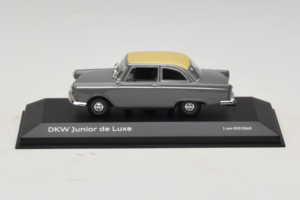
DKW model cars document one of the four founding companies of Auto Union, remembered for its distinctive two-stroke engines. Minichamps brings 1960s precision to this vintage German range at 1:43.
TL;DR: DKW model cars in 1:43 diecast, produced by Minichamps, reproduce 1960s two-stroke vehicles from an Auto Union founding marque. Filed under Vintage Classics, the subject suits collectors already building an Auto Union or German vintage lineup.
DKW's two-stroke engines gave it a distinct engineering identity within Auto Union, and that technical quirk is part of what makes the marque interesting to collect rather than just another vintage German sedan.
DKW was one of four manufacturers, alongside Audi, Horch, and Wanderer, whose 1930s merger formed Auto Union and its now-famous four-ring emblem. DKW brought two-stroke engine technology and motorcycle-building experience into the group, giving its road cars a mechanical character distinct from its three sister marques. That two-stroke identity persisted into the 1960s vehicles this collection documents, well after the merger that created Auto Union.
Minichamps applies its established precision-diecast standard to DKW's compact 1960s body styles, favoring accurate proportions and clean paint over opening-feature complexity at this scale. That approach suits a marque whose visual identity rests on tidy, functional postwar styling rather than dramatic design flourishes.
DKW reads best alongside its Auto Union sister marques, where the shared heritage and four-ring lineage give a display genuine historical coherence. At 1:43, several vintage German subjects fit comfortably together, letting a collector trace the whole Auto Union story across one shelf.