New arrival
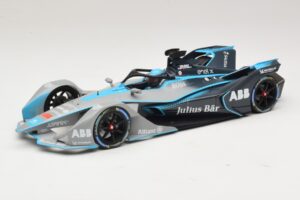
Formula E Gen2 Car ABB Championship 2024 Minichamps 1:18
Price:
99.00 €
Formula E scale models bring all-electric single-seater racing to the shelf in 1:18 diecast. This collection is built around Minichamps and the 2020s era, where dense sponsor liveries, exposed wheels and compact open-wheel bodywork reward close inspection and a season-by-season approach to collecting.

TL;DR: Formula E scale models in this collection are 1:18 diecast single-seaters from Minichamps, centered on the 2020s electric era. Expect sponsor-dense liveries, exposed wheels and compact open-wheel bodywork to judge on the shelf. A focused scope, ideal for collectors documenting electric racing alongside other open-wheel subjects.
Formula E scale models document a series that races electric single-seaters on temporary street circuits, and that changes what a collector looks at. Liveries turn over often, bodywork is compact, and the wheels sit exposed. This page covers the 1:18 diecast range here, how to read finish and fidelity, how the scale shapes a shelf, and how to plan a focused 2020s run.
This collection centers on 1:18 diecast, with Minichamps as the manufacturer represented and the 2020s as the era. That narrow focus is a strength. A 1:18 single-seater runs roughly 27 to 29 cm long, enough that wing profiles, sidepod shapes and cockpit surroundings read clearly from arm's length, yet compact enough that a row of them fits a standard cabinet shelf.
Diecast brings weight in the hand and a hard metal shell under the paint, which is why gloss reads deep and even under a display lamp. The trade-off is casting tolerance. Edges run a shade softer than cast resin, and panel joins sit a little wider. On an open-wheel racer, where the body is mostly aero surfaces and exposed suspension, that trade shows mainly in the thin trailing edges of the wings.
Whether a given model carries any moving parts differs from piece to piece, so the product card is where to check. What stays constant is the subject: all-electric racing cars from the current era, finished in full team colors. Detail on a car this compact rewards a closer look, which raises the question of how to judge it.
Livery is the first thing to check. These cars carry dense sponsor layouts that change from season to season, so decal and tampo printing quality separates a careful replica from a loose one. Look for sharp logo edges, clean color breaks where panels meet, and lettering that stays legible at close range.
Then read the shape. Compare a reference photograph of the real car with the model from the side and from above: wheel position relative to the bodywork, overall stance and ride height, and how the wings sit against the body. Exposed wheels and suspension arms are fragile and highly visible, so check that they look thin and straight rather than chunky.
Finish with the cockpit area. Open-wheel cars concentrate their detail around the driver's position and the cockpit protection structure. Seat, steering wheel and mirrors show how seriously the tooling treated small parts.
A livery belongs to one season, sometimes a single race. Match the model to a specific year in your records before adding it, because two cars that look alike at a glance can differ in sponsor placement and color accents.
Formula E sits in the same broad vehicle class as Formula 2, Formula 3 and IndyCar subjects, and collectors often shelve them together. They still read differently. City street racing, an electric powertrain and a clean rear end give these models a distinct silhouette. The technical story lives in aero and livery rather than in engine and exhaust detail.
Scale models in general follow a familiar tier pattern:
Here a single manufacturer supplies the 1:18 diecast range, so comparison happens between seasons and liveries rather than between brands. If you cross-shop another manufacturer for the same car, judge it by those construction signals, not by the name on the box. No tier is wrong; each serves a different stage of collecting.
Because the collection spans one era, the natural plan is chronological: one car per season, in order, so the evolution of the bodywork reads left to right. Collectors who prefer a theme can follow a single team's liveries or a favorite driver across years. Random buying works poorly here. It leaves gaps that are hard to explain on a shelf.
Plan for footprint. At roughly 28 cm each, five or six cars fill a full shelf, so decide early whether this is a dedicated cabinet or one row in a mixed display. A scope this narrow supports a small, tidy collection rather than a sprawling one, and that is an honest limit worth accepting.
Care is simple. Keep models out of direct sun, which fades printed sponsor logos. Dust with a soft brush, never solvents. Lift by the body, never by the wings, and keep the original box for storage, since protruding wings and wheels suffer most in a loose drawer.
The collection is built around 1:18 diecast, produced by Minichamps and centered on the 2020s. At that scale a single-seater measures roughly 27 to 29 cm, which gives wings, wheels and cockpit detail enough room to be judged properly on the shelf.
Start with livery printing: sharp sponsor edges and clean color breaks. Then compare stance, wheel position and wing shape against photographs of the real car. Finally inspect the thin parts, mirrors and suspension arms, since those show how carefully the small tooling was handled.
Formula E cars race on city street circuits with electric powertrains, so the silhouette is cleaner and the interest sits in aero and livery rather than engine detail. They pair naturally with IndyCar or junior-formula models, though each series keeps its own visual character.
Pick a season or team you follow and add one car at a time in chronological order. A single well-chosen livery shows you what to look for in printing and stance, and a clear plan keeps a narrow collection coherent as it grows.