Used
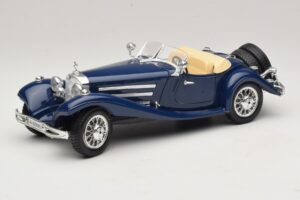
Mercedes 500K Roadster Blue Bburago 1:20
Price:
37.00 €
1:20 scale sits in a quiet pocket of the diecast hobby, chosen by Bburago for pre-war Mercedes grand tourers whose flowing fenders suit a size just under flagship 1:18. Collectors drawn to early Mercedes design and vintage-classic diecast construction find this scale a practical, detail-rich alternative to the more common ratios.

TL;DR: 1:20 scale model cars sit between the familiar 1:18 and 1:24 ratios, a size Bburago used for pre-war Mercedes vintage classics in diecast. Roughly 20 to 23cm long depending on the subject, the scale rewards close detail without the shelf footprint of 1:18, a quietly practical choice for era-focused displays.
1:20 occupies an overlooked corner of the diecast hobby, a ratio that never reached the ubiquity of 1:18 or 1:24 but still found steady use with specific subjects. Bburago's Vintage Classics line applied the scale to pre-war Mercedes grand tourers, cars whose long hoods and flowing fenders read well at a size just shy of flagship scale. Collectors focused on early Mercedes design often find this ratio a practical middle ground between display footprint and visible detail.
Scale ratio sets the physical terms of a model before a single detail gets added. Divide a pre-war Mercedes grand tourer's real length by 20 and the result lands around 22 to 23cm, noticeably more compact than the same subject rendered at 1:18 flagship scale, yet carrying more visual weight than a 1:24 piece on the same shelf. That middle position is exactly why 1:20 never became a mainstream standard: 1:18 claimed the flagship role with room for opening doors, detailed engine bays, and separately applied trim, while 1:24 settled into the budget-conscious middle ground that suits broad collecting. 1:20 sits quietly between the two, used by a handful of manufacturers for specific lines rather than adopted across the industry.
For a vintage Mercedes subject with long, flowing fenders, the 1:20 ratio keeps the proportions readable without demanding the same shelf depth flagship scale requires.
Bburago built its reputation as an Italian diecast manufacturer with accessible pricing and a broad model lineup, positioning it at the entry-to-mid tier of the hobby rather than among hand-built specialists. That tier shows up in the construction: zinc-alloy diecast bodies with tooled panel lines, a finish that favors consistency over the razor-sharp edges a resin cast can hold, and pricing that keeps vintage subjects within reach of newer collectors. The Vintage Classics line applies that approach to pre-war cars, including early Mercedes grand tourers rendered at 1:20 rather than the brand's more common 1:18 output.
Evaluating a piece from this tier means checking the signals that matter at this price point: even panel gaps around the hood and doors, a paint finish without visible orange-peel texture, and tampo-printed badges that stay sharp under close inspection. A diecast body at this tier carries real weight in the hand, a trait that comes from the metal itself rather than any single manufacturer's process, and it tends to hold its shape on a shelf for years without the fragility concerns that come with lighter materials.
Mercedes-Benz's pre-war era produced some of the most visually dramatic road cars ever built, long-hooded supercharged roadsters with exposed exhaust pipes sweeping along the fenders and a stance that announced performance before the engine ever turned over. Cars from this period favored flowing, sculpted bodywork over the boxier shapes that followed, and that design language is exactly what rewards close inspection at 1:20 scale. The long bonnet, the sweep of the fender line into the running board, and the proportion between cabin and hood all read clearly at this size, where a smaller scale would compress the details and a larger one would simply take up more shelf than many collectors can spare.
For collectors who organize displays by era rather than by manufacturer, pre-war Mercedes pieces anchor a shelf that can later expand to other prewar European marques without demanding a scale change. The period's design vocabulary, long hoods, flowing fenders, exposed mechanicals, gives these models a visual identity distinct from postwar design, which is part of why the era holds steady collector interest even in a less common scale.
A 1:20 piece sits close enough to 1:18 in footprint that most standard Vitrine shelving handles it without adjustment, though the slightly smaller size means a shelf built for flagship scale leaves a touch more breathing room between pieces. That extra space is useful for vintage subjects with long hoods and running boards, which benefit from enough clearance that neighboring models do not crowd the fender line. Direct sunlight remains the main threat to any diecast finish over time, fading paint and occasionally affecting the trim's luster, so placement away from a sunlit window matters more than the scale itself.
Dust settles into panel gaps and wheel wells faster than collectors expect, particularly on a model with exposed exhaust pipes and running-board details that catch grime. A soft brush handles routine cleaning better than cloth, which can snag on delicate trim pieces. Keeping the original packaging preserves both the display stand, often shaped for the specific vintage body style, and the long-term resale context that matters to collectors who eventually rotate their shelves toward other eras or scales.
1:20 scale runs a little smaller than 1:18, typically shaving a couple of centimeters off the overall length. The difference lets a shelf hold slightly more models or leave extra breathing room, while still reading as a substantial, detailed piece rather than a compact miniature.
Bburago sits at the entry-to-mid tier, known for accessible pricing and a broad lineup of zinc-alloy diecast. It does not compete with hand-built resin specialists on panel-line precision, but it delivers consistent, durable construction that holds up well over years of display.
Pre-war Mercedes grand tourers combined supercharged performance with dramatic, flowing bodywork, exposed exhaust pipes, and long hoods unlike anything that followed. That distinct design language gives collectors an era-specific anchor piece that reads clearly even at a less common scale like 1:20.
Mixing scales works best when grouped by era or subject rather than placed directly side by side, since the size difference between 1:20 and 1:18 is noticeable up close. Many collectors dedicate a separate shelf tier to vintage subjects to keep proportions visually consistent.