Last one
Back in stock

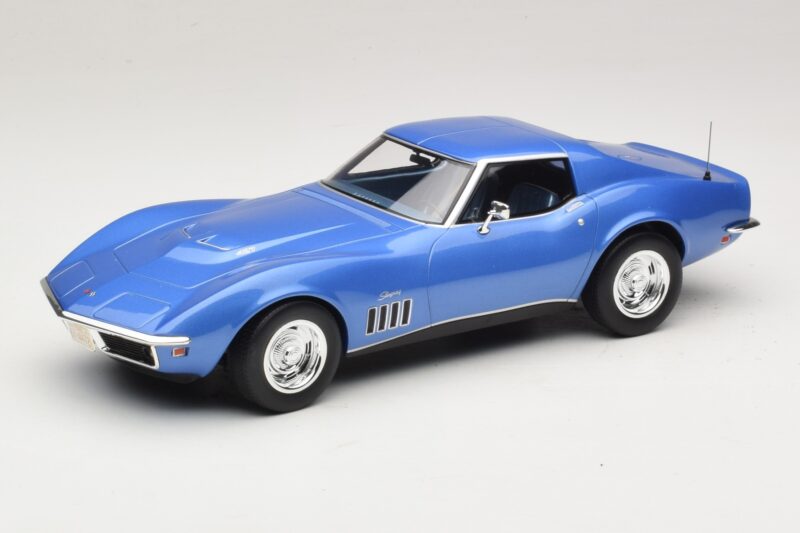
TL;DR: Norev's 1:18 diecast Chevrolet Corvette C3 reproduces the 1969 model year in Le Mans Blue, a factory color from the Corvette's second-generation Stingray body. Cast as a sealed one-piece body, the model keeps the coke-bottle profile continuous, a shape defined by dramatic curves rather than flat panels.
The C3 Corvette introduced a body shape so sculpted that Chevrolet's designers reportedly borrowed the term "coke-bottle" to describe the way the fenders flare out and pinch back in along the car's flanks. Norev's 1:18 diecast reproduces the 1969 model year in Le Mans Blue, cast as a sealed body that keeps those curves reading as one continuous form.
Chevrolet launched the third-generation Corvette for the 1968 model year, and by 1969 the design had settled into the form most collectors associate with the early C3: a low, wide body with pronounced fender flares, a pointed nose, and a fastback rear window that distinguished the coupe from the earlier C2 Sting Ray. The "Stingray" name, written as one word starting in 1969 rather than the two-word "Sting Ray" used on the C2, marked a small but meaningful branding shift as Chevrolet established the C3 as its own distinct generation rather than a direct continuation of its predecessor. Under the body, the 1969 Corvette carried forward the C2's chassis architecture, meaning the dramatic new styling sat on genuinely proven mechanical underpinnings.
The C3's fender flares and pinched waistline demand a casting process capable of holding compound curves without interruption, and Norev's sealed one-piece diecast body delivers that continuity. With no hinge tolerances to accommodate, the shutlines along the doors and hood run as clean, unbroken grooves rather than gaps, letting the coke-bottle profile read as a single sculpted form from the front fender to the rear haunch. Diecast's zinc alloy construction adds genuine weight to the model, a density that reflects well on a shape whose appeal rests almost entirely on how convincingly its curves are reproduced.
Le Mans Blue was one of the factory colors Chevrolet offered during the C3's early production years, a deep, saturated blue that plays well against the car's sharply defined fender lines and creases. Diecast handles the shade convincingly: paint sits on a hard metal shell, letting the blue hold an even, deep gloss across the Corvette's curved panels, with light traveling smoothly along the fender flares in a way that reveals the sculpting Chevrolet's designers built into the body. Against chrome bumpers and the era's signature side-exhaust pipes, the blue creates the kind of high-contrast presence that made the C3 a fixture of American car culture through the late 1960s and into the following decade.
At 1:18, the C3 comes out to roughly 24 centimeters long, a substantial footprint that gives the coke-bottle profile room to read clearly on a shelf. It pairs naturally with other American classics from the same era, or with later C3 model years, letting a collector trace how the Corvette's styling evolved across the generation's long production run. The sealed body construction keeps the piece simple to display and handle, with continuous curves that photograph cleanly from any angle.
No. The body is a sealed, one-piece diecast casting. The C3's coke-bottle profile is captured entirely through continuous panel lines and paint finish rather than an opening feature.
1969 marked the point where Chevrolet began using the one-word "Stingray" name on the C3, establishing it as a distinct generation, while the body had by then settled into its definitive early C3 form.
It describes the way the C3's fenders flare outward and then pinch back in along the car's flanks, a dramatic sculpted profile that became one of the generation's defining visual traits.
The C3 measures approximately 24 centimeters long at 1:18, a substantial footprint that gives the car's sculpted fender lines room to read clearly on a display shelf.