Last one
Used

Opel Commodore A Steinmetz #11 E. von Bayern / Johansson 24 Hours of Spa 1970 Minichamps 1:18
Only 1 left
Price:
109.00 €
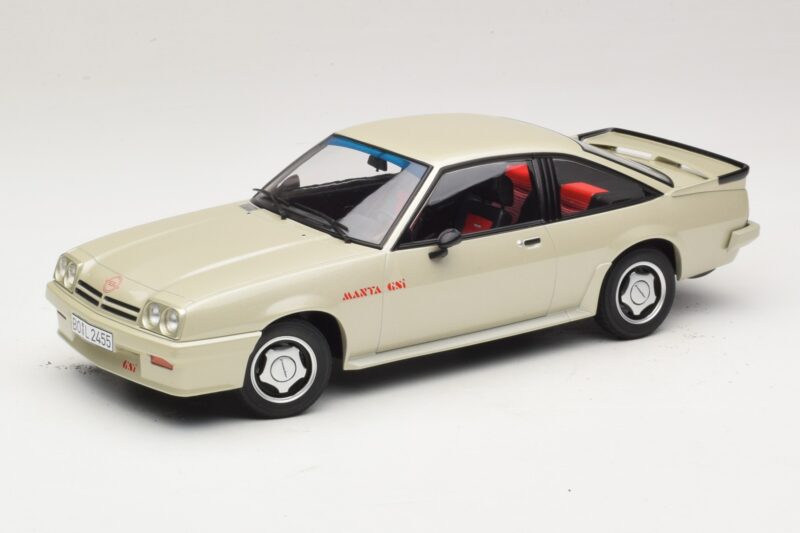
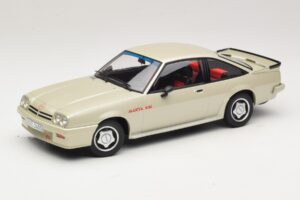
TL;DR: Norev's 1:18 diecast Opel Manta B GSi reproduces the fuel-injected 1987 coupe in Platin Metallic, one of the final specifications offered before Opel ended the Manta B's remarkably long production run. Cast as a sealed one-piece body, the model keeps its shutlines tight along a straightforward, angular 1980s profile.
The Manta B stayed in production for well over a decade, an unusually long run for a coupe competing directly against the Ford Capri, and the GSi represented the sportiest specification Opel offered before finally retiring the model. Norev's 1:18 diecast wears the late-run Platin Metallic finish over a sealed body that keeps the coupe's clean panel lines uninterrupted.
Opel introduced the Manta B in 1975 as a direct rival to the Ford Capri, and rather than replacing it quickly, kept the coupe in production for well over a decade while rivals moved through multiple generations. The GSi arrived as the range-topping specification, adding fuel injection to replace the carbureted engines used elsewhere in the lineup, a meaningful upgrade in throttle response and reliability for a chassis that had by then been refined over years of production. By 1987, the Manta B GSi represented the most developed version of a car that had started a decade earlier as a straightforward, conservatively engineered coupe. Norev's model reproduces that late-production specification rather than an earlier, less sorted version of the car.
The Manta B's design leans on flat surfaces and crisp, angular lines typical of late-1970s and 1980s European coupe styling, a shape that rewards precise panel gaps more than it demands elaborate curves. Norev casts the body as a single sealed diecast shell, meaning there are no hinge tolerances to account for and the shutlines along the doors and hatch run as continuous, unbroken lines rather than gaps that widen or narrow with a moving panel. Diecast's zinc alloy construction adds real weight to the model, a density that signals durable build quality, and the material holds the Manta's flat panels rigid and true over years of handling and display.
Platin Metallic sits firmly within the palette of muted metallics that dominated European coupe sales through the mid-to-late 1980s, a reserved counterpoint to the brighter primary colors more common a decade earlier. On diecast, the finish carries genuine depth: paint sits on a hard metal shell, letting the metallic flake catch light evenly across the Manta's flat hood and door panels rather than appearing dull or uniform. Against black trim and the era-correct alloy wheel design, the platinum tone gives the coupe a restrained, businesslike presence consistent with how the GSi was actually marketed at the time, as a mature, sorted performance coupe rather than a flashy statement car.
At 1:18, the Manta B comes out to roughly 22 centimeters long, a compact footprint that fits comfortably alongside other 1980s European coupes without demanding excess shelf space. It pairs naturally with contemporary rivals from the same era, building a display that traces how European manufacturers approached the affordable performance coupe segment before hot hatchbacks began drawing that market away in the following decade. The sealed body construction makes the piece low-maintenance for handling, with clean, continuous lines that photograph well from any angle without an access point interrupting the profile.
No. The body is a sealed, one-piece diecast casting. The Manta B's straightforward, angular profile is captured entirely through exterior panel lines and paint finish rather than an opening feature.
The GSi added fuel injection in place of the carbureted engines used elsewhere in the range, giving it sharper throttle response and marking it as the sportiest specification offered before the Manta B's production ended.
Opel built the Manta B for well over a decade starting in 1975, an unusually long run for a coupe competing against rivals like the Ford Capri that moved through multiple generations in the same period.
The Manta B measures approximately 22 centimeters long at 1:18, a compact footprint that fits easily alongside other European coupes of the same era on a standard display shelf.

You save 25.00 €
Lowest price in the 30 days before the reduction: 132.00 €
You save 25.00 €
Lowest price in the 30 days before the reduction: 132.00 €
You save 26.00 €
Lowest price in the 30 days before the reduction: 133.00 €