Used
Back in stock
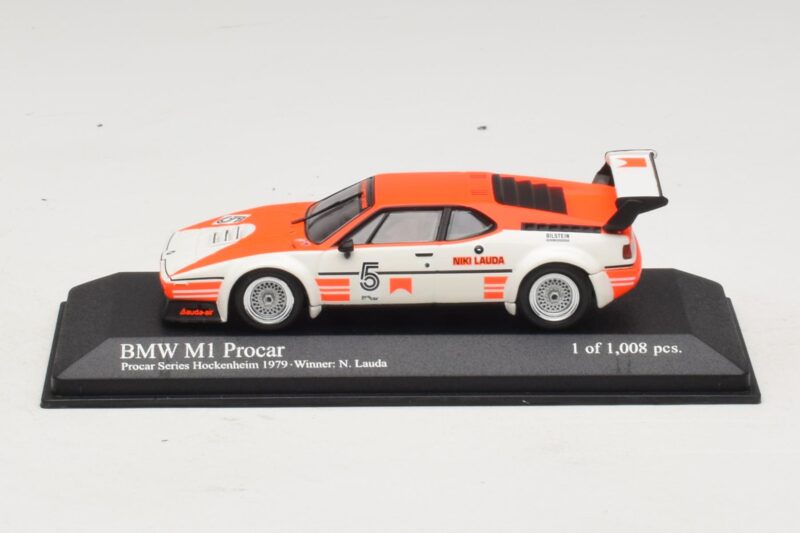
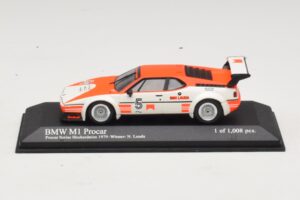
TL;DR: Minichamps' 1:43 diecast BMW M1 Procar reproduces car #5 from Niki Lauda's 1979 Procar Series campaign. The sealed body carries the identically prepared racing livery in sharp tampo print, with correct GT stance standing in for any opening panels.
The Procar Series existed for a strange, brilliant reason: identical BMW M1s, prepared to the same specification, racing head-to-head in front of Formula 1 grids so that talent alone decided the result. Niki Lauda's participation adds a name recognizable well beyond motorsport circles, and Minichamps' rendition of his car #5 puts that oddity of racing history on a shelf.
BMW built the Procar Series specifically to give its new M1 supercar a competition platform while the car established itself in showrooms, running identically prepared cars as a support category at select European Grand Prix weekends in 1979 and 1980. Because every car met the same specification, the series became one of the purest tests of driver skill in the sport at the time, drawing regular Formula 1 competitors alongside category specialists into the same field.
Niki Lauda, already a two-time World Champion by 1979, took part in the series during that same season, adding his name to a grid that mixed established Grand Prix talent with dedicated Procar drivers. Minichamps documents car #5 from that campaign specifically, reproducing the identical-spec livery and sponsor decals rather than a generic M1 racing finish, which matters given how visually similar every Procar entry actually was.
That similarity across the field is itself part of the series' appeal: a well-documented individual car number is the only thing that separates one Procar M1 from another, so getting the number and decal placement exactly right carries more weight here than it would on a grid full of visually distinct machinery. Lauda's brief but notable presence in the series gives this specific car a pedigree that outlasts any single race result from that 1979 season.
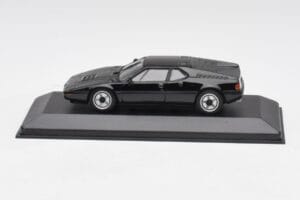
This M1 is cast as a sealed, one-piece zinc alloy shell, identical in construction approach to Minichamps' road-going M1 castings but finished entirely differently on the surface. Lifted from its box, the model carries genuine metal weight, and that heft suits a subject built around a mid-engine supercar chassis rather than a lighter economy casting.
The Procar livery reproduces the identical racing spec every series entrant carried, sponsor decals, car number and series markings, in sharp tampo print that sits flat against the body without the raised edge cheaper transfer methods leave behind. Wheel arch flares specific to the racing package fill correctly over period-correct racing wheels, and the ride height sits low and purposeful, matching how these cars were actually set up for grid racing rather than road use.
Shut lines around the doors and engine cover track as single, continuous grooves, glazing sits flush, and the louvered rear cover, a signature M1 detail, reads with genuine depth under direct light rather than a flattened approximation. Badge and number printing stays legible under magnification, exactly where a one-make series subject's authenticity has to hold up. Given how many M1 Procar entries ran near-identical liveries, that print sharpness is what actually distinguishes a well-made casting from an approximate one.
This Procar M1 works best displayed beside a road-going M1 or an M1 from BMW's 25th anniversary release, showing the same design serving two completely different purposes within a single model year. At 1:43, several Procar entries fit easily on one shelf, letting a collector recreate the identical-spec grid that made the series so distinctive.
Lauda's involvement gives this specific car a crossover appeal beyond dedicated M1 collectors, reaching Formula 1 enthusiasts who track his career across every category he touched. Priced within Minichamps' standard motorsport range, it offers genuine name recognition without the premium a rarer subject would command. For a series this visually uniform, a correctly numbered example is worth prioritizing over a generic entry.



You save 16.00 €
Lowest price in the 30 days before the reduction: 123.00 €