Used
Back in stock

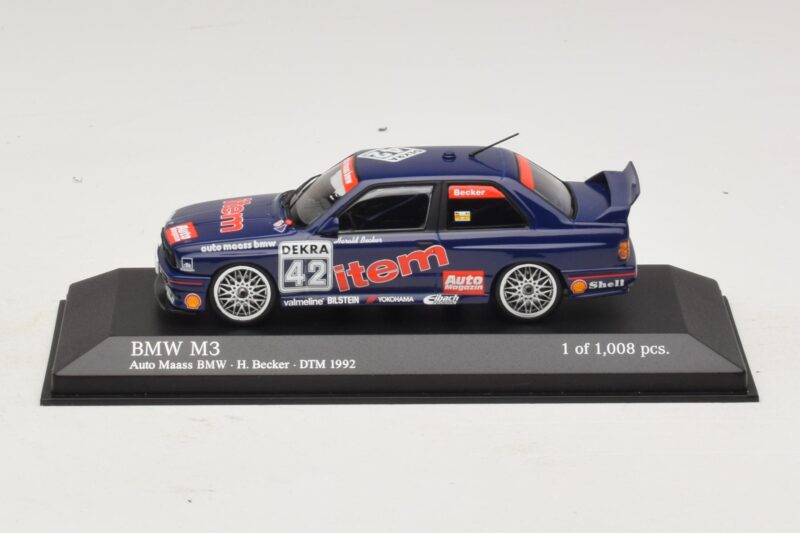
TL;DR: Minichamps' 1:43 diecast reproduces T. Becker's Auto Maas-liveried BMW M3 E30 #42 from the 1992 DTM season, one of the car's final competitive years. The sealed zinc alloy body carries tampo-printed sponsor graphics and the flared Group A stance that defined the E30 M3 across its DTM career.
By 1992, DTM had begun shifting toward the bigger, faster Class 1 machinery that would define the mid-1990s. The E30 M3, dominant just a few seasons earlier, was fighting to stay relevant on grids increasingly filled with newer metal. This Auto Maas-backed #42 captures that transitional moment, a customer entry keeping an aging but proven chassis competitive.
As with Minichamps' other 1:43 E30 M3 releases, this casting is a sealed zinc alloy shell, doors and hood fixed rather than hinged. That construction lets the Auto Maas sponsor block run in one continuous line across the door skin, uninterrupted by a panel seam. The tampo-printed graphics sit flat against the surface, holding sharp edges under magnification rather than the soft edge a decal transfer can leave over time. Zinc alloy also holds its shape over years on a shelf, which matters for a model that will likely sit alongside a growing DTM lineup rather than in isolation.
Judge this piece the way any small-scale touring car should be judged: compare the arch flare, the wheel offset, and the color separation between the white base and the Auto Maas graphics against period photography. At 1:43 there is little room for error in that comparison, and the panel gaps that would exist on an opening-door casting simply aren't part of this car's story. That absence of hinge lines is one advantage a sealed body has over a more complex opening casting at this size. Becker's number 42 sits on the roof and doors in a size that stays legible even at arm's length from the shelf.
BMW's E30 M3 had anchored DTM grids since the late 1980s on the strength of a Group A homologation built around roughly 5,000 road cars. By 1992, though, the series was already moving toward the larger-displacement Class 1 regulations that would bring Mercedes, Audi, and Alfa Romeo works cars onto the grid the following year. The M3 hadn't disappeared, but its competitive window was closing. That shift mattered to spectators too, since Class 1 cars looked and sounded nothing like the boxy Group A silhouette this casting reproduces.
Works BMW support had thinned by this point, and cars like Becker's Auto Maas entry represented the customer teams keeping the model on track through its final competitive seasons. Those privateer liveries are exactly what gives 1:43 DTM collecting its depth, dozens of legitimate color schemes on one chassis across a half-decade of racing. A shelf built around this #42 alongside earlier works liveries and other 1988-1990 privateer colors traces the M3's full arc from dominance to retirement, which is a more interesting story than any single hero car tells alone. Collectors chasing that full arc often find the closing seasons harder to source than the early works cars, which makes a well-cast privateer entry like this one worth prioritizing. 1:43 keeps that entire multi-season chronology on one shelf without demanding cabinet space a larger scale would need.
This #42 works best as part of a broader DTM display rather than a standalone piece, paired with earlier E30 M3 liveries to show the car's full competitive lifespan. Check the casting's arch flare and sponsor graphic registration against reference photos the way any 1:43 touring car deserves to be checked. At this scale, a strong closing-season entry rounds out a collection more than it anchors one. That's a reasonable role for a car that was never going to win 1992, but still deserves a place on the shelf. Pairing it with a 1988 works livery tells the E30 M3's whole DTM story in miniature, from championship contender to respected veteran.










You save 16.00 €
Lowest price in the 30 days before the reduction: 123.00 €