Last one
New arrival
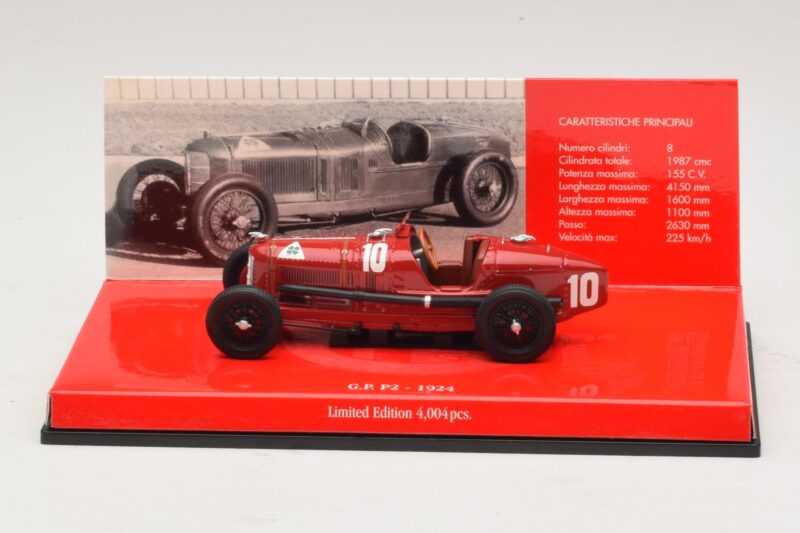
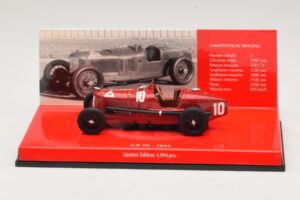
TL;DR: Minichamps' 1:43 Alfa Romeo P2 reproduces car #10 in period racing red, cast as a sealed one-piece diecast body. Vittorio Jano's landmark 1924 Grand Prix design, the car that helped Alfa Romeo win its first world championship, gets its narrow cycle-fendered proportions captured here, making this a foundational piece for any pre-war Grand Prix or Alfa Romeo racing display.
Before Alfa Romeo built road cars people actually remember, it built the P2, the Grand Prix machine that established the marque as a serious racing constructor. Vittorio Jano's design won races almost immediately, and Minichamps' 1:43 casting revives that early success in the same red livery the car wore through the 1920s.
The P2's narrow, cycle-fendered body left almost nothing hidden, exposed wheels, a slim cowl, and a tail that tapered to a point, and Minichamps reproduces that shape as a single sealed casting rather than an assembly of separately hinged panels. That approach suits an open-wheel subject naturally, since there is no bonnet or door to open on a car built with this little bodywork in the first place. Zinc alloy gives the model real weight despite the slim profile, and the casting holds the fenders and radiator cowl crisply, without the soft edges a lower-quality material would show on curves this tight.
The #10 marking and Alfa Romeo's traditional racing red are applied with clean edges, and the trim around the radiator and exposed engine covers holds its detail under close inspection. Getting a car this old right depends heavily on period photographs, since surviving examples and factory records from the mid-1920s are far sparser than for later racing eras. Minichamps' casting reads as a genuinely researched reproduction rather than a generic vintage racer, a distinction that matters to the small but dedicated group of collectors who specialize in pre-war Grand Prix history.
Vittorio Jano designed the P2 shortly after joining Alfa Romeo from Fiat, and the car made its competition debut in 1924, immediately proving faster than the established Grand Prix machinery of the day. The following year, the P2 helped Alfa Romeo claim the first World Manufacturers' Championship contested under the AIACR banner, a result that cemented Alfa's reputation as a genuine works racing outfit rather than a promising newcomer. That championship result is widely regarded as the foundation of Alfa Romeo's entire competition identity, the starting point for a racing heritage the marque still trades on today, decades after the P2 itself left the track.
The success of the P2 shaped how Alfa Romeo organized its racing efforts for years afterward, reinforcing the value of hiring top engineering talent and committing factory resources to a dedicated competition program. Antonio Ascari, one of the era's most respected drivers, campaigned the P2 during this period, adding another layer of documented history to the car's record. The quadrifoglio, the four-leaf clover symbol still associated with Alfa Romeo racing, traces its use back to roughly this same era of the marque's competition history, part of why a P2 model resonates with collectors well beyond those focused narrowly on 1920s racing.
A 1:43 P2 works as the oldest anchor point in a Grand Prix or Alfa Romeo racing display, predating even most pre-war sports prototypes by a decade or more. Its narrow, exposed-wheel silhouette makes an immediate visual contrast against later, more enclosed racing designs, useful for collectors who want their shelf to show the actual evolution of Grand Prix car design rather than just a row of similarly shaped machines. At this scale, the sealed casting and researched livery matter more than any opening feature could, since a car built this simply never had much to open in the first place. Collectors serious about pre-war motorsport history will find few subjects this foundational available in diecast at all.



You save 16.00 €
Lowest price in the 30 days before the reduction: 123.00 €