Last one
New arrival
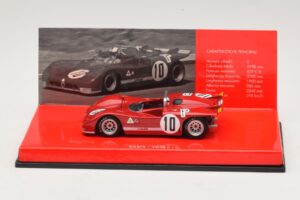
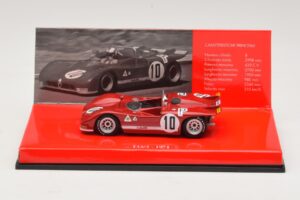
Alfa Romeo T33/3 #10 R. Stommelen / N. Galli ADAC 1000km Nurburgring 1971 Minichamps 1:43
Only 1 left
Price:
66.00 €
This model is currently sold out. Enter your email and we'll let you know when it's back in stock.
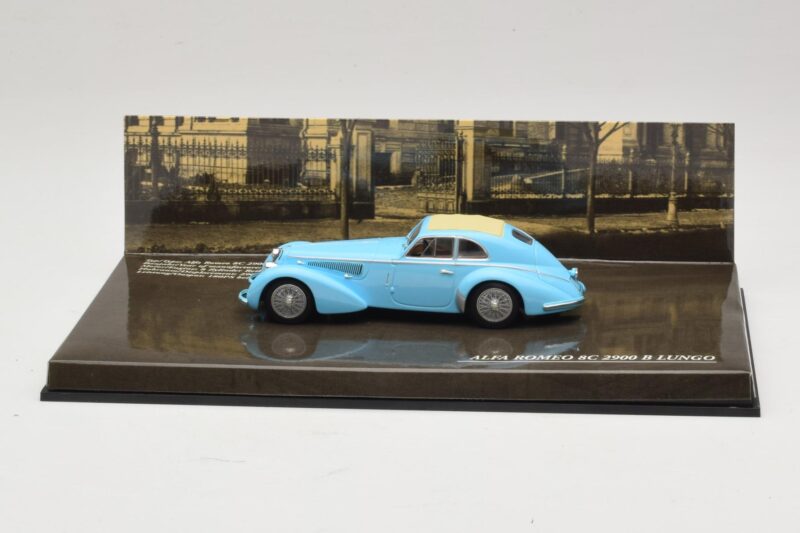
TL;DR: Minichamps' 1:43 Alfa Romeo 8C 2900B Lungo in Light Blue reproduces one of pre-war Europe's most advanced sports cars, built around a supercharged straight-eight and independent suspension years ahead of its rivals. The diecast body is a sealed, one-piece casting capturing the long-wheelbase touring coachwork's flowing lines.
Few pre-war sports cars combined technical ambition with coachbuilt beauty as completely as the 8C 2900B. Alfa Romeo gave it a twin-supercharged straight-eight and independent suspension at both ends, engineering most rivals would not match for another decade, while the Lungo's long-wheelbase touring body wrapped that chassis in some of the era's most fluid, uninterrupted bodywork.
The 8C 2900B's straight-eight engine ran twin superchargers at a time when most manufacturers had not settled on forced induction at all, producing output that made it one of the fastest road cars of the 1930s. Alfa Romeo paired that engine with independent suspension front and rear, a layout that gave the car composure over rough roads that live-axle rivals from the same period simply could not match. That combination of power and chassis sophistication is why period competition versions of the 8C performed so well in endurance events of the era, and why the road-going 2900B is remembered today as much for its engineering as for its styling. Few pre-war manufacturers were willing to put this level of technical ambition into a car built in such small numbers.
The 2900B was offered in both Corto, a shorter-wheelbase sport version, and Lungo, the longer-wheelbase touring configuration this model reproduces. Coachwork on these chassis often came from Carrozzeria Touring of Milan, known for lightweight construction methods that let a body follow the chassis's lines closely without adding unnecessary weight. The Lungo's proportions favor a more grand-touring stance, longer front fenders and a more graceful cabin placement than the sportier Corto, and that stretched silhouette is part of why the 2900B remains one of the most sought-after pre-war Alfa Romeos among collectors of the original cars today.
Light Blue is a demanding color for any casting because it shows surface irregularities more readily than darker tones, and Minichamps' zinc alloy construction meets that demand with an even, deep-gloss finish across the long hood and flowing fender line. The body is a sealed, one-piece casting, which suits a subject defined by unbroken, continuous surfaces rather than sharp mechanical panel breaks. Nothing on the model opens, so the sculptor's attention goes entirely into the exterior proportions: the long nose, the low, tapered tail, and the fender line that sweeps from headlamp to running board without interruption.
The 8C 2900B's bodywork is almost entirely compound curves, with few flat panels or hard creases anywhere on the surface, which makes it a demanding subject for any material. Diecast construction gives the casting real heft and dimensional stability, holding the fender's sweep accurately over years of display rather than warping the way a lighter material might. Wire wheels, the chrome grille shell, and the split windscreen carry period-correct detail that separates a serious reproduction from a simplified toy-grade casting. Collectors judging this casting should look first at how cleanly the fender line reads under raking light, since that unbroken curve is the detail hardest for any manufacturer to get right.
Pre-war Italian coachbuilt cars occupy a small, specialized corner of most 1:43 catalogs, and a genuinely advanced subject like the 8C 2900B is rarer still. Displayed alongside contemporary German and French classics, it makes the case for Italian engineering ambition in an era usually remembered for German technical dominance. The Light Blue finish also sets it apart visually from the more common black or red pre-war castings, giving a mixed-era shelf a distinct focal point. For a collector already invested in vintage classics, this Lungo rewards close inspection in a way few subjects from the same period can, because so much of what made the original significant translates directly into what the casting shows.