Used
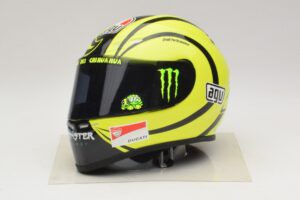
AGV Helmet V. Rossi MotoGP Valencia Test 2009 Minichamps 1:2
Price:
179.00 €
AGV is an Italian helmet brand, and this collection reproduces its racing helmets at half size in diecast from Minichamps. The assortment centers on MotoGP and motorcycle racing designs from the 2000s, where bold paint schemes turn each shell into a compact display piece with real shelf presence for racing fans and brand-focused collectors.
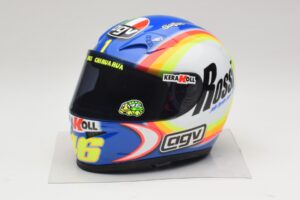
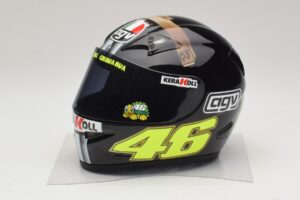
TL;DR: AGV helmet scale models here are 1:2 diecast replicas made by Minichamps, covering MotoGP and motorcycle racing designs from the 2000s. At half the size of the real helmet, each replica turns an Italian racing brand's shell shape and race graphics into a desk-sized display piece, judged by paint separation, symmetry, and lettering sharpness.
AGV helmet scale models make this brand category unusual: the subject is not a car or a bike but the equipment a racer wears. Collectors who browse by marque will find AGV reproduced at 1:2, where the shell becomes a canvas for race graphics. Here is how to read those designs, judge the diecast build, and arrange a themed display.
Most brand categories are about cars or bikes. This one is about the object a racer puts on before anything else happens. AGV is an Italian helmet brand with a long presence in motorcycle racing, and the replicas gathered here reproduce its racing helmets at 1:2 in diecast, made by Minichamps. The assortment centers on MotoGP and motorcycle racing, and the designs belong to the 2000s.
That narrow focus is a strength for a collector who likes to specialize by marque. Instead of chasing a manufacturer's entire output, a shelf can follow one brand across several designs and watch how a related shell shape carries very different graphics. The silhouette stays familiar from piece to piece; the paint, striping, and sponsor placement change, and that change is the collecting interest. Because every piece shares scale and material, comparison is clean: any difference you see is a design or finish difference, not a format one. This page reads only what the assortment holds and leaves the wider output of both names open.
A helmet is the most visible personal statement in racing. Riders use color and pattern to be recognized at speed, and the 2000s produced some of the boldest, most layered schemes in the sport. On a 1:2 replica those graphics are the main event, since there is no bodywork or livery to share the attention. Look at how the design flows over the curvature: a good replica keeps stripes continuous across the crown and lets the pattern wrap toward the chin bar without visible breaks.
Collectors tend to sort designs by character. Some are clean two- or three-color blocks that read from across a room. Others are dense, with layered patterns, small lettering, and sponsor marks that reward a close look. Both are valid themes. Blocky designs suit a minimalist shelf where each piece stands alone, while detailed ones suit a tight cluster where the viewer leans in. Matching design density to display style keeps a shelf from feeling chaotic.
Place any manufacturer by what you can observe, and apply that to these pieces. Start with weight: a diecast shell at half size feels dense and solid, and that mass tells you the body is metal rather than light plastic. Then look at the paint. Deep, even gloss with sharp edges where colors meet signals careful finishing; soft transitions or visible orange peel signal compromise. Printed lettering and logos should be crisp, with consistent spacing.
Diecast trades a little edge crispness for toughness. Very fine trim can read a shade softer than hand-built resin would show, but the metal shell stands up to being handled, which suits a piece collectors want to hold and turn. How an individual helmet treats its visor, vents, or accessories varies by model, so the product card is where to confirm detail. Minichamps' wider catalog is not described here; this collection speaks for itself, and the best test remains comparing pieces directly against each other.
The fastest way to learn a collection is to put two pieces next to each other under the same light. Differences in finish become obvious in seconds. Use a consistent checklist:
In a pairing, the more complex design usually exposes more of the finishing challenge, because every extra color boundary is another chance for a flaw. That makes a busy graphic an honest test piece. If a dense design still holds clean edges and balanced placement, it tells you the finishing standard is high. A flaw spotted on one piece is worth checking against the product photography of the others.
Half-size helmets look best with deliberate staging. A simple stand lifts the shell off the shelf and angles it toward the viewer, the position that shows visor area and graphics together. Give each piece a few inches of space, since the rounded form needs room to read as a silhouette.
Pairings extend the story. A smaller-scale racing motorcycle model nearby supplies the machine, while the helmet supplies the personality. Neutral backgrounds in black, grey, or white keep attention on color blocking, and warm, soft light brings out gloss without glare. Avoid direct sun, which fades paint over time, and hot spotlights, which wash out graphics. Dust collects in seams, so a soft brush and a glass-fronted case make upkeep simple. Rotate pieces occasionally so no single one takes all the light exposure.
The 2000s sit in the high-profile era of motorcycle racing's premier class, when rider helmets became recognizable images in their own right. Race graphics from the decade were large, high-contrast, and built to read at a glance on a television screen, which is why they translate so well to display pieces now. A helmet from this period carries the look of the grid without needing the bike beside it.
For a collector, the era works as a filter. Staying within the 2000s keeps a shelf visually consistent, since designs of one decade share color palettes and sponsor-heavy layouts. Heritage here is supporting context; the collecting value lies in how well the replica translates the graphic, not in recounting race results. Read the design, judge the finish, and let the period atmosphere do the rest.
A helmet has no wheels, glass, or body panels, so quality rests on shell symmetry, paint separation, and graphic sharpness. At 1:2 the whole piece is about six inches long, which puts finish front and center rather than mechanical detail.
Set them side by side under the same soft light and check color boundaries, gloss consistency, lettering spacing, and left-right symmetry. Busy graphics expose finishing quality fastest, so a dense design that stays clean is a reliable benchmark for the rest.
A small stand, a few inches of clearance, and soft indirect light show the shell best. Keep the piece away from direct sun, brush dust off regularly, and consider a glass-fronted case, which protects the gloss and keeps cleaning to a minimum.
Diecast gives the shell noticeable weight and handling toughness, with deep gloss paint. Very fine trim can look a shade softer than resin would allow. Details such as visors and vents differ by model, so confirm them on each product card.