Used
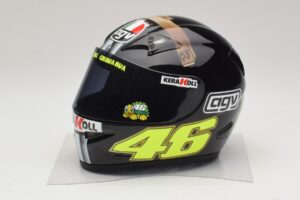
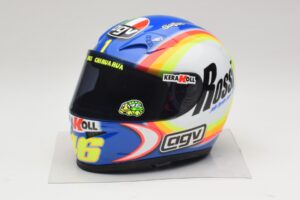
AGV Helmet V. Rossi MotoGP Jerez Test 2007 Minichamps 1:2
Price:
179.00 €
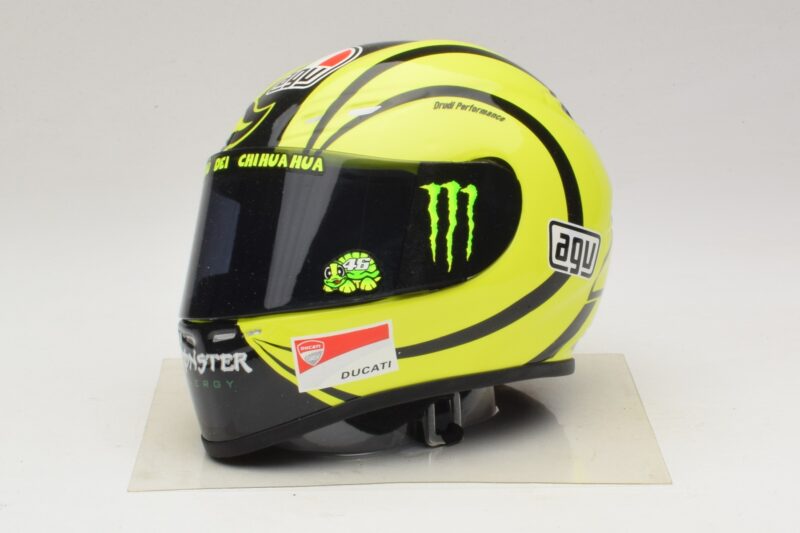
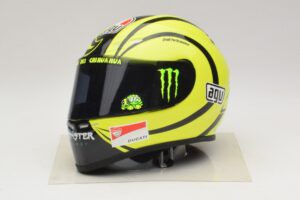
TL;DR: The Minichamps AGV Helmet V. Rossi MotoGP Valencia Test 2009 is a 1:2 diecast replica of Valentino Rossi's helmet at a 2009 Valencia test, in the year he won his ninth world title. The shell is one sealed casting. It suits collectors finishing a year-by-year MotoGP helmet row.
Nine world titles is a number that frames a career. The year Valentino Rossi reached it, 2009, is the year this helmet belongs to. Minichamps cast the Valencia Test 2009 version in diecast at half size, a dense metal shell that gives the later end of a Rossi shelf real weight.
Rossi won the 2009 MotoGP title for Yamaha, his ninth world championship across all classes. Valencia, in eastern Spain, is a regular MotoGP venue and a common site for tests, and the test label here marks a session rather than a race. The pairing of venue and year gives the helmet a precise place in his career timeline. Owners who track his eras find the 2009 piece the natural endpoint of the 2000s row, after Sepang 2005 and Jerez Test 2007 in this catalogue.
At this scale the casting material is obvious in the hand. Zinc alloy gives the shell mass and dimensional stability, so the curve of the crown does not drift over years on a shelf. Casting tolerances are a touch broader than those of cast resin, which is the trade for a body that survives careful handling and keeps its shape. Gloss sits deep on a hard metal surface, and clear coat should look smooth rather than orange-peeled. Check that finish under a lamp when the piece arrives.
Nothing on this helmet opens or moves, and that is a construction choice, not a shortfall. With no articulation to accommodate, the shell holds uninterrupted curves, and everything a collector judges sits on the outside. Compare it with photographs from the period. Start with the overall silhouette, then the way graphic color fields meet each other, then the clarity and fit around the visor area. A shell that gets those three right will read as accurate from across a room, which is how most displays are seen.
A half-scale diecast helmet sits in a distinct segment: larger and heavier than a car model, with a simpler form and fewer separate parts. Expect surface quality to be the differentiator rather than part count. That focus is honest for the subject, since a helmet's appeal is its finish.
Keep it away from direct sunlight, which fades paint over time, and dust it with a soft brush. Lift with both hands under the shell. Soft lighting from the side shows the gloss best. As a collecting choice it closes a 2000s run that begins with the 2005 Sepang version, and it also stands alone for anyone who wants one champion-year helmet. Heavy metal ages well when dry and dust-free, but a hard fall can chip paint. For a shelf built around Rossi, it is an easy piece to order.