Last one
Used

FrontiArt built its reputation on resin hypercars that mainstream diecast producers rarely attempt, and Koenigsegg’s 2010s output gives the manufacturer a signature subject: low-volume Swedish engineering reproduced at 1:18 with panel precision and surface detail suited to close inspection. This is a shelf for collectors chasing the exotic end of the hobby rather than everyday sports cars.
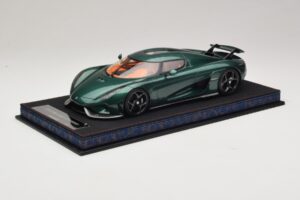


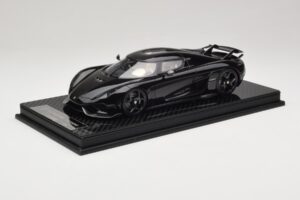


TL;DR: FrontiArt scale models bring investment-tier resin craftsmanship to Koenigsegg's 2010s hypercar era, reproducing 1:18 subjects like the Agera, One:1, and Regera with the panel precision and surface detail hand-built resin allows. Positioned among the hobby's premium hypercar specialists, FrontiArt targets collectors chasing low-volume Swedish engineering that mainstream diecast rarely covers.
FrontiArt scale models occupy the premium end of resin hypercar reproduction, built for subjects most diecast manufacturers won't touch: low-volume, mechanically extreme machines like Koenigsegg's 2010s lineup. Working in 1:18 resin rather than diecast lets the manufacturer chase panel precision and surface detail that suit a hypercar's exotic bodywork, and Koenigsegg's decade of Agera, One:1, and Regera variants gives FrontiArt exactly the kind of subject its construction approach was built to serve.
Hypercars present a specific problem for scale model manufacturers. The bodywork is often more sculptural than a conventional sports car, with surfacing that changes character depending on the angle and aerodynamic details that only read correctly if the proportions are exact. Mass-market diecast, tooled for volume and priced for accessibility, tends to smooth over exactly the details that make a hypercar recognizable up close. FrontiArt built its reputation addressing that gap directly, focusing on subjects like Koenigsegg where the real car's engineering ambition and the model's construction quality need to match. That focus explains why the manufacturer sits where it does in the hobby: not chasing the broadest possible catalogue, but concentrating on a narrower set of extreme, low-volume marques and reproducing them with a level of surface and panel fidelity that a high-run diecast operation rarely attempts. Collectors drawn to this category tend to already own diecast from more mainstream marques and are specifically looking for something that steps up in both subject rarity and construction ambition, rather than a first purchase into the hobby. That's the audience FrontiArt is built for.
Judging a resin hypercar model starts with the surfacing, since that's exactly where a hypercar's real character lives. Run your eye along the body's creases and vents; on a well-cast resin piece those lines stay crisp and consistent, without the softening a lower-tolerance mold introduces. Panel gaps around doors, hoods, and any visible engine covers should be narrow and even, since resin's tighter casting tolerances are the entire reason a manufacturer chooses the material over diecast for a subject like this. Paint depth is the next check: a properly finished resin body holds even gloss and color saturation across curved surfaces that would show inconsistency on a lesser cast. Interior and engine-bay detail deserve close attention too, since hypercars are frequently displayed with an emphasis on the mechanical components visible through glass or vents, and a manufacturer working at this tier should render that detail with genuine separation between parts rather than a single molded block. None of these checks depend on price alone, but at the investment tier they're a reasonable baseline expectation rather than a bonus.
Koenigsegg spent the 2010s establishing itself as one of the few independent hypercar manufacturers capable of matching, and occasionally beating, the established Italian and German giants on raw numbers. The Agera carried that ambition through most of the decade, evolving across several variants and pushing the small Swedish manufacturer's engineering credibility further with each one. The One:1 pushed the extremes even further, chasing a power-to-weight target that became the car's entire identity. The Regera arrived toward the decade's back half with a radically different drivetrain approach, trading a conventional gearbox for a direct-drive hybrid system that was as much an engineering statement as a performance one. That run of cars gives a resin manufacturer working in this space a genuinely rich decade to draw from, each car distinct enough in proportion and detailing that reproducing several of them side by side actually tells a design story rather than repeating the same shape with a different badge. It's a marque whose real-world rarity makes the scale model, for most collectors, the only practical way to own one at all.
Resin earns its place at the top of the hypercar collecting tier for reasons that show up the moment you handle one. The material holds tighter panel gaps and sharper creases than diecast tooling typically achieves, which matters enormously on a body where the surfacing itself is the engineering statement. It's factory-painted in the catalogue color with a finish depth that reads as considered rather than simply glossy, and it's noticeably lighter in hand than a diecast piece of the same size, a detail that surprises collectors used to metal's characteristic heft. That lightness comes with a trade-off: resin is more brittle than diecast, and a hypercar's low, wide stance often means thin, exposed splitters and wing elements that are more vulnerable to a knock than a conventional sedan's bumper would be. Handling by the base rather than any aerodynamic element matters more here than with most subjects. At 1:18, a hypercar's low profile and wide footprint give it a different shelf presence than a taller vehicle at the same scale, commanding attention through stance and width rather than height.
A FrontiArt collection benefits from a clear organizing idea, since hypercars as a category span several manufacturers and eras that don't automatically connect the way a single marque's model lineage does. A few approaches work well for this corner of the hobby:
Whichever direction fits, budget for the investment tier's realities: runs are limited, subjects are chased by a relatively small pool of dedicated collectors, and a piece that sells through rarely comes back at the same accessibility. Treating each release as a genuine decision, rather than an impulse purchase, suits the pace this category actually moves at, and that slower pace is part of the appeal for many collectors who value scarcity as much as detail.
Investment-tier resin asks for more deliberate care than a typical diecast shelf, mostly because the subjects themselves are built low, wide, and full of exposed detail that doesn't tolerate careless handling. Keep the model out of direct sunlight; UV exposure fades paint and yellows clear components over time, and a hypercar's expansive glazing and lighting elements have more exposed surface area to suffer than a conventional car's smaller windows. Dust with a soft brush rather than a cloth, since a cloth can catch on splitters, wing elements, or any fine photo-etched detail and bend it before you notice. Lift and move the piece by its base or chassis rather than by any aerodynamic element, since these are precisely the thin, load-bearing points most likely to crack under stress that a sturdier diecast body would simply absorb. A glass-fronted cabinet is worth the investment here more than almost anywhere else in the hobby, both for dust control and for keeping a low, wide car safe from the kind of accidental bump that happens more easily on an open shelf. Keep original packaging and any certificates of authenticity, since documentation carries real weight in this tier's resale market, where buyers expect a complete provenance trail rather than just the model itself.
FrontiArt works in resin rather than diecast, chasing panel precision and surface detail on hypercar subjects that mass-market tooling tends to smooth over. The manufacturer focuses on a narrower set of extreme, low-volume marques like Koenigsegg rather than a broad catalogue, positioning its work at the investment tier of the hobby.
The decade spans the Agera's evolution across several variants, the extreme power-to-weight focused One:1, and the Regera's direct-drive hybrid system introduced toward the decade's later years. Each car is distinct enough in proportion and engineering approach that a collection spanning several tells a genuine design story.
Resin generally suits hypercars better, since its tighter casting tolerances hold the sharp creases and narrow panel gaps that define a hypercar's sculptural bodywork. Diecast brings more durability and weight, but a hypercar's surfacing is often the entire engineering statement, which is where resin's precision earns its higher price.
More fragile than diecast, particularly around thin splitters, wings, and other low-hanging details that mirror the real car's aerodynamic elements. Handle these models by the base or chassis rather than any exposed aerodynamic piece, and consider a glass-fronted cabinet for both dust control and protection from accidental knocks.