New arrival
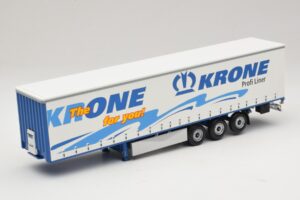
Krone remains an active manufacturer of semi-trailers and agricultural machinery, which sets this collection apart from most historical commercial-vehicle categories built around brands that no longer exist. These 1:43 Minichamps diecast models document 1990s haulage fleet trucks from a company still building trailers today, giving collectors a rare living link between scale model and current production.
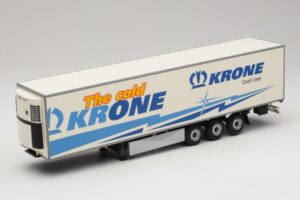
TL;DR: Krone model trucks are 1:43 Minichamps diecast documenting the German manufacturer's 1990s semi-trailer haulage fleet, built by a company that still produces trailers and agricultural machinery today. Diecast construction favors durability, and the still-active brand gives this category a rarer living connection to current production than most historical truck marques.
Most commercial-vehicle brands worth collecting in scale stopped building trucks decades ago, which makes Krone a genuine outlier. The company still manufactures semi-trailers and agricultural equipment today, and this 1:43 Minichamps diecast collection documents its 1990s haulage fleet, a decade when the brand's trailer construction was already establishing the reputation it still trades on. That ongoing production gives the category a living context most historical truck collecting lacks.
Krone occupies an unusual position among commercial-vehicle collecting subjects: it is one of the few brands in this corner of the hobby that never disappeared. Where marques like Bussing and Kassbohrer were absorbed into larger groups decades ago, Krone continues building semi-trailers and agricultural machinery today, which means this 1990s-era collection documents a working chapter of an ongoing story rather than the final years of a closed one.
That distinction changes how a collector approaches the brand. A Krone model isn't a memorial to a discontinued marque; it's a historical snapshot of a company whose current trailers still carry a recognizable design lineage back to the 1990s trucks in this collection. For collectors who enjoy connecting a scale model to something still visible on today's roads, that continuity offers a kind of relevance that a fully historical brand simply cannot match, and it makes the 1990s output here feel like a beginning rather than an ending.
The 1990s were a formative decade for European haulage generally, as trailer manufacturers refined designs to handle increasing freight volumes and tighter regulatory standards across an increasingly integrated European market. Krone's semi-trailer trucks from this period reflect that broader industry shift, built for operators who needed reliable, high-capacity trailers rather than novelty or prestige.
Collecting this era captures Krone at a genuinely interesting point in its development: established enough to have a real reputation among haulage operators, but decades before the brand's more recent expansion into a wider range of trailer types and agricultural equipment. That makes 1990s Krone models a useful reference point for collectors tracking how the company's design language evolved over time. Pairing a 1990s Krone trailer with a more contemporary reference, where available, shows how much, or how little, the underlying design philosophy has actually shifted across three decades of continuous production.
Modeling a working haulage fleet asks for a different sensibility than modeling a show car, and Minichamps' zinc-alloy diecast construction fits that brief. The material's weight gives a trailer model genuine heft and a stable stance, standing in for the mechanical solidity a real semi-trailer needs to carry serious freight loads day after day. Durability matters more here than on a display-only subject, since commercial-vehicle collectors tend to handle these models more, coupling and uncoupling trailers to build different combinations.
At 1:43, a full tractor-trailer combination still commands meaningful shelf length, which is worth accounting for before building a themed fleet display. Livery printing on a working-fleet subject should carry the kind of plain, functional branding real haulage trailers actually display rather than showroom gloss, and that restraint is appropriate rather than a shortcoming. As always, whether a specific casting includes a functioning coupling mechanism or opening rear doors is a detail to confirm per model rather than assume from the scale.
Because Krone continues to build trailers, a collection built around the brand has room to grow in a way a discontinued marque's collection does not. A 1990s-focused starting point gives collectors a defined historical chapter, and from there a collection can expand toward more recent Krone releases as they become available, tracking design evolution across decades rather than freezing on a single era.
A practical approach groups 1990s Krone trailers with period-appropriate tractor units from other manufacturers, since Krone built trailers rather than complete trucks and the historically accurate combination pairs a Krone trailer with whichever tractor brand actually hauled it. That pairing reflects how real haulage fleets operated, mixing tractor and trailer brands based on operator preference rather than a single manufacturer's complete lineup. For collectors who enjoy an open-ended project, Krone's ongoing production keeps that door open indefinitely.
Within commercial-vehicle collecting, Krone sits in a genuinely distinct category: an active, ongoing manufacturer being documented at a specific historical point rather than a closed catalog with a fixed endpoint. That status places it closer to how collectors approach an active passenger-car marque, where new releases keep expanding the collecting scope, than to how they approach a discontinued brand like Bussing or Kassbohrer.
In pricing and construction, the category remains accessible, mid-tier diecast typical of commercial-vehicle collecting generally, positioned well below investment-grade hand-built work. That accessibility, combined with the brand's ongoing relevance, makes Krone a genuinely practical entry point for a collector who wants a commercial-vehicle subject with room to grow rather than a fixed, finite catalog. It rewards patience the way collecting an active marque always does, since the next release is never entirely off the table.
Evaluating a Krone trailer model starts with proportion: trailer length, ride height, and axle spacing should match reference photographs of the actual 1990s equipment rather than a generic trailer silhouette. Because Krone trailers are often coupled with a separate tractor brand, checking that the coupling mechanism sits at a realistic height and angle matters as much as evaluating the trailer body itself.
Panel construction on the trailer body should show clean, consistent lines, since a working-fleet trailer's visual interest comes from functional details like tie-down points and marker lights rather than decorative styling. Livery, where present, should reflect the plain, practical branding real haulage fleets carried rather than an overly polished finish. Comparing a model against period photographs of actual Krone equipment from the 1990s remains the most reliable way to confirm a casting's accuracy, particularly since the brand's design details evolved meaningfully across the following decades.
Yes. Unlike many historical commercial-vehicle brands collected in scale, Krone continues building semi-trailers and agricultural machinery today. That ongoing production gives this 1990s-focused collection a living context, connecting a historical scale model to a company still visible on current roads.
This collection focuses on 1990s semi-trailer haulage fleet trucks, a decade when Krone's trailer construction was already establishing the reputation the brand still trades on today. It offers a useful reference point for tracking the company's design evolution over subsequent decades.
Historically accurate haulage combinations pair a Krone trailer with whichever tractor brand actually hauled it, since Krone built trailers rather than complete trucks. Mixing tractor and trailer brands based on the pairing reflects how real fleets operated rather than sticking to a single manufacturer's lineup.
Check trailer length, ride height, and axle spacing against reference photographs, along with the coupling mechanism's height and angle relative to the tractor. Livery should reflect plain, functional branding rather than showroom gloss, since these are working-fleet subjects rather than display-only show trucks.