Used

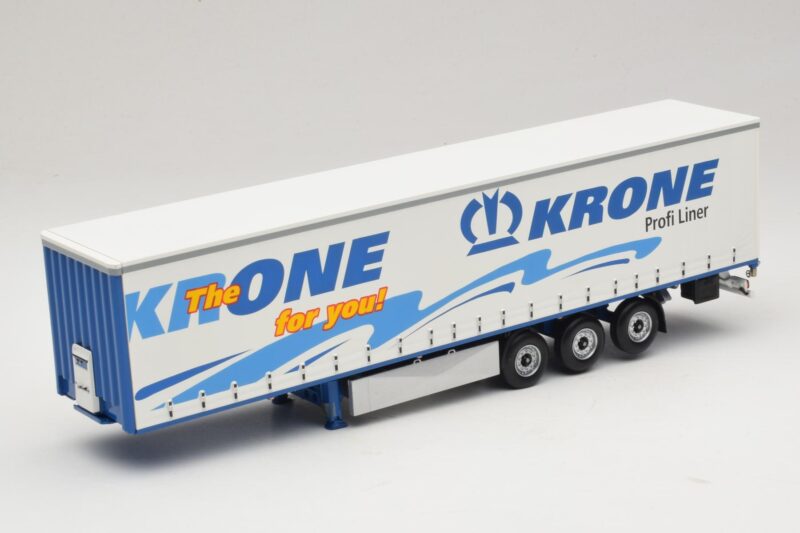
TL;DR: Minichamps' 1:43 Krone Profiliner is a zinc alloy diecast of the curtainside semi-trailer from the early 1990s, sold as a standalone trailer unit rather than a complete rig. The body is sealed with no moving parts, so molded curtain ribbing and panel registration carry the entire presentation on a shelf.
Curtainside trailers changed how European hauliers loaded and unloaded freight, replacing rigid box sides with a sliding tarp system that let a forklift reach cargo from either flank rather than only the rear doors. Krone, a German trailer builder, produced the Profiliner as one of the design's standard-bearers through the 1990s. Minichamps renders that trailer alone at 1:43.
Most of the trucks in a Mercedes-liveried commercial range come as complete tractor-trailer combinations, so this Krone piece stands apart by design: it is the trailer alone, meant to be paired with whichever tractor unit a collector already owns or plans to add. That modularity mirrors how real haulage fleets work, where a trailer builder like Krone supplies bodies that get coupled to tractors from several different truck manufacturers over the course of a working life. Collecting the Profiliner on its own is an invitation to build a mixed fleet, matching this trailer to a Mercedes or any other tractor a collection already includes, rather than being locked into one paired combination.
The curtainside format itself dates the trailer to a specific moment in European freight history, when tarp-and-rail systems replaced the older solid box body as the default choice for general cargo. Krone built its reputation on this format through the 1990s, and the Profiliner name became closely associated with the curtainsider category during that period. Minichamps captures the trailer's characteristic side rail structure, the vertical posts that support the rolled tarp, and the load-bed height that period regulations across Europe standardized. Getting that rail spacing correct is what separates a purpose-built curtainsider casting from a generic box trailer wearing painted-on tarp lines.
The real trailer's tarp rolls back along its side rails to expose the load bed, but this casting represents that curtain in its closed, traveling position, molded and painted as part of the sealed body rather than as a working mechanism. That is the correct choice at this scale and price point: a functioning sliding curtain would demand loose parts and thin material a die-cast casting cannot replicate credibly, while a molded curtain lets Minichamps concentrate on getting the pleat lines, rail brackets, and corner posts sharp and consistent along the trailer's full length. The result is a trailer that photographs and displays convincingly at typical shelf viewing distance, where the eye reads pleats and rails rather than searching for a seam that would only exist on a working mechanism.
Buying the trailer alone means the coupling point, the fifth-wheel connection at the front of the trailer bed, is finished to a generic standard height rather than matched to one specific tractor cab. That is a practical trade-off rather than a flaw: it is what makes the trailer compatible with tractors from across a collection instead of only one paired truck. Collectors assembling a fleet from several manufacturers over time will find this approach more useful than a fixed combination, even if it means doing a bit of visual matching by eye when the rig finally comes together on the shelf.
Building a fleet around trailers rather than tractors flips the usual collecting logic: instead of picking a favorite cab and finding liveries for it, a collector picks bodies and haulier brands first, then matches tractors to suit. This Profiliner rewards that approach, since curtainside trailers were used across nearly every major European operator in the 1990s regardless of which tractor brand pulled them. At 1:43, it stores easily alongside other trailer subjects even before a matching tractor is found, making it a sound standalone purchase rather than an incomplete one. For American collectors more familiar with fixed tractor-trailer combinations, this modular approach is worth trying, since it opens the door to mixing brands within a single haulage-themed shelf.