New arrival

Nilu27 Nilu Super White GT Spirit 1:18
Price:
100.00 €
This category gathers 1:18 resin replicas produced by GT Spirit of vehicles customized by Nilu27, a builder working in special and unique modified vehicles rather than factory-stock cars. Resin casting captures the flared bodywork, altered stance, and aftermarket details that define each build with a precision diecast rarely matches.
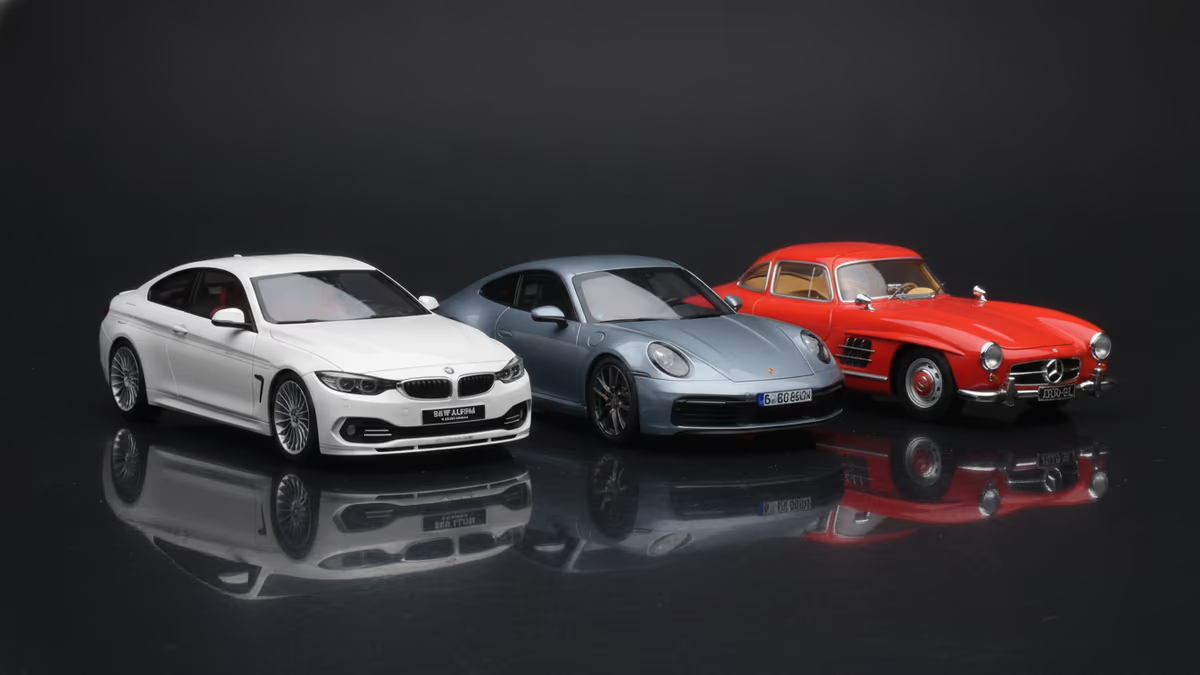
TL;DR: Nilu27 scale models bring GT Spirit's resin craftsmanship to custom and modified vehicle builds, cast in 1:18 scale from the 2020s. Resin construction favors crisp panel definition and deep paint finish over mass production. This niche category suits collectors drawn to tuner culture and special-build subjects mainstream diecast manufacturers rarely touch.
Nilu27 represents a corner of the hobby most mainstream diecast never reaches: scale reproductions of customized, one-off vehicle builds rather than factory-stock cars. GT Spirit, the resin specialist behind this range, has built its name on subjects too specialized or too limited for volume manufacturers to license. That combination, an unconventional donor vehicle rendered in painstaking resin detail, gives this small category outsized appeal for collectors who follow custom and tuner culture rather than showroom catalogs.
GT Spirit built its reputation covering subjects the volume diecast world leaves alone: dealer-tuned specials, motor-show one-offs, and now Nilu27's customized builds. Where a licensed factory model reproduces an unmodified production car, a Nilu27 replica documents a car after it has passed through a customization studio, wide-body kit fitted, wheel offset changed, ride height dropped, aero pieces added. That is a different job for a scale model to do, and resin is the natural material for it. Cast resin holds tighter panel tolerances than tooled diecast, which matters when a subject's whole appeal rests on how a flared fender meets a widened track or how a splitter sits relative to the front bumper.
Everything currently in this range dates to the 2020s, reflecting how recent this strand of customization culture is; Nilu27's work is a contemporary phenomenon, and GT Spirit's reproductions track it in close to real time rather than looking back at a decades-old build. For a collector, that immediacy is part of the draw: the model documents a build still turning heads at car meets, not one already settled into automotive folklore.
Placing a specialist manufacturer outside the familiar big names starts with the same checks that apply everywhere in the hobby, not with the label on the box.
Look at paint depth and evenness under direct light, check how tightly shut lines run around doors and hoods, and see whether the interior is built from separate molded pieces rather than one flat tub. GT Spirit's resin output sits toward the small-batch, hand-finished end of the spectrum rather than mass-market tooled diecast, and that shows up in the price as much as the finish. A short production run on a niche subject simply costs more to bring to market than a licensed sedan built by the tens of thousands.
Resin holds crisper edges and finer molded detail than a die-cast shell allows, which matters when a subject's entire appeal rests on how a flared fender meets a widened track or how a front splitter sits against the bumper. The tradeoff is weight and brittleness: a resin body is lighter in the hand and less forgiving of drops than cast metal. Every piece in this category arrives factory-painted and fully finished, a complete collectible rather than a raw casting awaiting further work.
Scale choice is not neutral when the subject is a modified build rather than a stock production car.
At 1:18, roughly 25 to 28 centimeters depending on the donor vehicle, there is enough surface area to carry the details that actually define a custom build: the exact lip profile of an aftermarket wheel, the gap where a widened arch meets the original sheet metal, the angle of a lowered stance relative to the wheel well. Those details simply do not survive the jump to a smaller scale with the clarity a collector needs to recognize the specific build being reproduced. A model this size also displays like a hero piece, holding its own on a shelf rather than blending into a row of smaller subjects.
Smaller scales such as 1:43 remain the practical choice for collectors documenting a broad range of subjects on limited shelf space, and nothing about this category rules that scale out for other builds. But a modified vehicle's identity lives in details a smaller scale compresses past legibility, which is why specialist resin manufacturers working this subject matter tend to favor 1:18 for exactly this kind of build.
Resin behaves differently on the shelf than diecast, and a collection built around this category benefits from a few habits adopted early. Keep pieces out of direct sunlight, since UV exposure fades paint on resin faster than on a lacquered metal shell, and a custom build's carefully matched paint code is exactly the detail worth protecting. A closed cabinet or glass-fronted Vitrine cuts down on the dust that settles into wheel wells, side skirts, and the fine gaps around aftermarket aero pieces, all harder to clean than a flat factory panel.
Production runs in this niche tend to be small, so an original box and any accompanying certificate carry more weight here than with mass-market diecast, since provenance matters more when a specific build is unlikely to be reissued. None of this is unique to any one manufacturer; it is simply how small-batch resin ages best on a shelf over years rather than months.
A Nilu27 shelf reads differently than a marque-focused collection built around one brand's model history. There is no factory lineage to trace, no generation-by-generation story running through the range; instead, the connecting thread is the customization studio itself and the specific builds it has chosen to put its name on. That makes this category better suited to a collector already following tuner and custom-car culture than to someone starting a first collection from scratch, since the appeal depends on recognizing what makes each build distinct in the first place.
Pairing pieces from this range with a broader modified-car or special-edition section of a collection tends to work better than isolating it, since the common ground is the idea of a car reworked past its factory specification rather than any single brand's identity. A collector who already keeps a shelf of dealer-tuned specials, motor-show one-offs, or other unconventional resin subjects will find Nilu27 pieces slot naturally alongside them. For anyone newer to this side of the hobby, a single well-chosen piece is a reasonable way to test whether the appeal of a documented custom build outweighs a familiar factory model's pull.