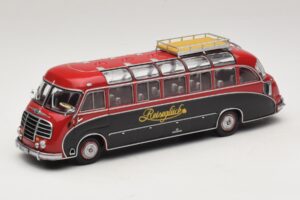
Setra S8 Reisegluck Minichamps 1:43
Price:
85.00 €
Setra took its name from the German word for self-supporting, and the manufacturer’s frameless coach construction produced a lower, more streamlined touring bus than most mid-century competitors could match. This collection’s 1:43 diecast Setra coaches, filed under Special and Unique Models and built by Minichamps, bring that distinctive silhouette to a shelf where commercial vehicle collectors can display it alongside heavy trucks and service vehicles from the same reconstruction decade.
TL;DR: Setra bus models in this collection are 1:43 diecast pieces from Minichamps, reproducing 1950s touring coaches from the German manufacturer widely credited with introducing self-supporting, frameless bus body construction. Filed under Special and Unique Models, the scale preserves the coach's long glazed profile and low, streamlined roofline that set it apart from ordinary buses.
Setra earned its name from the German word for self-supporting, a construction method the manufacturer became closely associated with when it did away with the separate chassis frame most buses relied on. This collection's Setra models, filed within a Special and Unique Models class rather than a standard bus category, reproduce that 1950s touring coach in 1:43 diecast from Minichamps. The result is a scale profile as distinctive as the real coach's low, glazed silhouette.
Setra bus models occupy an unusual place in this catalog: filed among Special and Unique Models rather than grouped with ordinary commercial buses, a classification that reflects how distinctive the marque's engineering approach was compared to typical mid-century coachwork. A self-supporting body construction meant the coach's exterior panels carried structural load themselves, eliminating the heavy separate frame most contemporary buses depended on, and that engineering choice produced a lower, sleeker profile than a conventionally framed bus of the same era could achieve.
At 1:43, a Setra touring coach running perhaps 10 to 11 meters in full size shrinks to a model around 23 to 26 centimeters long, among the largest single pieces a commercial vehicle collector is likely to display, with a long run of side glazing that needs to read clean and continuous rather than broken into visibly separate window units. Minichamps produces this collection's Setra lineup, working at a tier generally recognized for careful tampo printing and tight glazing fit, both qualities that matter more on a coach than on almost any other commercial vehicle type.
The name Setra comes directly from the German phrase for self-supporting, selbsttragend, and the manufacturer is widely credited with bringing that frameless construction method to touring coach design during the early 1950s. Rather than building a bus body onto a separate ladder chassis, Setra's approach let the body's own steel structure bear the load, a method that reduced weight, lowered the floor, and allowed a longer, uninterrupted window line than a framed bus of the same period could offer.
That engineering decision shaped the coach's entire appearance, and it is why 1950s Setra models look distinctly different from contemporaneous buses built by competitors still working with separate chassis frames. The lower, more streamlined profile that resulted became closely associated with the brand's identity for decades afterward, well beyond the specific models this collection reproduces. For a collector, understanding that construction story explains why a Setra coach's silhouette reads as more modern and integrated than a same-era truck-chassis bus, even though both vehicles come from the same general decade of postwar reconstruction-era manufacturing.
A touring coach lives or dies on its glazing and roofline, since that long run of windows is the single most visible feature on the real vehicle and the hardest for a diecast model to reproduce convincingly. Before adding a Setra model to a shelf, check:
Minichamps generally handles this glazing challenge well within its commercial vehicle line, and the tier this collection sits in reflects that: above mass-market pricing, built for a collector who will notice if the window line breaks or the roofline reads as too boxy for a self-supporting design. A coach with a compromised glazing run loses much of what makes the Setra shape distinctive in the first place.
A coach body presents a different construction challenge than a truck or a passenger car, mostly because of scale and glazing area. Diecast's structural rigidity supports the coach's long, unbroken roofline without the sag or flex a lighter material might show over a run of ten or eleven meters at full size, and the metal shell's weight gives the model genuine heft appropriate to a vehicle of that length.
The trade-off shows most in the glazing itself. Diecast construction typically uses separate glazing inserts along the window line, and how cleanly those inserts sit flush against the body determines whether the coach's signature continuous window run reads as intended or breaks into visibly separate panes. Casting tolerances that run slightly wider than resin allows can widen that visual break marginally, a trade collectors accept for the durability and accessible pricing diecast offers over a hand-built resin equivalent. Whether a specific model's luggage doors or entrance steps articulate is a detail that varies by product and belongs on the individual listing.
A Setra coach works well as the anchor piece of a themed 1950s transportation display, since its distinctive self-supporting silhouette contrasts clearly against framed buses, heavy trucks, or passenger cars from the same reconstruction decade. Where a hauling truck reads as pure utility, a touring coach reads as postwar mobility and leisure travel returning to a rebuilding country, a different but equally real facet of the era.
Given the collection currently centers on Special and Unique Models from a single manufacturer, collectors drawn specifically to Setra have room to expand within the marque's broader model range over time rather than exhausting the category quickly. That breadth also rewards patience: a coach's long production life within Setra's range means new subjects can surface in a collection over time without disrupting an established display theme. Pairing a Setra coach with other 1950s commercial vehicles, whether heavy trucks or service vehicles from the same decade, builds a display that tells a fuller industrial and social story than any single vehicle class could manage alone.
A coach's long glazing run is its most vulnerable feature on display, more exposed to dust settling into window seams than a truck's flatter cab surfaces. A soft brush or a burst of clean air clears that dust without the risk a cloth carries of catching on delicate window trim or roof-mounted vents.
Sunlight fades a coach's livery paint and yellows its extensive glazing faster than it affects a smaller-windowed vehicle, simply because there is more painted and glazed surface exposed to UV at once. Positioning the model away from direct light protects both the paint and the clarity of that signature window run. Given the coach's length at 1:43, roughly 23 to 26 centimeters, shelf spacing needs slightly more allowance than a standard passenger car requires, both for physical fit and so the long profile reads clearly rather than crowding against neighboring models. A glass-fronted cabinet suits a coach particularly well, protecting the glazing from dust while still letting the low, streamlined roofline read clearly under display lighting.
Setra's self-supporting body construction, without a separate chassis frame, produced a lower and more distinctive silhouette than typical framed buses of the same era. This collection reflects that engineering distinction by grouping the marque separately from ordinary commercial buses.
It means the body's own structure bears the load rather than a separate frame, producing a lower floor and a longer, more continuous window line. In 1:43, that shows as an unbroken glazing run and a lower roofline than a conventionally framed coach would carry.
Diecast typically uses separate glazing inserts along the window line, and how flush they sit determines whether the coach's signature continuous window run reads cleanly. Slightly wider casting tolerances than resin can leave a marginally more visible seam, a trade-off for diecast's durability and accessible pricing.
A Setra coach anchors a 1950s transportation theme well alongside heavy trucks or service vehicles from the same decade, contrasting pure utility against postwar leisure travel. The combination tells a fuller story of the era's mobility than any single vehicle class alone.