Used

This model is currently sold out. Enter your email and we'll let you know when it's back in stock.
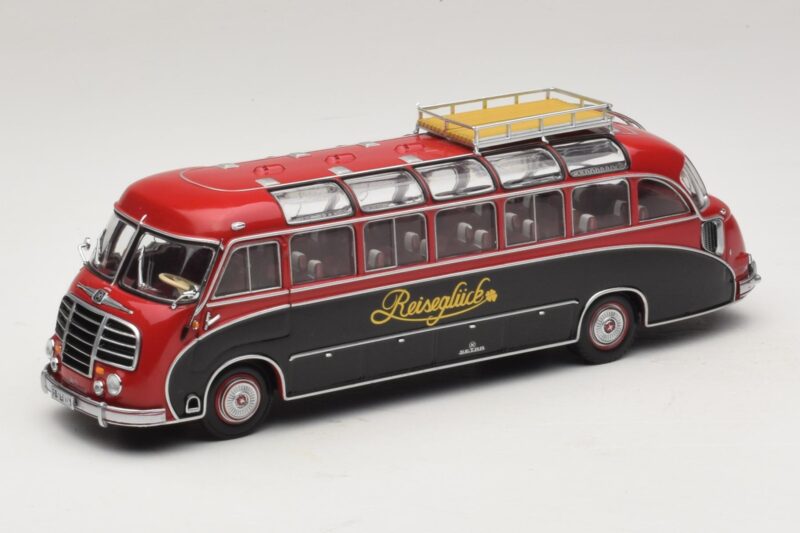
TL;DR: Minichamps' 1:43 Setra S8 reproduces the 1951 coach that introduced the self-supporting bus body Setra's name literally describes, a genuine milestone in commercial vehicle engineering. This 'Reisegluck'-liveried example is a sealed-body diecast with tampo-printed lettering and rounded, period-correct coachwork, sized for a compact transportation-history display.
Setra's name comes directly from the German phrase for self-supporting, and the S8 is the car that earned it: the coach that did away with a separate chassis and built its strength into the body itself. This 1:43 diecast reproduces that specific milestone vehicle in its Reisegluck livery, a rare commercial-vehicle subject among the sports and touring cars that dominate most diecast catalogs.
The S8 arrives as a sealed, one-piece diecast body, and for a coach defined by its unified, chassis-free structure, that construction choice suits the subject unusually well: the real bus itself had no separate frame to visually distinguish from its body, and a single casting captures that integrated character. Minichamps molds the rounded roofline, the period-correct window band, and the front grille and headlamp cluster directly into the shell, holding the S8's distinctively smooth, bulbous 1950s coach styling without the panel breaks a hinged door or luggage bay would introduce. The 'Reisegluck' lettering is tampo-printed onto the flank, sitting flush against the body's curvature.
Given the vehicle's considerable real-world length, Minichamps must compress substantial proportions into a 1:43 footprint, and the model holds those proportions credibly, with the window band spacing and roofline curve reading correctly against the coach's actual dimensions. Zinc alloy construction gives the piece real heft despite its length, and the paint finish carries even coverage without the streaking a rushed finish would show. Wheel and tire proportions are simplified relative to what a full-size coach requires, an acceptable trade-off given the scale, and the overall impression favors correct silhouette and livery accuracy over interior seating detail invisible through the small windows anyway.
The Setra S8, introduced in 1951, holds a genuinely significant place in commercial vehicle history as the first bus built with a self-supporting body, meaning the body structure itself carried the vehicle's load rather than relying on a separate ladder-frame chassis underneath, as virtually every bus before it had done. That engineering shift, which gave the company its very name, reduced weight, improved rigidity, and set the template that Setra and much of the broader European coach industry would follow for decades afterward.
The 'Reisegluck' name on this particular example, translating roughly to travel happiness on the road, points to the kind of touring and excursion coach service the S8 was built to serve, carrying passengers on long-distance leisure trips across postwar Germany. For a collector, the S8 offers something genuinely different from the sports cars and racing liveries that fill most diecast catalogs: a documented piece of engineering history arguably more consequential to how buses are built today than any single passenger car model from the same decade.
At 1:43, the S8's considerable real-world length translates into a genuinely substantial diecast footprint relative to passenger car models at the same scale, worth accounting for when planning shelf space. It stands apart from typical sports car and sedan diecast, offering a commercial-vehicle anchor for a transportation-history display or a broader collection built around European industrial design milestones. The sealed diecast body and tampo-printed livery will hold their finish reliably over years of display. Collectors interested in engineering firsts, rather than only racing results or celebrity vehicles, will find the S8 a genuinely rewarding subject to research further.