Used
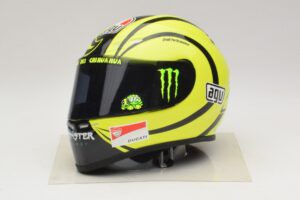
AGV Helmet V. Rossi MotoGP Valencia Test 2009 Minichamps 1:2
Price:
179.00 €
This 1:2 collection holds half-size diecast helmet replicas from Minichamps, drawn from MotoGP and motorcycle racing in the 2000s and finished in AGV designs. At this scale the shell shape, visor area, and paint graphics become the whole subject, which makes each piece a compact desk or shelf centerpiece for racing fans.
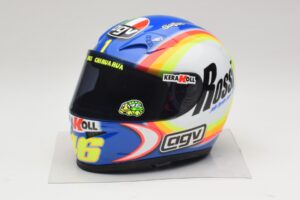
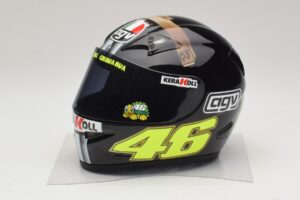

TL;DR: 1:2 scale models in this collection are half-size diecast replicas of MotoGP and motorcycle racing helmets, made by Minichamps in AGV designs from the 2000s. At roughly six inches front to back, each piece is a shelf-top display object, not a vehicle, so judging comes down to shell shape, paint depth, and graphics sharpness.
1:2 scale models change the character of a collection more sharply than any neighboring ratio. Half the size of the real object puts a helmet replica at the edge of what a shelf model can be: large enough to read paint depth and graphic edges from a few feet away, small enough to live on a desk. This page covers the scale itself, the diecast build, and how to plan a display around it.
Half size is a different proposition from the usual collecting ratios. A 1:18 car and a 1:43 car both shrink a vehicle until it fits a shelf; a 1:2 helmet shrinks an object that was already hand-sized. A real full-face helmet runs about a foot front to back, so the replica lands near six inches. That is large enough for the curve of the shell, the seam where visor area meets shell, and the edge of each painted graphic to register at normal viewing distance.
It also changes how the pieces behave on a shelf. A helmet is a compact, rounded form, so a 1:2 piece takes less footprint than a 1:18 car yet stands taller and reads heavier. Collectors tend to treat these as individual statement pieces rather than a lineup. One helmet at a shelf end is a focal point; a row of them becomes a gallery of racing graphics. With no wheels or body panels to compare, finish quality carries the whole impression.
This collection centers on one manufacturer, one marque, and one racing world. Minichamps supplies the diecast pieces, AGV is the helmet brand reproduced, and the subject area is MotoGP and motorcycle racing, with the designs belonging to the 2000s. That decade matters to collectors because race graphics were bold and high-contrast, and riders used custom paint schemes to signal identity from the grid to the podium. A helmet is the most personal piece of a racer's kit, which is why replicas make a coherent theme on their own.
The page describes what is here, not everything either name has ever produced. Neither Minichamps nor AGV is defined by this collection alone, and AGV is one helmet brand among several in racing. Within the assortment, the useful comparisons are between designs: how a graphic is laid out, how colors separate, and how cleanly lettering and sponsor marks are printed.
Diecast brings mass. At half size a metal-bodied piece has real heft, and that weight reads as solidity when it comes out of the packaging. The metal shell also tolerates handling and the occasional bump better than a lighter, more brittle resin body would, which matters for an object collectors want to pick up and turn. Paint on a hard metal shell tends to look deep and even under a lamp, and it holds a gloss that suits a racing helmet.
The trade-offs are modest. Casting tolerances run a little wider than resin allows, so very fine edges, such as thin trim or small vent detail, can come out a shade softer than hand-finished resin manages. Resin is lighter in the hand, crisper at the edges, and more fragile. Neither material is better as such. For a piece that sits within reach on a desk, diecast durability is a practical advantage; for a sealed cabinet, resin edge crispness may matter more. Visor, vent, and accessory detail varies from model to model, so check each product card.
Judging a helmet works differently from judging a car, because there are no wheels, glass panes, or badges to anchor the comparison. Start with the shell: the silhouette should be smooth and symmetrical from the front, with a believable chin bar and rear contour. Then work through the checkpoints:
Compare left and right sides, since symmetry errors on a rounded form show immediately. A raking light reveals any waviness in the paint. These checks apply at every price tier, and they let a collector place an unfamiliar helmet without leaning on a name.
A 1:2 helmet wants a base and some breathing room. Because the shell is round, it can roll or tip on a shelf lip, so a stand or a shelf with a slight rim keeps it stable. Allow several inches of clearance on each side so the silhouette reads cleanly, and set the piece at eye level or a touch below, where graphics face the viewer directly.
Light matters more here than on a car. Glossy paint on a large curved surface throws strong reflections, so a soft, indirect source flatters it, while a bare spotlight creates a glare patch that hides the graphics. Direct sunlight fades paint and yellows clear parts over time, so a window shelf is a poor home. Dust settles on the crown and in seams; a soft brush clears it without scratching the gloss. A glass-fronted case protects the finish and cuts cleaning to a minimum, worth considering for any piece you value.
Because 1:2 helmets are individual statement pieces, the collecting logic is selective rather than completist. Most collectors pick a thread and hold to it: one racing discipline, one season, or one helmet brand across several designs. A shelf built inside the 2000s MotoGP theme can tell a clear story from a handful of pieces, since each helmet already carries its own graphic identity.
A dual-scale approach works well too. Smaller-scale motorcycle models document the machines and the grid in breadth, while a few half-size helmets supply close-up personality pieces that anchor the display. The helmet shows what the rider wore, the small bike shows what the rider rode, and the pairing makes a themed shelf read as a deliberate narrative. Start with one piece that has personal meaning, live with it for a while, and let the display, not an urge to fill space, decide what comes next.
Half the size of the real thing, so roughly six inches front to back for a full-face helmet. That is a compact footprint compared with a 1:18 car, yet tall enough to command a shelf. Exact dimensions vary from piece to piece, so check each product card.
Diecast adds weight and handling toughness. The metal shell feels solid in the hand and carries a deep gloss, while very fine trim can read slightly softer than resin allows. It suits pieces collectors want to pick up and turn, though detailing differs from model to model.
Use a stable stand or a shelf with a small rim, soft indirect light, and a few inches of clearance on each side. Keep it out of direct sun, which fades paint, and brush dust away regularly. A glass case reduces cleaning and protects the gloss.
Start with a single design that connects to you, then judge it against the fidelity checkpoints: shell symmetry, paint separation, and graphics sharpness. Living with one piece shows whether half-size display suits your space before you build a theme around the scale.