Volkswagen Golf GTI Mk8 Blue Norev 1:18
Price:
115.00 €
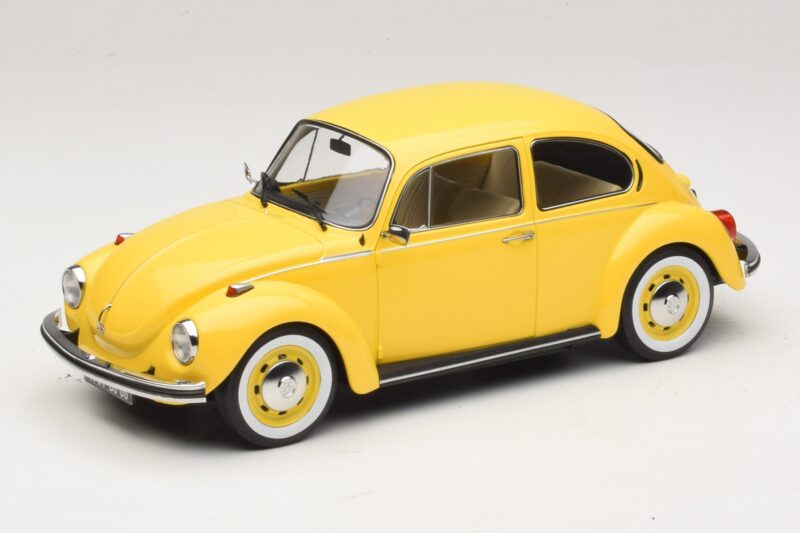
TL;DR: Norev's 1:18 diecast Volkswagen 1303 reproduces the curved-windshield Beetle in Pastel Yellow, a 1973 variant that changed the model's front-end proportions more than any update since its original design. Cast as a sealed one-piece body, the model keeps rounded panel lines continuous across a genuinely distinct Beetle silhouette.
The 1303 looks like a Beetle from a distance but reveals real engineering changes up close, starting with a curved windshield that altered the car's entire front-end proportion compared to the flat-glass Beetles that came before it. Norev's 1:18 diecast wears that shape in Pastel Yellow, cast as a sealed body that keeps the rounded lines uninterrupted.
Volkswagen introduced the 1303 designation in 1970 to mark a Beetle variant built around a curved windshield, replacing the flat glass used since the car's original design decades earlier, a change that required a reshaped dashboard and a more rounded front hood to accommodate the new glass's geometry. The result gave the 1303 a noticeably different face from the classic Beetle silhouette most people picture, with a fuller, more bulbous front end that also improved interior space and visibility. Underneath, Volkswagen paired the new front-end design with a MacPherson strut front suspension, a genuine mechanical upgrade over the earlier torsion-bar setup that improved ride quality on a car whose basic engineering had otherwise changed little since the 1930s.
The Beetle's continuous, rounded surfaces reward a casting process that can hold curves without interruption, and Norev's sealed one-piece diecast body delivers exactly that. With no hinge tolerances to plan around, the shutlines along the doors and rear engine lid run as clean, continuous grooves rather than gaps that shift with an opening panel, letting the 1303's rounded fenders and curved windshield frame read as one unbroken form. Diecast's zinc alloy construction adds real weight in the hand, a density that signals durable build quality well suited to a shape defined almost entirely by smooth, flowing surfaces rather than sharp panel breaks.
Pastel Yellow belongs to a family of cheerful, muted factory colors Volkswagen offered widely across the Beetle range in the early 1970s, a palette that matched the car's growing identity as an affordable, approachable everyday vehicle rather than a status symbol. Diecast handles the shade well: paint sits on a hard metal shell, letting the yellow hold a soft, even gloss across the Beetle's rounded panels without appearing washed out under display lighting. Against chrome bumpers and black trim typical of the era, the pastel tone gives the model the same friendly, unpretentious character the real car built its reputation on.
At 1:18, the 1303 comes out to roughly 22 centimeters long, a compact footprint that suits a dense display of small classic cars without demanding much shelf space. It pairs naturally with earlier flat-windshield Beetles, letting a collector show the visual evolution of one of the most recognizable car shapes in automotive history side by side. The sealed body construction keeps the piece low-maintenance to handle, with rounded lines that photograph cleanly from any angle without an access point breaking the continuous curves.
No. The body is a sealed, one-piece diecast casting. The 1303's rounded shape is captured entirely through continuous panel lines and paint finish rather than an opening feature.
The 1303 introduced a curved windshield in place of the earlier flat glass, requiring a reshaped, more rounded front end and dashboard, along with a MacPherson strut front suspension upgrade.
Volkswagen introduced the 1303 designation in 1970, and this model reproduces a 1973 example finished in Pastel Yellow, one of the cheerful colors offered during that production period.
The 1303 measures approximately 22 centimeters long at 1:18, a compact footprint well suited to a dense shelf display of small classic cars from the same era.

You save 36.00 €
Lowest price in the 30 days before the reduction: 180.00 €
You save 36.00 €
Lowest price in the 30 days before the reduction: 180.00 €