Volkswagen Golf GTI Mk8 Blue Norev 1:18
Price:
115.00 €
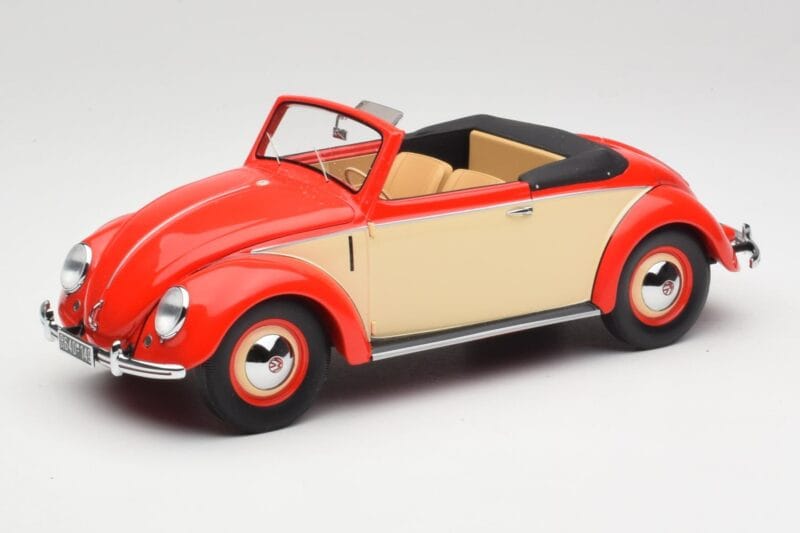
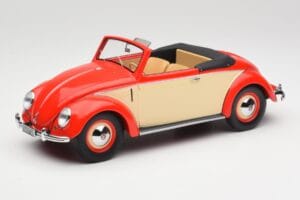
TL;DR: Minichamps' 1:18 resin Volkswagen Beetle Hebmuller convertible reproduces the rare two-seat cabriolet German coachbuilder Hebmuller built on the Beetle platform starting in 1949, before a factory fire sharply curtailed production. Finished in red and cream, the sealed resin body captures the folding top's compound curves with sharper lines than a diecast casting could manage.
Hebmuller wasn't a household name even in its own era, a small coachbuilder that saw an opportunity in the Beetle platform and built one of the few genuinely open-top versions of it before fate intervened. Minichamps renders that story in sealed resin, a material choice that suits this car's rounded convertible lines particularly well.
Hebmuller & Sohn began building a two-seat cabriolet version of the Volkswagen Beetle in 1949, cutting the roof away and reinforcing the structure to create an open car quite different in character from the four-seat Beetle sedan most buyers knew. Production had barely started when a fire tore through the Hebmuller works in the summer of 1949, destroying tooling and severely limiting how many of these cabriolets the company could ever build. What followed was a small, scarce run that continued in reduced form for a few more years, making surviving Hebmuller Beetles some of the most sought-after variants in the entire Type 1 family today.
A convertible body lives or dies on the tightness of its beltline and the crispness of its folded-top silhouette, details that a sealed resin casting can render with sharper edges than diecast tooling built around opening panels typically allows. Minichamps uses that advantage here, and the result is a body with clean, consistent lines along the door tops and windshield frame, the areas where a lesser casting tends to show soft or uneven edges. The trade is straightforward: no opening doors on this piece, in exchange for a body that reads correctly from every angle.
The red and cream combination Minichamps applies here is a classic period-style two-tone, the kind of pairing coachbuilders often used to visually separate the body from the beltline and give an open car a lighter, more festive look than a single-color sedan ever managed. The color break sits cleanly along the waistline, with no bleed between the cream upper section and the red lower body, and the interior continues the theme with upholstery tones that complement rather than clash with the exterior scheme. Because the body is sealed resin rather than diecast, Minichamps can hold tighter tolerances around the windshield frame and the folded soft-top shape behind the seats, areas that on a lesser convertible replica often look thick or approximate. Lifted from its base, the model is noticeably lighter than a diecast piece of the same size, a trait resin collectors learn to expect and one with no bearing on how finished the piece looks sitting on a shelf.
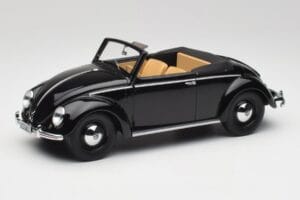
Minichamps also produces this same Hebmuller convertible in diecast, finished in black rather than red and cream, and setting the two side by side is a genuine lesson in what each material trades away. The diecast version can open its doors; this resin version cannot, but its body holds sharper, more consistent lines along the top edge and beltline than the diecast casting achieves. Neither is the objectively better choice: a collector who wants to handle and interact with the model should look to the diecast sibling, while a collector chasing display-quality precision should reach for this one.
At roughly 19 to 20 centimeters given the Beetle's genuinely compact real-world footprint, this model takes up modest shelf space, leaving room to build out a broader Volkswagen display without a single subject dominating the row. Paired with a standard Beetle sedan of the same era, the Hebmuller tells the more interesting half of the story: proof that even Volkswagen's most utilitarian design attracted coachbuilders willing to reimagine it as something closer to a boulevard cruiser.