Volkswagen Golf GTI Mk8 Blue Norev 1:18
Price:
115.00 €
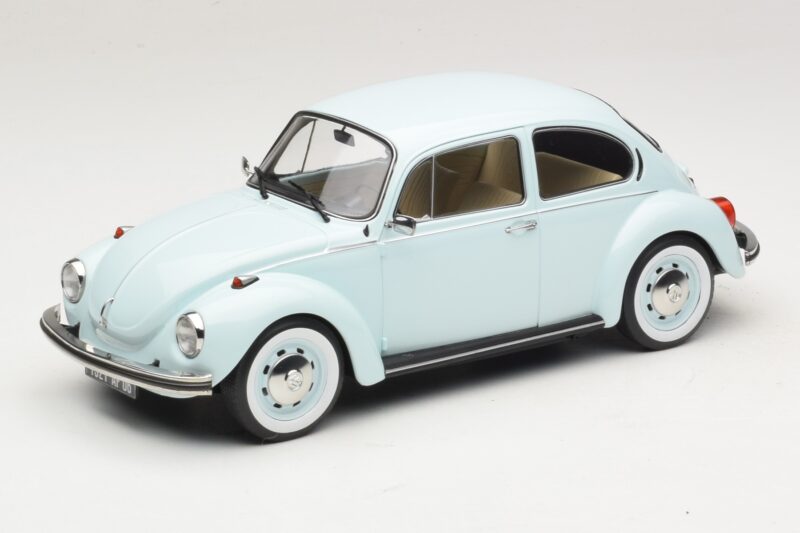
TL;DR: Norev's 1:18 diecast Volkswagen 1303 reproduces the curved-windshield Beetle in Pastel Blue, a 1973 variant whose reshaped front end and MacPherson strut suspension marked a genuine engineering update. Cast as a sealed one-piece body, the model keeps its rounded panel lines continuous in a soft, nostalgic factory shade.
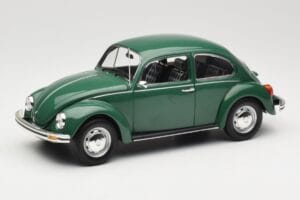
Pastel Blue carries the same quiet, road-trip nostalgia that has attached itself to the Beetle across decades of popular culture, and Norev's 1:18 diecast pairs the color with the 1303, a variant whose curved windshield genuinely changed the classic Beetle shape rather than simply updating its trim.
Volkswagen introduced the 1303 in 1970 around a curved windshield that replaced the flat glass used since the Beetle's earliest design, a change that forced a reshaped dashboard and a fuller, more rounded front hood to accommodate the new glass geometry. The resulting nose looks distinctly different from the flat-fronted Beetles most people picture, with more interior space and improved forward visibility as practical benefits alongside the styling change. Volkswagen paired the new front end with a MacPherson strut front suspension, replacing the older torsion-bar setup and delivering a genuine ride quality improvement on a platform whose fundamentals dated back decades. The 1303 represents one of the most substantial updates the Beetle received during its extraordinarily long production run.
The Beetle's continuous, bulbous surfaces are exactly the kind of shape a sealed casting handles best, since there are no straight panel breaks to interrupt the flow of curves from the front fenders back to the rear engine lid. Norev builds this model as a one-piece diecast body, meaning no hinge tolerances need to be accommodated and the shutlines along the doors run as clean, continuous grooves rather than gaps that shift with a moving panel. The zinc alloy construction gives the model genuine weight in the hand, a quality that reflects well on a shape whose appeal has always rested on smooth, uninterrupted surfaces rather than sharp creases.
Soft pastel colors like this blue were a common choice across Volkswagen's Beetle range in the early 1970s, matching the car's reputation as an affordable, unpretentious vehicle built for everyday use rather than status. Diecast supports the shade well: paint sits on a hard metal shell, letting the blue hold an even, gentle gloss across the Beetle's rounded panels without looking flat or washed out under display lighting. Set against chrome bumpers and black trim typical of the period, the pastel tone reinforces the same approachable character that made the Beetle a fixture of road-trip and everyday-car culture across multiple generations of owners.
At 1:18, the 1303 measures roughly 22 centimeters long, a compact footprint that suits a dense shelf display without demanding much space. Pastel Blue pairs naturally with other 1303 colorways or with earlier flat-windshield Beetles, letting a collector trace the model's visual evolution across its decades-long production run. The sealed body construction keeps handling simple, with rounded lines that photograph cleanly from any angle since there is no access point to interrupt the continuous curves.
No. The body is a sealed, one-piece diecast casting. The 1303's rounded shape is captured entirely through continuous panel lines and paint finish, without an opening feature.
The 1303 introduced a curved windshield with a reshaped front end and dashboard, along with a MacPherson strut front suspension that replaced the earlier torsion-bar design for improved ride quality.
The curved windshield required a fuller, more rounded hood shape to accommodate its geometry, giving the 1303 a distinctly bulbous nose compared to the flat-glass Beetles built before 1970.
The 1303 measures approximately 22 centimeters long at 1:18, a compact footprint well suited to a dense display of small classic cars from the same era.

You save 36.00 €
Lowest price in the 30 days before the reduction: 180.00 €
You save 36.00 €
Lowest price in the 30 days before the reduction: 180.00 €