BMW X6M F86 Red Norev 1:18
Price:
94.00 €
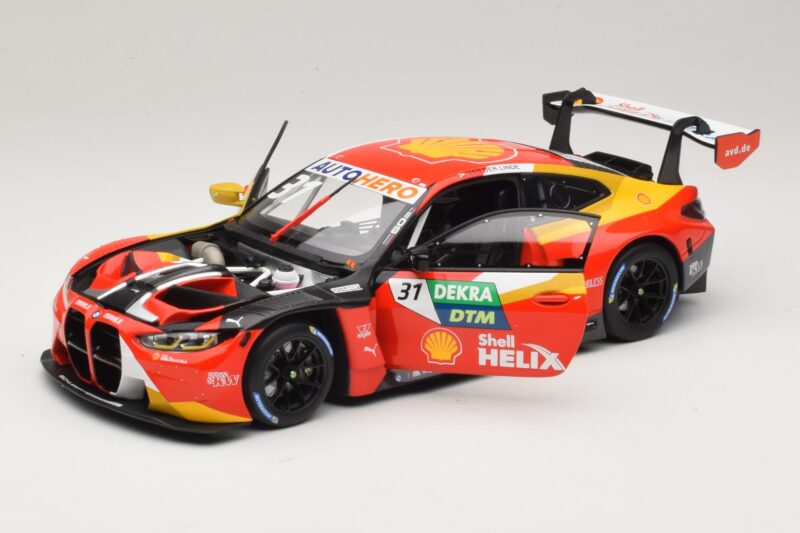
TL;DR: Minichamps' 1:18 diecast BMW M4 GT3 reproduces car #31, Schubert Motorsport's winning entry for Sheldon van der Linde at the Lausitzring round of the 2022 DTM season. Opening doors and hood reveal cast cage and engine detail, and the printed sponsor livery marks a specific race result rather than a generic GT3 build.
DTM abandoned its own bespoke chassis rules for 2021, opening the grid to GT3 machinery already racing worldwide. That shift let a team like Schubert Motorsport, long tied to BMW's works program, campaign a car built for global GT3 competition rather than a series-specific prototype, and this Lausitzring winner is one product of that changeover.
DTM ran its own turbocharged Class One prototypes through 2020, a formula that grew too expensive for manufacturers to sustain alongside their global GT3 programs. The series switched to GT3 cars for 2021, folding DTM into the same rulebook already used at Spa, the Nürburgring 24 Hours and dozens of other GT3 grids worldwide. That decision let long-running German teams keep competing without funding a bespoke chassis, and it opened DTM to a wider field of manufacturers building GT3 cars rather than the smaller group able to justify a DTM-specific program.
Schubert Motorsport has fielded BMW cars in DTM for well over a decade, one of the manufacturer's most consistent partner teams through several regulation changes. Car #31 carried Sheldon van der Linde at the Lausitzring round of the 2022 season, a South African driver who built his DTM career largely inside BMW's junior and works programs. A win at that round is the specific result this livery documents, distinct from the generic factory colors Minichamps might apply to a car that never crossed a finish line first. That distinction, a genuine result tied to a genuine date and circuit, is what separates a race-replica livery from a showroom color option.
The M4 GT3's bodywork carries a deep front splitter, wide flared arches and a fixed rear wing, all shaped to generate the downforce GT3 regulations allow, and Minichamps' casting follows that silhouette rather than softening it toward a road-car profile. Sponsor graphics on a race livery like this are printed rather than simply painted, since a genuine GT3 entry wears dozens of small decals alongside the primary colors, and reproducing that density in miniature is one of the harder jobs a manufacturer takes on with a race-specific tool. Getting the proportions and decal placement right against reference photography from the actual Lausitzring weekend is what separates a documented livery from an approximate one.
Doors on this casting open, exposing a cast representation of the roll cage and stripped-out cockpit a GT3 regulation car carries in place of road-going trim. That interior view matters more on a race subject than a street car, since the safety structure and minimal cabin are part of what defines the category. Diecast construction handles the wider surfaces of a race body confidently, holding the flat splitter and wing edges with the structural rigidity metal provides, at the cost of the slightly wider tolerances a resin casting could hold tighter on smaller details.
At 1:18, the M4 GT3's wide-bodied race proportions come out larger than the fixed-wing width alone suggests, and it commands more shelf depth than a same-scale road car because of how far the splitter and diffuser project beyond the wheel line. That footprint matters when planning cabinet space, particularly if the intent is to build a run of GT3-era liveries across different manufacturers on one shelf, since the wide-body format from BMW, Audi, Mercedes and Porsche GT3 entries all share that same space demand. The bright red and blue Schubert Motorsport colors give this particular entry strong shelf presence against the white or black liveries more common among current GT3 grids, making it a natural focal point rather than a background piece in a themed DTM or GT3 lineup. For collectors building a chronology of DTM's post-2021 GT3 era specifically, a documented race winner carries more long-term interest than an undated factory-color example, since it ties the model to a specific weekend rather than a generic specification sheet.
A win livery is a different proposition than a standard factory color scheme, because it fixes the model to one weekend, one driver and one result rather than leaving it as a generic specification example. That specificity is part of what modern GT3-era DTM collecting rewards, since the series now shares grids and liveries with sports car racing worldwide, and a genuinely documented winner stands out from the broader field of GT3 replicas on the market. Anyone building a Schubert Motorsport or BMW works-program shelf gains a genuine result rather than a placeholder color, and anyone tracking DTM's transition years specifically gets a marker of exactly when and where that transition produced a winner.

You save 28.00 €
Lowest price in the 30 days before the reduction: 142.00 €


You save 38.00 €
Lowest price in the 30 days before the reduction: 189.00 €


You save 16.00 €
Lowest price in the 30 days before the reduction: 123.00 €

You save 22.00 €
Lowest price in the 30 days before the reduction: 109.00 €