Last one
Used

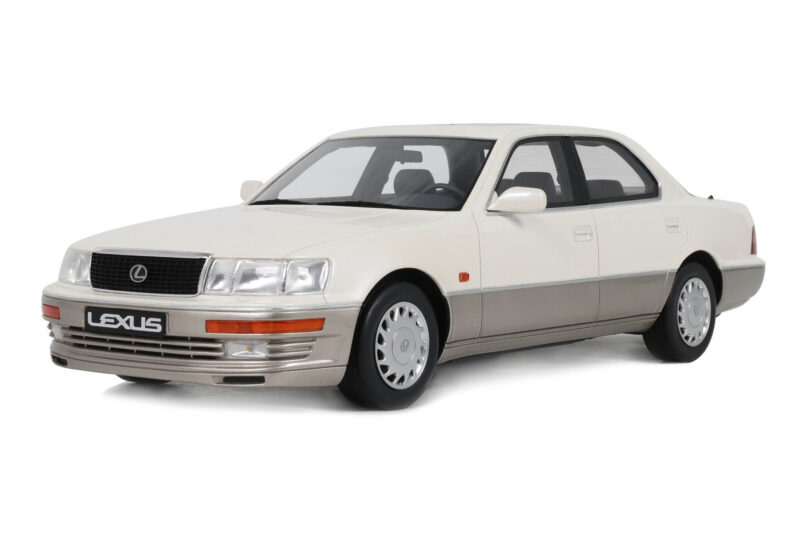
TL;DR: Otto's 1:18 resin Lexus LS400 XF10 reproduces Toyota's 1992 first-generation flagship sedan in Diamond White Pearl, the color long associated with the LS400's understated launch identity. The sealed one-piece body holds tight, consistent panel lines across the sedan's smooth flanks, honoring a car built around engineering restraint rather than visual flash.
When Toyota launched Lexus in 1989, the LS400 carried an entirely new brand's reputation, and the company tested prototypes more exhaustively than nearly any production car before it, chasing quietness and reliability the established German luxury makers hadn't prioritized. This 1992 example, finished in Diamond White Pearl, represents the car that first convinced skeptical American buyers to take a Japanese flagship seriously.
Toyota's development team for the LS400 reportedly logged extraordinary mileage across prototypes in punishing conditions worldwide before signing off on the design, an approach closer to how a company proves a new engine platform than how most manufacturers validate a trim-level luxury sedan. The result was a car whose V8 ran with a smoothness and interior quietness that rival luxury sedans of the era struggled to match, achieved not through radical engineering but through relentless attention to tolerances, sound damping, and build consistency. That obsessive, almost paranoid approach to refinement became the founding identity of the entire Lexus brand, and the XF10 is the car that had to prove it worked.
Part of what made the LS400's launch such a genuine disruption was price: Toyota positioned it well below comparable Mercedes-Benz and BMW flagships while matching or exceeding their refinement, a combination the established German makers hadn't faced from an Asian manufacturer before. Skeptical buyers who test-drove one often became converts once they experienced the near-silent cabin and effortless V8 power delivery. That underdog positioning, a new brand proving itself against decades of luxury pedigree through sheer engineering discipline, gives the LS400 a genuine significance beyond just being an old Toyota-built sedan.
The LS400's design deliberately avoided sharp creases or aggressive character lines, favoring a smooth, understated shape that let the engineering underneath do the talking rather than the styling. That restraint actually raises the bar for a scale reproduction, since there's little ornamentation to distract from an uneven surface or an inconsistent shutline. Otto's sealed one-piece resin body suits this shape well, holding continuous, even panel lines along the doors and trunk without a single hinge gap to interrupt the sedan's quiet, unbroken profile, the same understated confidence the real car projected on the road.
Diamond White Pearl carries a subtle multi-layer depth that a flat white paint can't replicate, showing a faint shimmer as light moves across the hood and roof rather than a single uniform tone. On this resin casting, that pearl effect reads clearly under a directed lamp, catching differently along the sedan's rounded shoulder line than on the flatter door panels. It's a fitting color choice for a car whose entire appeal rested on subtlety rewarding a closer look rather than announcing itself from a distance.
The LS400 rarely gets the attention that era-defining sports cars or racing legends receive, but its importance to the luxury sedan segment is hard to overstate. Displayed next to a contemporary Mercedes W140 S-Class or a BMW E32 7 Series, the LS400 tells the story of how quickly the established order had to respond to a genuine outside challenger, since both German makers accelerated their own refinement programs partly in response to what Lexus proved was possible. For a collector building an ultra-luxury sedan theme across manufacturers and decades, the XF10 is close to a mandatory inclusion, the car that changed what buyers expected a luxury sedan to deliver at a given price point. Otto's resin format keeps it consistent in scale and finish quality with the German rivals it's most interesting displayed alongside, so the comparison reads as a fair one rather than a mismatch.
The LS400 doesn't announce its importance the way a supercar or a rally car does, and that understatement is exactly the point. Otto's resin execution matches that restraint, a sealed body with smooth, consistent lines and a pearl finish that reveals its depth only under close inspection, precisely mirroring how the real car earned respect through experience rather than first impressions. For a collector focused on the history of the luxury segment, this is a genuinely important piece, the car that forced Mercedes-Benz and BMW to take a new competitor seriously.