Last one
You save 5.00 €
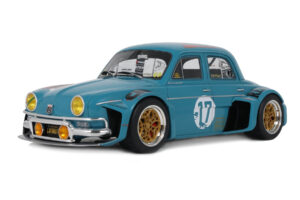
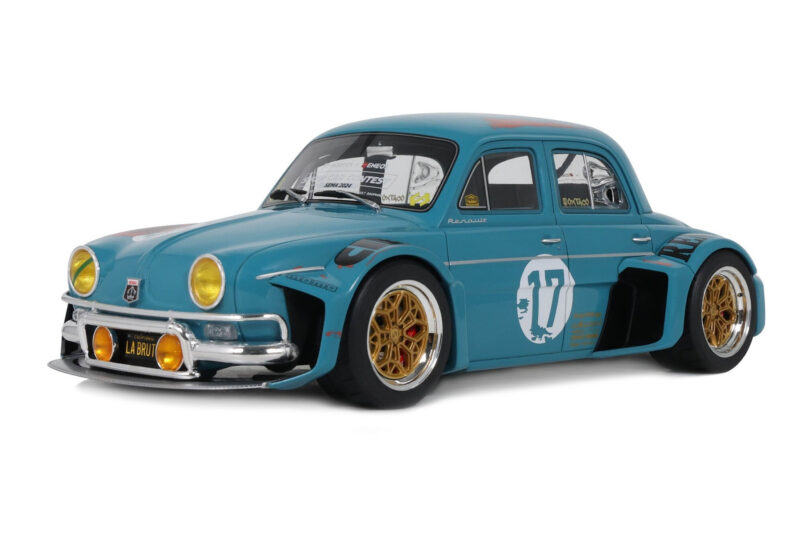
TL;DR: Otto's 1:18 resin Renault Dauphine La Brute reproduces the 2024 SEMA Best of Show patina build, its faded green paint and bare-metal wear rendered on a sealed one-piece body. Rather than a factory-fresh restoration, this piece captures a deliberately aged kustom finish, translating a genuine show-winning build into hand-finished scale form.
The Renault Dauphine was one of France's most successful post-war exports, a small rear-engined sedan that briefly outsold nearly everything else on American roads in the late 1950s before fading from memory. Decades later, a builder took a Dauphine in the opposite direction from restoration, embracing rust, faded green paint, and worn chrome as the finished look, and that patina build earned Best of Show honors at SEMA.
Renault sold more Dauphines in the United States during the late 1950s than almost any other imported car, a genuine surprise given the segment's usual dominance by domestic full-size sedans. Its rear-mounted engine, compact footprint, and fuel efficiency appealed to a slice of American buyers looking for something different, and for a brief window the Dauphine was a common sight on American roads before quality issues and rust problems caught up with its reputation. That combination, a car that sold well and then largely vanished, left the Dauphine as a genuinely rare survivor today, which is part of what makes a surviving example dramatic enough to reimagine as a serious custom build rather than a forgotten footnote.
Rust and faded paint are usually a Dauphine's downfall, the reason so few clean survivors remain, but the La Brute build flips that liability into the entire aesthetic. Rather than stripping the car back to factory specification, the build embraces decades of wear, exposed metal, and a green finish that reads as genuinely weathered rather than freshly painted to look old. That's a harder trick to pull off convincingly than a full restoration, since faked patina tends to look artificial next to the real thing, and getting it recognized at SEMA suggests the execution held up under expert scrutiny.
Casting a deliberately weathered finish in resin is a different challenge than casting a glossy factory color, since the goal is inconsistency that still reads as intentional rather than sloppy. Otto's sealed one-piece body carries layered tones across the green paint, mottled rust bleeding through at the edges and along panel seams, with the depth resin allows letting each layer sit distinctly rather than blending into a flat wash. The fixed body works in the finish's favor here, since there's no hinge line to interrupt the weathering pattern running across doors and fenders.
The Dauphine's simple, rounded 1950s sedan silhouette gives the patina finish room to be the focus rather than competing with aggressive body lines or modern styling cues. Under direct light, the worn green catches unevenly across the roof and hood in a way a uniform gloss never would, and that inconsistency is exactly the point, each angle revealing slightly different texture. It's a finish built to be studied up close rather than glanced at from across a room, which suits a display piece meant to draw a second look.
Special and unique builds like this one serve a different purpose in a collection than a faithful factory reproduction. Where most models earn their place by accurately representing a specific historical trim or racing livery, La Brute earns its place by being a one-of-a-kind creative statement, the kind of car that exists specifically to be photographed, discussed, and remembered from a single show appearance. Placed next to a stock, clean Dauphine, the contrast tells its own story about how differently two builders can interpret the same 1950s French sedan, one chasing period accuracy and the other chasing pure visual impact. For collectors who follow SEMA and the broader custom-build scene, owning a scale version of an actual award-winning show car carries real weight, since these builds rarely stay on public display for long after the show circuit ends. It also broadens what a themed shelf can include beyond factory-stock and racing liveries, making room for genuine automotive art.
La Brute won't fit every collection, and it isn't trying to. It rewards a buyer who follows custom-car culture and wants a tangible piece of a specific show-winning build rather than a generic patina-style model invented for the catalog. Otto's execution carries the weight of that specificity: a sealed resin body finished with the same layered, deliberately uneven texture the real car wore into SEMA's judging hall, rendered with enough control that the wear reads as art rather than accident. Standing alone, it's simply a distinctive, conversation-starting piece, exactly the role a one-of-a-kind build is meant to play.


You save 57.00 €
Lowest price in the 30 days before the reduction: 189.00 €