Last one
Used
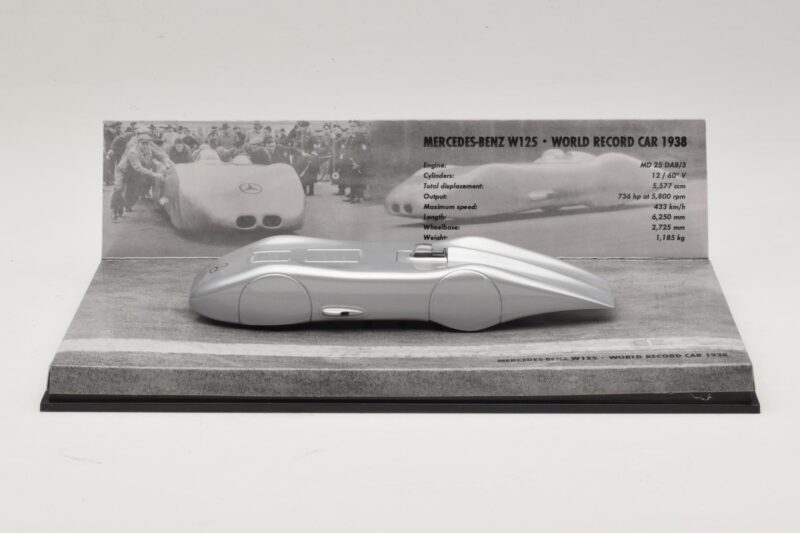
TL;DR: Minichamps' 1:43 diecast Mercedes-Benz W125 Rekordwagen reproduces the fully-enclosed streamliner Rudolf Caracciola drove to a public-road speed record on the Frankfurt-Darmstadt Autobahn in January 1938. The sealed one-piece casting captures its extreme aerodynamic shape, a genuine pre-war milestone for any Silver Arrows collection.
Few cars in this catalog carry a documented top speed attached to their name, and the W125 record car is one of them: 268.9 mph on a closed public highway, a number that still commands respect eight decades later. Minichamps renders that streamlined body at 1:43, small enough to display without the drama a full-size replica would demand.
On January 28, 1938, Rudolf Caracciola drove a specially bodied Mercedes-Benz W125 chassis along a closed stretch of Autobahn between Frankfurt and Darmstadt, reaching 268.9 mph, a speed record for a public road that stood unmatched for decades. The run was part of a Reichsautobahn speed program that pitted Mercedes-Benz against Auto Union, each side building increasingly extreme streamlined bodies over Grand Prix running gear to set the fastest possible mark on ordinary highway pavement rather than a purpose-built track. Caracciola's record became the benchmark against which every subsequent closed-road speed attempt was measured, and it remains one of the defining moments of the pre-war Silver Arrows era.
Underneath the fully enclosed bodywork sat a modified version of the W125 Grand Prix chassis, its supercharged straight-eight engine tuned specifically for sustained top speed rather than cornering agility. The body itself covered the wheels entirely and tapered to a long tail, a shape driven purely by aerodynamics rather than any styling convention of the period, since nothing on the road looked remotely like it. That single-purpose design is what makes the Rekordwagen such a distinct subject next to Mercedes' open-wheel Grand Prix cars from the same years. No comparable closed-road record would fall for decades, and the car's silver paint became inseparable from that specific January morning.
Minichamps casts the Rekordwagen as a single sealed shell, an appropriate choice for a car whose entire purpose was an unbroken aerodynamic surface with nothing to open or interrupt the shape. The casting holds the extended tail and fully enclosed wheel arches without a seam breaking the line, and the low, tapered nose comes through correctly at this scale, distinct from the open-wheel Grand Prix cars Minichamps casts elsewhere in its pre-war range. Zinc alloy gives the small model real weight, appropriate for a subject built entirely around mass moving at extreme speed.
The silver finish reproduces the bare-metal look associated with Mercedes' pre-war racing program, applied with an even sheen rather than a mirror polish that would look anachronistic on a 1938 subject. Panel lines along the tail and cockpit canopy are molded in rather than cut as separate pieces, keeping the surface as continuous as the real record car's was. Small details like the cockpit glazing and the shape of the intake ahead of the windscreen are picked out with enough precision to identify the car immediately as the Rekordwagen rather than a generic streamlined shape. Getting a one-off historic subject like this right depends on period photography rather than surviving production drawings, since the car was built once and never repeated in quite the same form. That kind of research-driven accuracy is part of what separates a specialist pre-war casting from a generic streamliner shape.
The Rekordwagen works best as an anchor piece rather than a starting point, the single most extreme expression of what Mercedes' pre-war engineers were willing to attempt in pursuit of one number. Displayed beside the marque's open-wheel Grand Prix cars from the same years, it shows how far a shared engine and chassis platform could be pushed once cornering stopped mattering at all. At 1:43, a subject this visually distinct earns its shelf space even in a small footprint, standing apart from any Grand Prix car nearby simply by its shape. For a pre-war or land-speed-record themed display, this is a genuine centerpiece rather than a filler entry. Few subjects in the catalog carry this much documented history behind one single day.







You save 16.00 €
Lowest price in the 30 days before the reduction: 123.00 €