Used
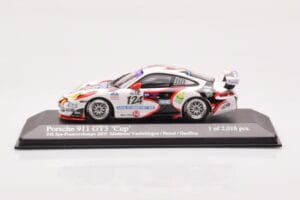
Porsche 911 997 GT3 Cup #124 Mattheus / Geoffroy / Vanbellingen / Fumal 24 Hours of Spa 2005 Minichamps 1:43
Only 3 left
Price:
33.00 €
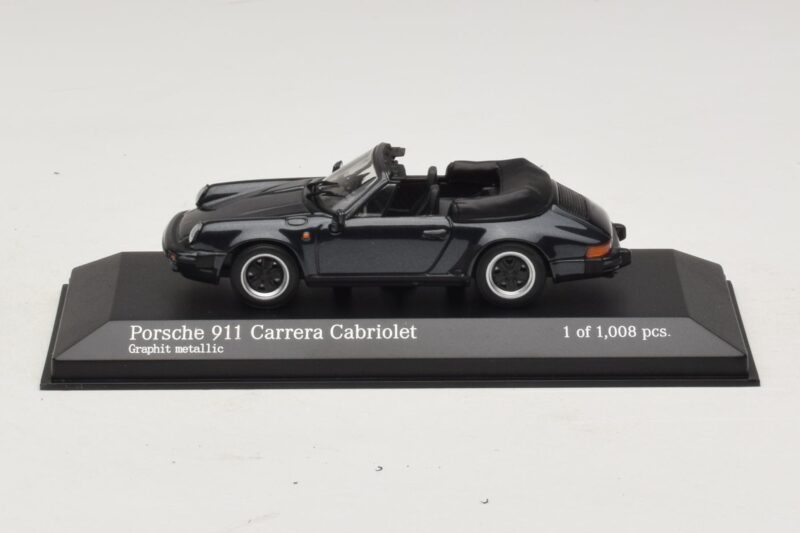
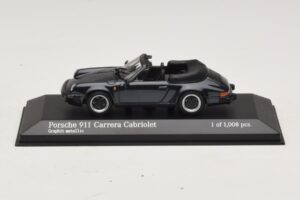
TL;DR: Minichamps' 1:43 diecast Porsche 911 930 Carrera Cabriolet in grey metallic reproduces 1983's first factory 911 soft-top, wide Carrera hips and folded fabric roof cast as a sealed one-piece body, with correct G-series stance and badge detail for collectors tracking Porsche's convertible history.
The 911 went two decades without a proper factory soft-top, and when Porsche finally built one for the 1983 model year, it borrowed the flared hips and wide rear track from the Turbo-look body rather than the narrower standard Carrera. Minichamps casts that combination in 1:43 grey metallic, a color that lets the shape do the talking instead of a loud livery.
Convertible 911s existed before 1983 only as aftermarket conversions or the Targa's partial open-top compromise. The factory Cabriolet, introduced for that model year, used the wider Turbo-derived body shell, complete with the flared rear arches and broader hips that give the car its planted, muscular stance. That widebody treatment is why this cabriolet reads differently from the narrower Carrera coupes of the same period, and Minichamps' casting keeps the arch flares wide enough that the rear tires visually fill them rather than sitting tucked and undersized. The wraparound rear bumper and the correct G-series headlamp height round out a shape that was, at the time, a genuine first for Porsche's flagship model.
The soft top sits closed and lowered behind the seats as molded surface detail rather than a hinged, removable piece, a construction choice that suits a sealed one-piece body. Fold lines in the fabric top trace realistically across the rear deck, and the top's stowed profile does not intrude on the trunk lid's shutline. Keeping the roof mechanism out of the equation lets Minichamps hold a tighter beltline and a cleaner transition between the top's boot cover and the rear fenders than an articulated casting would allow at 1:43. The windshield frame carries correct chrome trim consistent with the era's brightwork.
Grey metallic paint reveals a fine flake structure under direct light that flat colors cannot replicate, and on this casting the metallic effect reads consistent across the hood, doors, and rear deck without patchiness. That evenness comes down to the zinc alloy body underneath, a hard, stable surface that holds paint better than a softer material would over years on a shelf. Lifted from its case, the model carries the weight collectors expect from diecast at this scale, denser than a resin equivalent despite the smaller footprint. Grey metallic also happens to be a period-correct Porsche color, not a generic stand-in, which matters to anyone who has compared factory paint charts against a model.
The Fuchs-style alloy wheels carry the deep-dish, five-spoke pattern associated with 1980s 911s, mounted with the correct offset so the rear track reads properly wide against those flared arches. Window glazing sits flush without gaps at the corners, and the chrome bumper trim, mirror housings, and door handles are picked out with enough contrast to separate cleanly from the grey body color under a display light. Porsche crest badging on the hood and wheel centers is sharp enough to read under a loupe, a small detail that separates a considered diecast from a toy-store equivalent at a glance.
Grey metallic is a versatile choice for a mixed-era 911 shelf, reading as understated next to brighter Turbo or Carrera coupes from the same decade without disappearing into the background. This Cabriolet also fills a specific historical role: it is the model that finally gave Porsche's flagship a proper open-top option, a gap that had persisted since the 911's 1963 debut. Pairing it with a same-era Turbo coupe highlights how much of the Turbo's widebody language filtered down to the drop-top Carrera. At 1:43, the footprint stays modest enough to build a full run of 1980s 911 variants, coupe, Targa, Cabriolet, and Turbo, on one shelf tier without crowding.


You save 16.00 €
Lowest price in the 30 days before the reduction: 123.00 €