Used
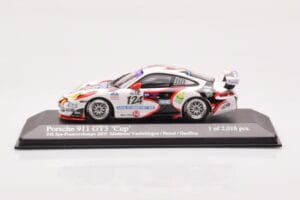
Porsche 911 997 GT3 Cup #124 Mattheus / Geoffroy / Vanbellingen / Fumal 24 Hours of Spa 2005 Minichamps 1:43
Only 3 left
Price:
33.00 €
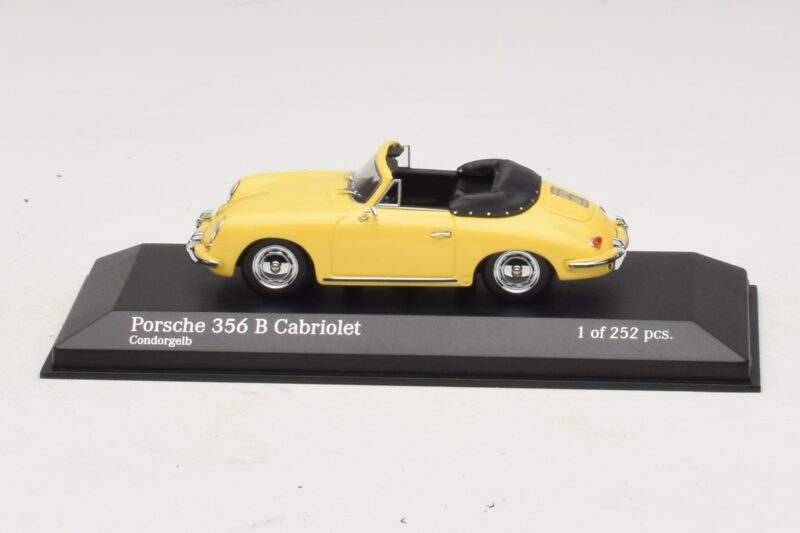
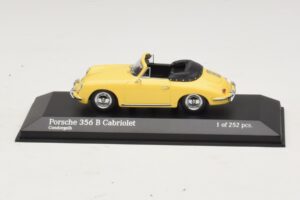
TL;DR: Minichamps' 1:43 diecast Porsche 356 B Cabriolet reproduces the 1960 open-top model in yellow, with a sealed one-piece body holding the era's rounded fenders and correct top-down proportions. Zinc alloy construction brings genuine weight at compact scale. A foundational piece for a Porsche chronology display.
The 356 is where Porsche's sports car identity actually begins, years before the 911 existed, and the B-series update refined the shape without abandoning what made the original work. Minichamps' 1:43 cabriolet captures that mid-cycle Porsche in a cheerful yellow that suits the car's genuinely open, top-down character.
Porsche introduced the 356 in the late 1940s as its first production sports car, and the model stayed in production for roughly two decades through a series of incremental updates. The B-series revision, built from 1959 through 1963, brought a taller windshield, raised headlight positioning, and a revised bumper treatment over the earlier A-series cars. This casting reproduces the cabriolet body style from that B-series window, an open-top variant built on the same rounded, aerodynamically influenced shape that made the 356 distinctive against boxier contemporaries.
The 356's significance to Porsche's later history is hard to overstate: the mechanical layout it established, a rear-mounted engine driving through a compact chassis, carried forward conceptually into the 911. Minichamps' rendering holds the rounded fender line and split-level bumper detail correctly for the B-series specifically, distinguishing it from the earlier A-series or later C-series cars. The yellow finish suits the car's cheerful, top-down character better than a somber color, and it was a genuine period-correct option rather than an invented shade.
This casting's body is a sealed, one-piece shell with no opening doors or trunk, and on a classic subject this compact, that construction plays to the model's strengths: the fender line has to curve correctly from every angle, the split windshield era's proportions have to read true, and the folded soft top has to sit believably behind the seats rather than looking bolted on.
Zinc alloy diecast gives this 1:43 piece a satisfying density for its size, noticeably heavier than a similarly scaled plastic toy, and the metal holds the rounded 356 shape without the soft edges a lower-tolerance casting process would introduce. Shut lines around the fixed body stay tight, since there is no hinge mechanism to accommodate, which matters on a car whose whole visual appeal rests on smooth curves rather than sharp creases. Yellow paint sits evenly across those curves, with trim around the windshield surround picked out in a contrasting finish.
A 356 B Cabriolet belongs at the starting point of any Porsche lineup organized by generation, the piece a collector places before the 911, the 914, and everything that followed. At 1:43, it takes up minimal shelf space, making it easy to build a full chronological run without running out of room. It also pairs naturally with a 356 Speedster or coupe from the same era, letting a shelf show the range of body styles Porsche offered on a single early platform.


You save 16.00 €
Lowest price in the 30 days before the reduction: 123.00 €