Used
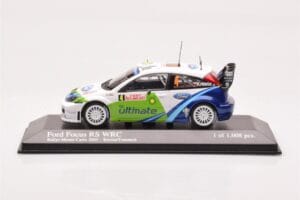
Ford Focus RS WRC #4 R. Kresta / J. Tomanek Rally Monte Carlo 2005 Minichamps 1:43
Only 2 left
Price:
103.00 €
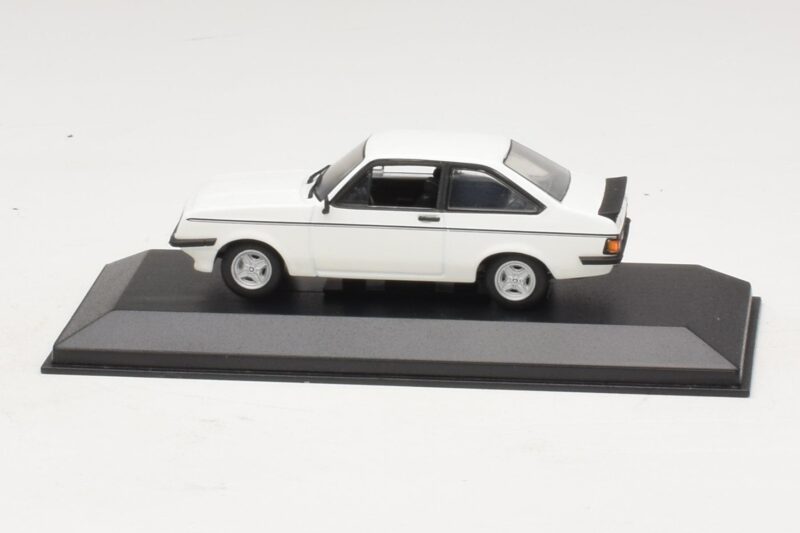
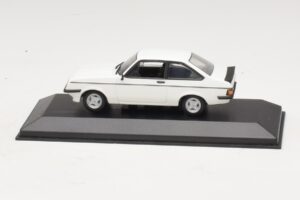
TL;DR: Minichamps' 1:43 diecast Ford Escort Mk1 Twin Cam reproduces the 1968 homologation special in white, a sealed one-piece casting with correct coupe proportions, crisp shut lines, and period trim. The car that gave Ford its rally-winning Escort formula, scaled down for a compact 1960s British collection.
Ford needed a genuinely competitive rally base by the late 1960s, and the Escort Mk1 Twin Cam was built specifically to provide it, a homologation special that dropped a Lotus-derived engine into an otherwise ordinary small coupe body. That combination turned an unremarkable-looking family car into the foundation for a rally dynasty, and Minichamps' white example captures it in its plainest, most honest factory form.
The standard Escort Mk1 was a conventional small family coupe, but Ford needed a rally-homologated version to compete seriously against the established front-runners of the late 1960s, and the answer was dropping a Lotus-derived twin-cam engine, the same basic unit found in the Lotus Cortina, into the lighter, more compact Escort body. The result, built from 1968 in the numbers required to satisfy competition regulations rather than mass-market demand, punched well above its unassuming looks. It was never meant to be a comfortable road car. It was meant to win rallies, and the raw specification underneath that plain white paint reflects exactly that priority.
The Twin Cam's success on rally stages through the late 1960s and into the early 1970s laid the groundwork for the RS1600 and Mexico models that followed, cars that turned the Escort name into a genuine motorsport legend across the following decade. Without the Twin Cam proving the small-coupe rally formula could work, Ford's later works Escorts would not have had the same starting point. Collectors who trace Ford's rally lineage back to its roots treat the Twin Cam as the essential starting point, not a footnote before the RS models arrived.
This casting is a sealed, one-piece body rather than an articulated shell, doors and hood molded shut, and that construction suits a subject like this one particularly well: the Twin Cam's appeal was never about opulent detail, it was about a plain small coupe hiding a serious engine, and a clean, unbroken body reinforces that honesty. The shut lines run as tight, consistent grooves along the door and hood cuts, free of the wider seams a hinged casting sometimes shows. White paint, unlike a metallic or a bright color, hides very little, so the crispness of those lines and the flatness of the panel surfaces are on full display here rather than disguised by a busier finish.
Zinc alloy gives the casting genuine heft for its size, weight that signals metal construction and that holds the model's shape reliably across years of shelf display. The narrow chrome bumpers, round headlamps, and simple grille are all molded with clean definition rather than softened edges, and through the glazing the cabin shows a basic, correctly austere interior, no unnecessary luxury trim, matching the Twin Cam's stripped-for-purpose character. That restraint carries through the entire model, from paint to cabin, without a single overstated detail.
This Escort works as a foundation piece for anyone building a British rally lineage on their shelf, the plain, unassuming predecessor that makes the later RS1600 and Mexico variants make more sense once it sits beside them. At 1:43, a full progression from Twin Cam through the RS-badged Escorts fits into a manageable display footprint, tracing a genuine motorsport story rather than assembling a random set of liveries. Priced at the accessible end of the diecast spectrum, it rewards collectors more interested in history than in flash. For 1960s British motorsport specialists, that context alone justifies the purchase, regardless of how plain the paint looks on a shelf.






You save 16.00 €
Lowest price in the 30 days before the reduction: 123.00 €