Used

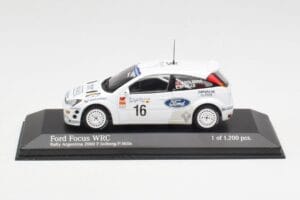
Ford Focus RS WRC #4 R. Kresta / J. Tomanek Rally Monte Carlo 2005 Minichamps 1:43
Only 2 left
Price:
103.00 €
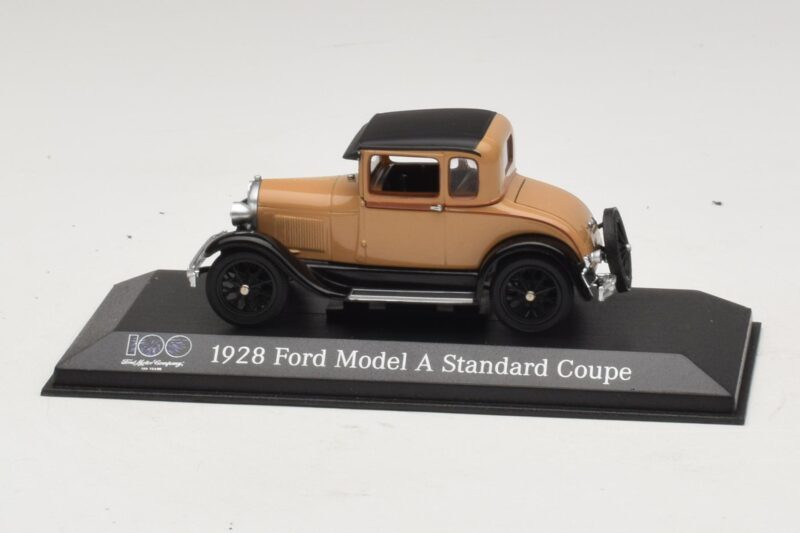
TL;DR: Minichamps' 1:43 diecast Ford Model A Standard Coupe reproduces the 1928 original in bronze, a sealed one-piece casting with correct pre-war proportions, crisp shut lines, and period brass-era trim. The car that replaced the Model T and later became a cornerstone of American hot rod culture.
Ford's Model A arrived in late 1927 as the overdue replacement for the Model T, selling in numbers, roughly five million units over its run, that made it one of the defining American cars of its era. Decades later it found a second audience: hot rod builders who valued its simple, rugged chassis. Minichamps captures the standard coupe in a period-correct bronze.
The Model T had run essentially unchanged in basic concept for nearly two decades by the mid-1920s, and by the time Ford finally replaced it with the Model A in late 1927, competitors had caught up with more modern features, a conventional gearshift among them, that the aging T never offered. The Model A answered that gap directly, and buyers responded: the car sold in the millions across its production run through 1931, a scale of success that confirmed Ford could still define mass-market taste even after retiring the car that had defined it for a generation. The standard coupe body, plain and practical, was one of the most common configurations buyers actually chose.
Decades after its original run ended, the Model A found an entirely different following among American hot rod builders, who valued its simple, boxy chassis and readily available parts supply as an ideal foundation for custom builds. That connection, uniquely American in character, gave the Model A a cultural relevance well beyond its original role as basic transportation, and it remains one of the most recognizable pre-war Fords specifically because of that later adoption. Seeing the stock coupe form makes the hot rod modifications that followed easier to appreciate by contrast.
This casting is a sealed, one-piece body, doors and hood molded shut rather than hinged, a construction approach that suits the Model A's upright, boxy coupe shape well: there are no complex compound curves to disguise a shut line, so the tight, consistent gaps along the door cuts here read clearly against the flat body panels. The bronze finish is period-correct for the era, when factory colors ran toward earthy, restrained tones rather than the bright palettes later decades would embrace, and Minichamps holds that finish evenly across the hood and fenders without patchiness.
Zinc alloy gives the model genuine heft, weight that signals metal construction the moment it clears its packaging and that holds the casting's shape reliably over decades of display, fitting for a subject already tied to the idea of longevity. The narrow fenders, exposed headlamps, and simple grille shell are all molded with clean, defined edges, capturing the era's mechanical simplicity honestly rather than smoothing it over. That honesty in the detailing is what separates a genuine pre-war replica from a generic vintage-styled toy.
This Model A works as a starting point for any pre-war American collection, the car that bridges Ford's Model T era into its modern mass-production identity, and a natural companion piece for anyone also displaying later hot-rod-styled Model A variants. At 1:43, it occupies a modest footprint that makes assembling several pre-war Fords alongside it a realistic project. Priced at the accessible end of the diecast range, it suits collectors drawn to automotive history over motorsport glamour. For American collectors specifically, the Model A's dual identity, mass-market workhorse and later hot rod icon, gives it a resonance few pre-war European cars can match on a US shelf.





You save 16.00 €
Lowest price in the 30 days before the reduction: 123.00 €