Last one
Used
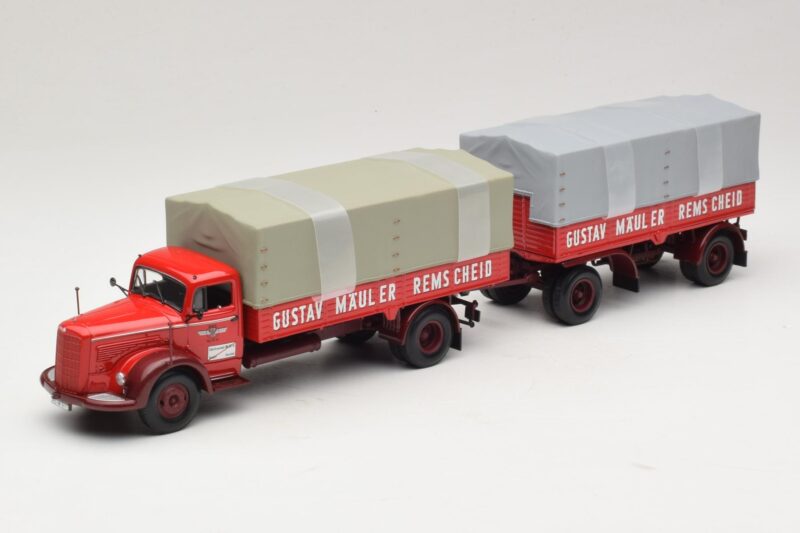
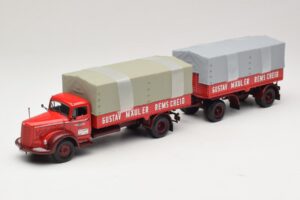
TL;DR: Minichamps' 1:43 Mercedes L315 combines the round-cab flatbed truck with a matching drawbar trailer, liveried for Gustav Mauler and dated to 1954. The body is sealed with no opening parts, so cab styling, trailer coupling, and livery registration carry the full presentation of this two-unit haulage rig.
Where the solo flatbed L315 shows off Mercedes' Rundhauber cab on its own, this version puts that same truck to work pulling a full drawbar trailer, doubling the load capacity and the amount of livery a haulier could paint across the rig. Gustav Mauler's colors dress a combination built for the everyday freight runs of 1954 West Germany.
A Pritschenzug, literally a flatbed-and-drawbar-trailer combination, was the workhorse configuration for general freight in 1950s West Germany, letting one truck and driver haul roughly double the payload of a solo flatbed on the same routes. Minichamps builds this L315 as the complete rig, truck and trailer sharing an identical cab tooling to the solo version but finished with the drawbar coupling and second set of wheels the trailer requires. Getting the trailer's ride height to match the truck's is the detail that makes or breaks a combination casting like this one, and here the two units sit level with each other rather than one riding noticeably higher.
Independent road hauliers were common across West Germany's reconstruction-era freight network, each running a small fleet under its own name and colors rather than a large centralized carrier. Gustav Mauler's livery on this rig follows that pattern, with the company name lettered across both the truck door and the trailer side in a period-appropriate typeface, giving the combination the look of a real regional operator's truck rather than a generic factory demonstrator finish. That kind of small-operator branding is exactly what a livery-focused collector looks for, since it ties the model to the texture of everyday postwar haulage rather than to a famous manufacturer showcase piece.
With no opening parts on either unit, the entire combination is judged on how convincingly the truck and trailer sit together, and the coupling point between them is the detail that carries the most weight. Minichamps fixes the drawbar at a natural towing angle rather than a stiff, straight-ahead position, which lets the rig read as though it is mid-journey rather than parked awkwardly for a photograph. The trailer's wheels track directly behind the truck's rear axle rather than offset to one side, keeping the whole combination visually balanced when viewed from the front or rear. That kind of attention to towing geometry is easy to overlook until it is done wrong, at which point a rig looks like two separate toys pushed together rather than one working vehicle.
Because this cab shares its tooling with the solo flatbed L315 in the same catalog, a collector who owns both pieces can compare panel lines, paint depth, and glazing fit directly, unit for unit, which is a useful exercise for anyone learning to judge diecast quality by eye rather than by brand reputation alone. The trailer adds its own set of panel lines and load-bed ribbing that the solo truck does not have, giving this version a slightly more complex casting to inspect despite starting from the same cab mold.
Owning both the solo flatbed and this full Pritschenzug combination from the same L315 tooling turns a simple purchase into a small study of how one cab design served multiple roles on 1950s German roads. Displayed together, the pair shows the range of a single truck platform, from light local delivery work to full-capacity long-haul freight, in a way that a single model cannot demonstrate on its own. For a collector building a themed haulage shelf, this rig adds both visual variety and historical completeness without introducing an entirely new cab casting to track down. It is the kind of pairing that rewards patience over impulse buying, one livery and one configuration at a time.




You save 16.00 €
Lowest price in the 30 days before the reduction: 123.00 €