Used

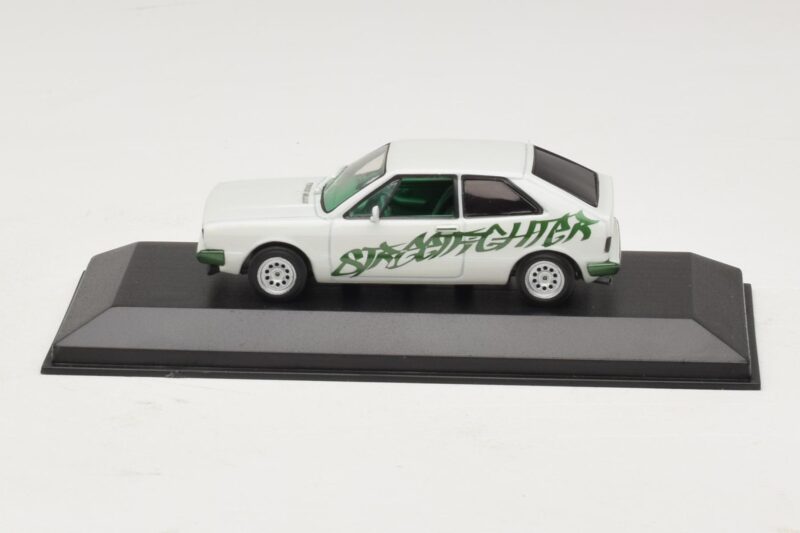
TL;DR: Minichamps' 1:43 diecast Volkswagen Scirocco Mk1 Streetfighter in White reproduces the 1970s widebody tuner special as a sealed one-piece zinc alloy casting, with flared arches and an aggressive stance. A niche tuner-culture piece that stands apart from a stock Scirocco on the same shelf.
The original Scirocco was already a sharp-looking hatchback when it launched in 1974, Giugiaro's wedge shape doing more with less than most compact coupes of its era. The Streetfighter treatment pushes that design further with wider arches and a more planted stance, capturing the aftermarket tuning culture that grew up around VW's small hatchbacks through the late 1970s and beyond.
Minichamps casts this Streetfighter Scirocco as a sealed, one-piece zinc alloy body, and the material brings real heft that a lighter resin casting would not match at this price point. The widened arches, a hallmark of the tuner treatment, are cast as part of the continuous body shell rather than as bolted-on add-ons, which keeps the transition between arch and door panel seamless rather than showing a visible parting line. That single-shell approach suits a widebody subject particularly well: there is no hinge tolerance to accommodate around a flare that already pushes outward further than the factory bodywork ever did, so the arch line stays crisp from the front fender clear back to the rear quarter.
The White finish sits directly on the hard metal shell, giving the paint a deep, even gloss that shows off the widebody's surfacing without the color competing for attention the way a bright livery might. Panel lines around the hood and hatch run as single consistent grooves, and the lower body's aggressive stance comes through in the wheel-to-arch relationship: wheels pushed out to fill the flared arches rather than sitting tucked inboard the way a stock Scirocco's would. Trim pieces and lighting units separate cleanly from the body color, and the wedge-shaped greenhouse Giugiaro drew keeps its proportions true against the widened lower body.
Volkswagen introduced the Scirocco in 1974 as a sportier alternative to the Golf, sharing its underpinnings but wearing a wedge-shaped two-door body designed by Giorgetto Giugiaro's studio. It was an affordable coupe rather than a halo model, which is exactly what made it such fertile ground for the aftermarket tuning scene that grew up around it through the late 1970s and into the 1980s. The Mk1's compact proportions and light weight made it a natural platform for widening, lowering, and adding aerodynamic addenda, the same formula that turned other affordable European hatchbacks into cult tuner subjects.
Widebody kits like the one this model represents were a genuine period phenomenon, workshops and specialist builders reshaping factory bodywork with flared arches, deeper front spoilers, and more aggressive stances long before such treatments became mainstream. That culture sits at the roots of the modern tuner scene, and a model built around it tells a different story than a factory-stock Scirocco would. For a VW collection that spans both the brand's mainstream output and its enthusiast fringe, a Streetfighter Scirocco is the piece that represents the fringe honestly rather than glossing over it.
At 1:43, this Scirocco holds a small footprint, well under 10 centimeters long, easy to slot alongside other Mk1 and Mk2 Sciroccos, a Golf GTI, or a Jetta from the same era without crowding a display case. Its real value on a shelf is contrast: parked next to a stock Scirocco, the widened stance and aggressive proportions tell the tuner-culture side of the story that a factory-spec model cannot. Pricing sits in the same accessible bracket as other Minichamps 1:43 diecast, so this is not a premium purchase, but a distinctive one. Collectors building a themed VW hatchback wall, or anyone with a soft spot for the widebody scene of the late 1970s, get more character here than a standard Scirocco offers for a comparable outlay.






You save 16.00 €
Lowest price in the 30 days before the reduction: 123.00 €