Used

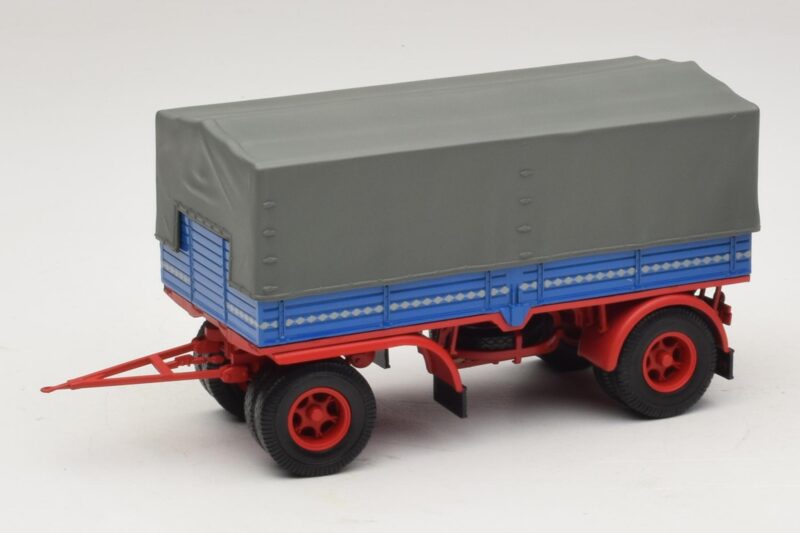
TL;DR: Minichamps' 1:43 truck and trailer combination reproduces a 1950s semi-trailer rig in sealed diecast, finished in blue and red livery across both units. A compact commercial-vehicle piece built as one fixed body, suited to collectors building an early postwar trucking display.
Postwar Europe rebuilt much of its road freight network around exactly this kind of rig: a cab-over tractor pulling a boxed semi-trailer, workhorse machinery rather than showpiece automobiles. Minichamps renders the pairing at 1:43 in blue and red, a two-piece diecast set that gives a commercial-vehicle collection genuine period texture alongside the passenger cars that usually dominate a shelf.
Minichamps builds both the tractor cab and the box trailer as sealed castings rather than opening ones, a construction choice that suits commercial vehicles particularly well since their visual interest sits almost entirely in the exterior panel work rather than an accessible cabin. Zinc alloy gives each unit real heft, and the two pieces connect through a fifth-wheel coupling that lets the trailer articulate for display even though neither body opens on its own. Panel lines along the trailer's flat sides run clean and consistent, and the cab's rounded fenders and split windshield hold the crisp edges that a fixed casting can achieve more easily than an articulated one.
The blue cab and red trailer combination gives the rig strong shelf visibility, a two-tone scheme common on commercial fleets of the period rather than a fanciful modern repaint. Paint coverage stays even across the trailer's large flat panels, the surface most likely to show flaws in lesser castings, and the cab's grille and headlamp surrounds are picked out in separate chrome-effect tooling. Wheel and tire detail follows the dual rear-axle configuration typical of period semi-trailers, with visible tread pattern rather than a smooth stand-in disc.
By 1950, European road-freight operators were rebuilding their fleets from wartime shortages and prewar equipment, and the cab-over semi-trailer configuration became a practical standard: mounting the driver above the front axle rather than behind a long hood maximized cargo length within the overall vehicle length rules many countries enforced. That efficiency mattered enormously to operators rebuilding supply chains for a recovering continent, and the format this model reproduces represents that pragmatic postwar solution rather than a stylistic choice.
The cab-over layout traded some ride comfort and engine access for cargo capacity, a trade every operator of the era accepted willingly given how much freight volume mattered to profitability. Pairing that cab with a separate box trailer, rather than building a single rigid truck body, let operators swap trailers between loads and kept the tractor working continuously. This two-unit format is precisely what most commercial diecast collectors look for when building an early-postwar trucking theme, since it reflects the actual operational logic of the period rather than a simplified toy silhouette.
Without a named marque attached, this model earns its place through honest construction rather than brand prestige, and that is a legitimate way to build a shelf: commercial vehicles from this period rarely carried the badge recognition of passenger cars, yet they defined how goods actually moved. Displayed alongside 1950s sedans and coupes, the rig provides scale and functional contrast, a reminder that the era's road network depended on machines built for work rather than show. At 1:43, the tractor-trailer pairing takes up more shelf length than a single car, so plan placement accordingly. Judge it on paint evenness, panel consistency, and coupling fit, the same standards that apply to any well-built commercial diecast at this scale.










You save 16.00 €
Lowest price in the 30 days before the reduction: 123.00 €