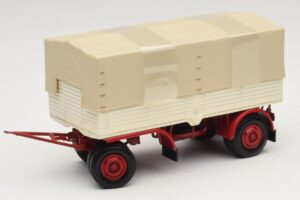
Used

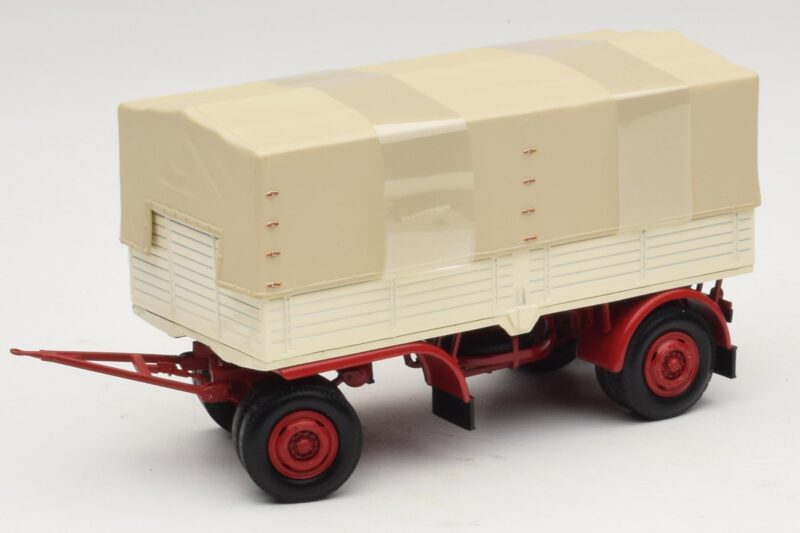
TL;DR: Minichamps' 1:43 semi-trailer reproduces a 1950s canvas-sided rig in white and red, cast as a sealed zinc-alloy body designed to pair with a period tractor unit. It is a companion piece rather than a standalone vehicle, built to complete a full hauling rig on a vintage trucking shelf.
A trailer alone rarely gets top billing in a truck collection, yet it does the visual work that sells the whole rig. This canvas-sided semi-trailer, in white with red trim, belongs to the era when covered flatbeds hauled everything from produce to dry goods across a growing highway network.
Minichamps casts this trailer as a single zinc-alloy shell, the same construction approach used across its vintage commercial vehicle line, since a trailer has no cab, no engine bay, and little reason to open anything even at larger scales. What the sealed body buys instead is precision on the surface: the canvas top is molded with fabric-like ribbing and taut panel lines rather than a flat, featureless roof, and the underframe carries axle and chassis rail detail that reads correctly from a low display angle. Weight sits appropriately light for a trailer body, distinct from the denser feel of a cab-and-chassis casting, which is honest to how a real empty trailer behaves.
The white-over-red color split follows a common commercial livery pattern from the period, clean panel colors rather than a fleet logo, which keeps this trailer useful as a generic companion piece rather than tying it to one specific carrier. Paint sits evenly across the canvas molding without pooling in the recessed rib detail, and the coupling hardware at the front, the kingpin and landing gear, is cast with enough definition to read as functional equipment rather than a smooth afterthought. Collectors assembling a period rig should check that this coupling profile matches whatever 1950s tractor unit they intend to pair it with.
Through the 1950s, covered flatbed trailers like this one were common on growing highway networks, cheaper to build and maintain than fully enclosed box trailers while still protecting cargo from weather. Canvas tops could be rolled back for loading and stripped down for repair far more easily than a rigid body, which made this configuration a practical choice for regional haulers moving mixed freight. The style faded as enclosed vans became standard, which is part of why a well-detailed period trailer like this one reads as a distinct era rather than a generic truck accessory.
Trailers rarely carry a collection on their own, and this one is not meant to. Its value comes from what it completes: a period tractor unit gains real presence once it's coupled to a correctly detailed trailer instead of standing alone on a shelf. That pairing role shapes how this model should be judged, less about dramatic styling and more about whether the coupling height, canvas texture, and livery era match the rig it will join.
This trailer earns its place by what it enables rather than what it shows off alone. At 1:43, it sits at a scale where a full rig, tractor and trailer together, occupies a modest, manageable footprint on a shelf built around passenger cars and light trucks rather than a dedicated commercial-vehicle display. Judge fidelity by checking the coupling height against the tractor it will pair with, the canvas rib spacing, and whether the livery era matches the rest of a period trucking lineup. It is an honest, modestly priced addition for a collector building out 1950s commercial vehicles rather than a hero piece meant to stand alone, and it is worth exactly what it promises: a correctly detailed companion for the tractor unit that does the rest of the storytelling.











You save 16.00 €
Lowest price in the 30 days before the reduction: 123.00 €