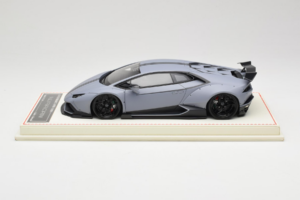
Last one


This model is currently sold out. Enter your email and we'll let you know when it's back in stock.
TL;DR: Kyosho's 1:18 diecast Lamborghini Countach LP500S reproduces the 1984 wedge-shaped supercar in black, complete with scissor doors, wide rear haunches, and a mapped V12 engine bay. Marcello Gandini's uncompromising design made the Countach the era's defining poster car, and this diecast captures that shape with correct, accurate proportions.
No supercar defined the bedroom-wall poster era quite like the Countach, a wedge so extreme it looked more like a concept sketch than a production car. Kyosho's 1:18 diecast renders the LP500S variant in black, the color that suits its knife-edge lines best.
Marcello Gandini, working at Bertone, drew the Countach with almost no reference to what supercars had looked like before it, favoring flat planes, sharp angles, and a nose so low it barely cleared a curb. The scissor doors, hinged at the front and swinging upward rather than out, became the car's signature feature and one of the most imitated design details in supercar history, copied by manufacturers chasing the same dramatic effect for decades afterward.
The LP500S variant, produced through the early-to-mid 1980s, widened the Countach's already dramatic rear arches to cover wider tires and revised the naturally aspirated V12 for a useful power increase over the earliest LP400 cars. Those wider haunches are arguably the version most associated with the Countach in popular memory, the shape that appeared on more bedroom walls and toy shelves than any other variant of the car.
Kyosho builds this Countach in diecast, hinging the scissor doors so they swing upward exactly as the real car's did, a detail that would be lost entirely on a sealed resin body. A sealed resin Countach might hold marginally sharper edges along the wedge's flat planes, but it would lose the scissor-door articulation that is arguably the single most important feature to preserve on this specific subject.
Lifting the rear deck reveals a scaled V12 mounted longitudinally behind the cabin, positioned correctly in the layout that made the Countach one of the first modern supercars to place its engine directly behind the driver rather than amidships in the more common transverse arrangement. The wide rear arches carry genuine flare rather than a toned-down approximation, and the NACA ducts along the flanks, functional air intakes on the real car, are molded with real depth rather than painted flat lines. Black paint suits this shape particularly well, since it emphasizes the wedge's flat planes and hard edges rather than competing with them the way a bright color would.
At roughly 26 centimeters and with genuine width to match the LP500S's flared arches, the Countach demands real shelf space, more than most 1980s supercars its own length, and it is worth planning cabinet layout around that width rather than assuming it will fit standard spacing. It sits naturally beside other wedge-era supercars, the wide, angular designs Gandini and his contemporaries produced through the late 1970s and 1980s, rather than beside the curved, aerodynamic supercars that followed in the 1990s. Diecast construction keeps this famous subject reasonably priced relative to its cultural weight, letting the shape speak for itself rather than requiring elaborate packaging or a heavy price tag to justify its place on the shelf. Kept out of direct light, black paint on a car with this many flat surfaces shows dust more readily than lighter colors, so routine dusting matters more here than on most other 1980s supercar finishes.