Used

You save 23.00 €
Lowest price in the 30 days before the reduction: 189.00 €
This model is currently sold out. Enter your email and we'll let you know when it's back in stock.
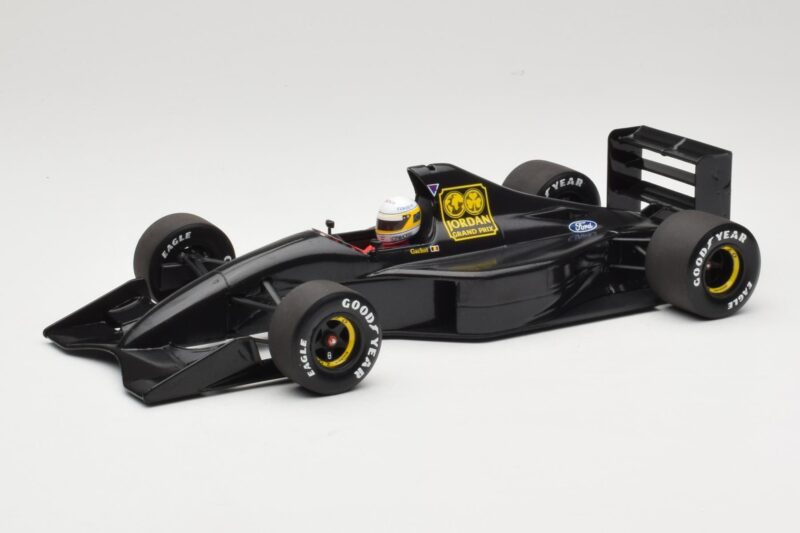
TL;DR: Minichamps' 1:18 diecast Jordan Ford 191 reproduces Bertrand Gachot's #32 test car from a Paul Ricard session on 15 January 1991, in the team's debut 7Up livery, months before Michael Schumacher took the same seat for his F1 debut. Sharp tampo-printed green and blue graphics document a genuine pre-season moment.
The 191 is one of those Formula 1 cars people remember for how it looked before they remember anything it actually won. Minichamps builds this one from a test day, not a race, which is exactly where its story gets interesting.
Jordan's 1991 livery, green and blue over a 7Up-sponsored body, is still cited among the best-looking Formula 1 cars ever built, and Minichamps treats that reputation seriously with tampo-printed graphics that hold their registration across every curved panel. The green base carries genuine depth rather than a flat single tone, and the blue accents along the sidepods and nose stay sharp-edged rather than soft or misaligned, the kind of print quality a genuinely iconic livery deserves rather than a rushed approximation.
This is specifically a test-day car, dated to a Paul Ricard session on 15 January 1991, which means the livery and sponsor placement reflect the team's pre-season configuration rather than a specific Grand Prix weekend. That distinction matters to collectors who track Jordan's early history closely, because the car's detailing, right down to the number 32 rather than a race number, documents a different, earlier moment than any of the season's actual races would show.
Jordan entered Formula 1 in 1991 as a new, independent constructor, running Gary Anderson's chassis design around a customer Ford-Cosworth V8 rather than a factory-backed power unit, the same competitive position most new teams occupy. What made the 191 remarkable was how far its chassis and aerodynamics outperformed that modest budget position, a genuine surprise in a season where bigger, better-funded teams expected to dominate the midfield fight comfortably.
Bertrand Gachot held this seat through the early part of the season before a legal dispute took him out of the car partway through the year, and Jordan turned to a largely unknown Formula 3000 driver as a late replacement for the Belgian Grand Prix. That replacement was Michael Schumacher, and his debut in this exact chassis is now one of the most retold stories in the sport's history, which gives a pre-Schumacher test car like this one real narrative weight.
At roughly 22 centimeters, the 191 fits any open-wheel display row, and its test-session dating makes it a genuinely different subject from the raced, numbered cars most Jordan models replicate. Displayed with context, or simply on its own merits as one of the sport's best-looking liveries, it works as a pre-season curiosity that happens to sit one seat-change away from a much bigger story. Priced at Minichamps' familiar mid-tier standard, it is an accessible way into a chassis whose reputation outgrew its era.



You save 16.00 €
Lowest price in the 30 days before the reduction: 123.00 €