On sale:
-20%
Last one
Used

Mercedes R-Class W251 Obsidian Black Minichamps 1:18
Only 1 left
Price:
was
189.00 €
151.00 €
You save 38.00 €
Lowest price in the 30 days before the reduction: 189.00 €
This model is currently sold out. Enter your email and we'll let you know when it's back in stock.
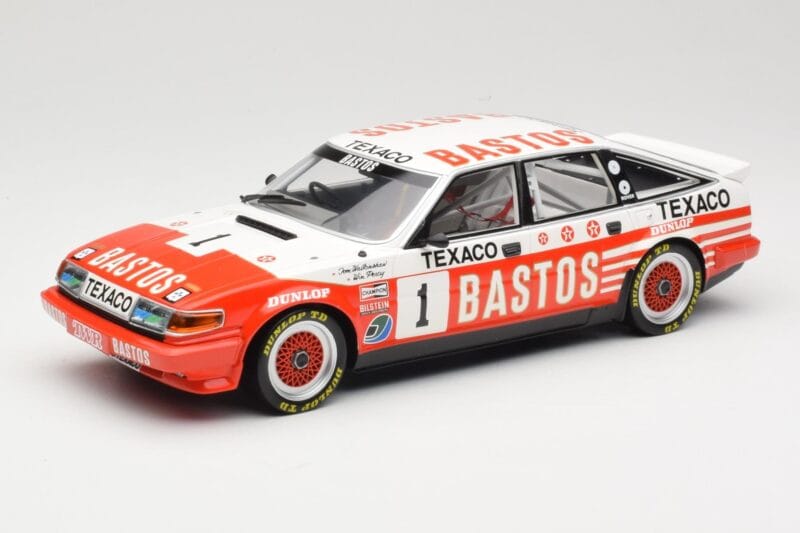
TL;DR: Minichamps' 1:18 diecast Rover SD1 Vitesse reproduces the Bastos Texaco #8 entry that Tom Walkinshaw and Win Percy drove to victory in the 1985 Donington 500km. Built on TWR's European Touring Car Championship program, this racing SD1 pairs sharp livery registration with genuine motorsport pedigree for a 1980s touring car display.
Tom Walkinshaw Racing turned the Rover SD1 Vitesse into one of the more formidable touring car weapons of the early 1980s, and the Bastos Texaco-liveried #8 car that Walkinshaw shared with Win Percy at Donington in 1985 stands as one of the program's clearest victories.
Tom Walkinshaw Racing took the road-going Vitesse's fastback body and V8 layout and turned it into a genuine ETCC contender, developing the chassis over several seasons into one of the more competitive touring car programs Britain fielded in the early 1980s. The Donington 500km rounds were among the calendar's endurance-format events, rewarding reliability and pace over a longer distance rather than a single sprint, conditions that suited a well-developed program like TWR's. Walkinshaw shared driving duties with Win Percy for this entry, a pairing that reflected TWR's practice of running experienced touring car talent alongside its own team boss, and the result was a win that added to the SD1 Vitesse's growing reputation as a genuine touring car weapon rather than a saloon that merely looked sporty.
Bastos Texaco's sponsorship brought a distinct livery to this SD1, built around bold lettering and sponsor graphics laid across the fastback's flanks and bonnet, with the number 8 positioned prominently on the doors and roof in the style typical of period ETCC entries. Livery accuracy matters especially on a car like this, where sponsor identity was central to the entry's presentation, and getting the proportions and placement of that graphics package right is a meaningful measure of how seriously a manufacturer treats a racing subject. On the model, that graphic layout translates into a livery with genuine visual complexity, sponsor text, numbering, and team branding all competing for space across a fairly compact body.
Minichamps applies the Bastos Texaco graphics with clean edges and consistent color registration across the fastback's curved surfaces, avoiding the soft or slightly misaligned printing that can undermine a busy sponsor livery at this scale. Race-spec details, the roof-mounted number, the door graphics, and the front splitter fitted for the touring car regulations of the period, are all present and proportioned correctly relative to the standard road car's bodywork. As a diecast, the model retains opening doors, giving access to a cabin trimmed for competition use rather than road comfort, with detail that reflects the car's racing specification instead of a simplified street interior.
Displayed next to a standard Vitesse in blue or red, this Bastos Texaco racer makes the shared underlying bodywork obvious while highlighting exactly what TWR added for competition: the front splitter, the race livery, the numbering. At roughly 22 centimeters in 1:18 scale, it sits comfortably alongside its road-going siblings without demanding extra shelf space, making a themed SD1 display, road car plus one or two race liveries, a realistic project rather than an unwieldy one. Keeping the model out of direct sunlight preserves the sharpness of the printed livery over time, since UV exposure fades applied graphics faster than it does the underlying body paint.
You save 38.00 €
Lowest price in the 30 days before the reduction: 189.00 €



You save 16.00 €
Lowest price in the 30 days before the reduction: 123.00 €

You save 22.00 €
Lowest price in the 30 days before the reduction: 109.00 €