Last one
Used
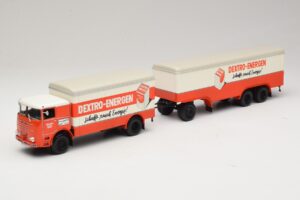
Bussing built some of the most recognizable heavy trucks and buses in postwar Germany before the marque was absorbed into MAN in 1971, and that engineering lineage survives today mainly through scale replicas. This collection gathers 1:43 Minichamps diecast covering 1960s heavy duty trucks and light commercial vehicles, giving commercial-vehicle collectors a durable, accessible way to document a brand that no longer builds trucks of its own.
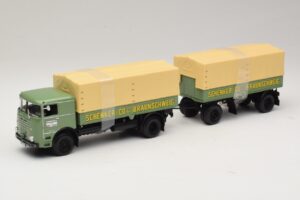
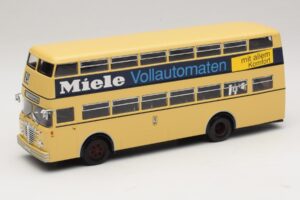
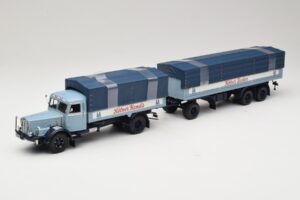
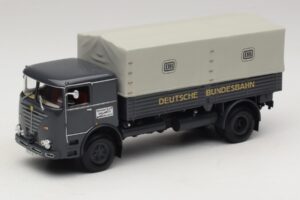
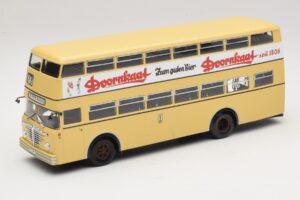

TL;DR: Bussing model trucks are 1:43 Minichamps diecast documenting the German manufacturer's 1960s heavy duty trucks and light commercial vehicles, produced before Bussing was absorbed into MAN in 1971. Zinc-alloy construction favors durability over fine detail, making this a practical entry point for commercial-vehicle collectors tracking a discontinued marque.
Few truck brands carry the specific kind of nostalgia Bussing does among German commercial-vehicle collectors. The company built heavy haulage trucks and buses recognized by a lion emblem on the grille for decades before disappearing into MAN's badge in 1971, leaving scale models as one of the few ways to keep the marque visible. This 1:43 Minichamps collection documents that 1960s-era output in diecast, spanning heavy duty trucks through lighter commercial vehicles.
Bussing built trucks and buses in Germany for most of the twentieth century, its vehicles identified by a lion badge that became one of the more recognizable marks in European commercial transport. The company's heavy haulage trucks served postwar reconstruction and the freight demands of a rapidly industrializing West Germany, while its bus chassis carried passengers across cities rebuilding their transit networks from scratch. That combined output makes Bussing a brand collectors track less for glamour than for genuine engineering relevance to the era.
The marque's independence ended in 1971, when Bussing was absorbed into MAN, and its name eventually stopped appearing on new vehicles altogether. That closure is exactly why scale models matter here: unlike a marque still building trucks today, there is no current production to compare against, and no new full-size examples to photograph at a show. A 1:43 Bussing model truck is, in a real sense, one of the more accessible ways left to hold a piece of that discontinued lineage in hand.
The 1960s sit at a genuinely interesting point in Bussing's history: postwar rebuilding was largely complete, West German industry was expanding fast, and the company's heavy duty trucks were doing the unglamorous work of moving that growth around the country. Alongside the big haulage chassis, Bussing also built lighter commercial vehicles aimed at local delivery and smaller operators, a segment that rarely gets the same attention from collectors as flagship long-haul trucks.
Covering both classes in this collection gives a more complete picture of what the marque actually built rather than isolating its most photogenic trucks. Heavy duty haulage models document the visible, load-bearing side of Bussing's business, the trucks that hauled freight on the era's expanding autobahn network. Light commercial vehicles fill in the everyday side: delivery vans and smaller trucks that rarely survive in preserved condition today, which makes their scale counterparts more valuable as a record of the full lineup rather than just its highlights.
Commercial vehicle modeling asks different things of a casting than a sports car does. A truck's value in scale comes less from panel-gap drama and more from correct cab proportions, an accurate chassis length, and a load bed or trailer that sits at the right height relative to the cab. Minichamps' zinc-alloy diecast construction suits that brief well: the material's weight gives a truck model the kind of solid, planted stance a full-size haulage vehicle actually has, and its durability handles the repeated handling commercial-vehicle collectors tend to give their models compared to a static display piece.
At 1:43, a Bussing truck occupies a manageable footprint even with a full trailer attached, which matters for collectors building out entire haulage combinations rather than single cabs. Paint on commercial-vehicle diecast tends toward flatter, working liveries rather than showroom gloss, and that's appropriate: these were tools, not display pieces, in their original context. Whether a given casting includes opening doors or a tilting cab is worth checking per model rather than assuming from the scale or material.
Collecting Bussing invites a different strategy than collecting a car marque, because the subject matter itself is narrower and more specialized. Rather than chasing every generation of a passenger car, a Bussing collector is documenting a finite, closed catalog: a company that stopped building trucks over five decades ago, with a model range that will not expand with new releases the way an active marque's does.
That finiteness is an advantage for collectors who prefer a project with a visible endpoint. A realistic goal is assembling the marque's core 1960s lineup: a heavy haulage tractor unit, a rigid truck, and a light commercial van, paired if possible with trailer variants that show how the same cab served multiple roles. Pairing Bussing trucks with models from contemporaries of the same decade builds useful context for how the era's haulage industry actually looked on the road, and a themed haulage-yard display often reads better than isolated trucks on open shelving.
Truck and commercial-vehicle collecting occupies its own corner of the scale model hobby, distinct from the marque-chasing that dominates passenger-car collecting. Within that corner, Bussing sits among the historically significant but discontinued brands, alongside other manufacturers absorbed into larger groups during Europe's postwar consolidation of the truck industry. That positioning matters for value and rarity expectations: a discontinued marque's model range will not grow, so completing a themed collection is a realistic, bounded goal rather than an open-ended chase.
In construction terms, the category sits in accessible, mid-tier diecast territory rather than hand-built investment pricing, which is typical for commercial-vehicle subjects generally. Trucks have historically drawn a smaller, more specialized collector base than sports and racing cars, and manufacturers price accordingly. For a collector already interested in postwar European industrial history, that combination of specialization and accessibility makes Bussing a genuinely rewarding, low-barrier entry into commercial-vehicle collecting specifically.
Evaluating a truck casting asks for a different eye than judging a car. Start with the cab: proportions should match reference photographs closely, since a truck's cab shape is its most visually defining feature and the easiest place for a casting to go subtly wrong. Check that the chassis length and wheelbase look correct relative to the cab, since an undersized or oversized chassis throws off the entire model's stance in a way that's immediately obvious to anyone familiar with the real vehicle.
From there, look at wheel and tire detail, since commercial vehicles often run multiple axle configurations that a careful casting should reflect accurately. Livery printing matters more here than on a passenger car, since haulage liveries frequently carried operator names and logos that reward crisp, legible print work. A trailer or load bed, where included, should sit level with the cab's ride height rather than tilted, a detail that separates a considered commercial-vehicle model from a rushed one.
No. Bussing was absorbed into MAN in 1971, and the marque no longer produces vehicles. That makes scale models one of the more practical ways collectors keep the brand's history visible, since there is no current production line to compare against or new full-size examples to see in service.
This collection focuses on 1960s output, covering heavy duty haulage trucks alongside lighter commercial vehicles from the same decade. That period sits at the peak of Bussing's independent production, before the marque's absorption into MAN ended its run as a standalone truck builder.
Start with cab proportions and chassis length, since those define a truck's stance more than any other detail. Correct wheelbase and axle configuration matter more here than paint gloss, and a level trailer or load bed relative to the cab is a reliable sign of a carefully engineered casting.
A discontinued marque like Bussing offers a finite, completable catalog rather than an ever-expanding model range. Collectors who prefer a bounded project, documenting a closed chapter of postwar European commercial-vehicle history, often find that scope more satisfying than chasing a marque that keeps releasing new subjects.