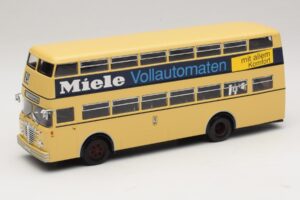
Last one
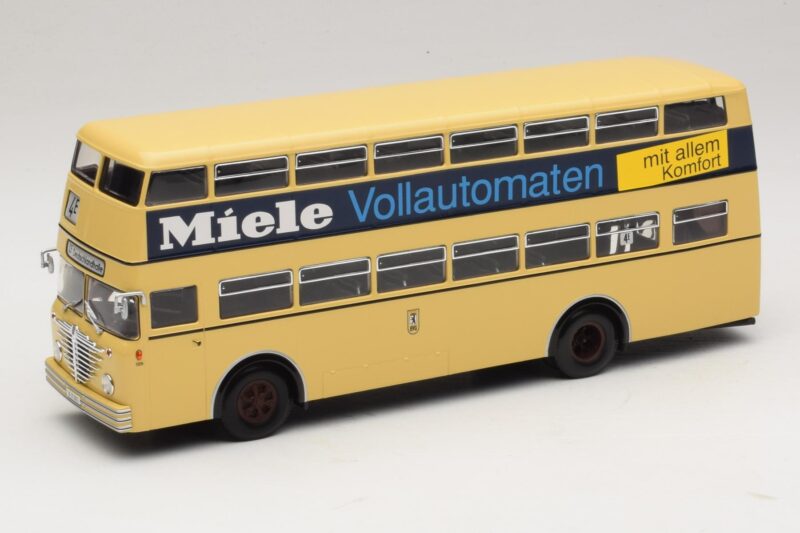
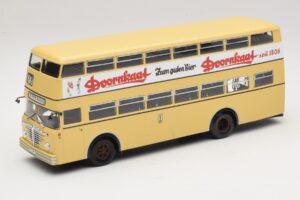
TL;DR: Minichamps' 1:43 diecast reproduces the Büssing D2U transit bus in its Heckturen rear-door configuration, carrying Miele's advertising livery from the mid-1960s. The sealed zinc alloy body holds the double rear-door detail and window band as one fixed casting, with the Miele branding tampo-printed along the flank.
Where the D2U in Heckeinstieg form boarded passengers through a single rear door, the Heckturen version split that opening into a pair of doors, a small but genuine difference in how the same chassis handled its own transit route. Miele's advertising replaces Doornkaat's on this flank, and few German brands carry more instant recognition today.
Heckturen describes a rear boarding arrangement built around double doors rather than the single-door Heckeinstieg layout, a variation German bus operators specified depending on expected passenger volume and how quickly a route needed to load and unload at each stop. On a busier urban route, two doors moved people faster than one, even on an otherwise identical chassis. That kind of door-count variation is exactly the sort of detail transit historians and serious commercial-vehicle collectors track closely, since it tells you something real about how a specific operator ran its fleet rather than just which paint scheme it chose. A collector who owns both door variants effectively owns a small piece of operational history most single-model buyers never think to look for.
Like its Heckeinstieg sibling, this D2U dates from Büssing's last decade as an independent manufacturer before the 1971 merger folded the brand into MAN. Büssing built a genuine reputation for sturdy, well-engineered buses through the 1960s, competing directly against Mercedes-Benz for municipal contracts across West Germany, and the D2U represents that competitive era rather than the diminished status the brand held in its final years under MAN's ownership. Reproducing two door configurations of the same chassis, rather than just one, signals a real interest in documenting that history rather than filling a catalog slot. That distinction, easy to overlook, is precisely what separates a considered commercial-vehicle range from a generic one.
Minichamps casts this D2U as a sealed one-piece body, and Miele's lettering and logo run across the flank in continuous tampo-printed registration with no door seam to break the design. Unlike the regional Doornkaat livery on the Heckeinstieg version, Miele's branding carries instant recognition well beyond Germany, since the appliance manufacturer remains a globally known name today rather than a company whose profile has faded with time. That recognizability makes the printing quality even more important: a familiar logo printed poorly stands out immediately to anyone who knows what it should look like.
The double rear-door area, molded rather than functional, carries correct step and handrail detail even though nothing on the model actually opens, and the window band sits flush in its frame the way it does on the Heckeinstieg version. Zinc alloy gives the casting real heft for its length, and the boxy 1960s body panels stay flat and consistent rather than showing any casting seam. Wheel arches and the front destination board pick up their own crisp printed detail, and none of that finish depends on comparing it unfavorably to a hinged model; a sealed body simply suits an advertising bus better.
Advertising buses carrying a still-famous brand name occupy a slightly different collecting niche than ones tied to companies long since folded or forgotten, since the recognition works instantly rather than requiring context. At 1:43, this Miele-liveried D2U pairs naturally with its Heckeinstieg sibling to show a single chassis handling two different door layouts, a genuine transit-history detail rather than a repeated paint job. For collectors building a German commercial-vehicle theme around brand recognition as much as bus history, Miele's continued presence on supermarket shelves today gives this livery a staying power that regional or discontinued brands simply cannot match.